Retail Growth in the Mobile Era: 10 Reasons to Build Your Own Retail Store App
Retail has moved beyond physical store aisles and website browsers. Modern consumers find products on their mobile devices, check prices in a flash, and look for immediate, individualized suppliers at all times and places. This transition to mobile-dominated actions has drastically altered the way retail companies expand, fight and keep their customers.
Having a mobile-friendly website has become a prerequisite, but alone it is still not a way to drive long-term growth. Retail companies that depend only on browsers will experience a slower rate of customer acquisition, less interaction and weaker customer loyalty. This is why more retailers are investing in a dedicated Retail Store App, to gain speed, control, personalization, and direct access to their customers.
This blog explains why a Retail Store App has become a strategic growth asset, not just a technology upgrade. The insights shared here are based on industry best practices and our team’s hands-on experience working with retail brands that have successfully transitioned from mobile websites to high-performing retail apps.
TL;DR
- Mobile-first shoppers expect app-level experiences
- Retail apps outperform mobile websites in speed and retention
- Push notifications drive repeat purchases
- Apps reduce cart abandonment significantly
- Retail apps strengthen brand loyalty and data ownership
Key Points
- A Retail Store App gives retailers full control over customer engagement
- Apps enable faster checkout and higher mobile conversions
- Personalization is more effective inside mobile apps
- Retail apps support omnichannel shopping behavior
- Long-term growth depends on owned mobile channels
Why Retail Brands Are Moving Beyond Mobile Websites
According to the experience of our team with expanding retail sectors, those brands that put their money into a Retail Store App always have better results than those that depend only on mobile websites. Apps make a direct, high-performing channel through which retention is very much strengthened, personalization is made easier, and eventually scaling up is supported as growth becomes a long-term affair. Here are the top ten reasons that the retailers have described as most important for them to switch.
1. Mobile Is the Primary Shopping Channel Today
Mobile devices have now taken over the entire retail journey, dominating it from discovery and research to checkout and post-purchase engagement. The Retail Store App is designed exclusively for mobile conduct that comes with user-friendly navigation and a shopping flow that feels like second nature to smartphones, in contrast with mobile sites that are constrained by browsers’ limitations.
- Designed for thumb-friendly navigation
- Optimized for frequent mobile interactions
- Aligned with modern consumer shopping habits
- Higher engagement than mobile web experiences
- Stronger long-term customer retention
2. Faster App Performance Increases Conversions
Speed has a direct impact on mobile conversions. In our team’s experience, Retail Store Apps have always been much faster and much more responsive compared to mobile websites. By keeping crucial data on the user’s device, apps make the whole process faster, help reduce frustration and let the customers to browse and purchase without being interrupted.
- Faster page and product loading
- Reduced bounce and exit rates
- Smooth transitions between screens
- Higher mobile conversion rates
- Improved overall user satisfaction
3. Push Notifications Drive Repeat Purchases
Retailers receive a strong and direct communication channel through push notifications, which is nothing less than what mobile websites can offer. A Retail Store App using the method of alerts, promotional updates, and notifications of orders has real-time interaction with customers; thus, the brands are always in the memory of the consumers and they get the motivation to buy again.
- Instant customer communication
- Higher engagement than email campaigns
- Increased repeat purchase frequency
- Better timing for promotions
- Stronger re-engagement of inactive users
4. Stronger Brand Presence on Customer Devices
Installing a Retail Store App immediately puts your brand on the home screen of every customer’s phone, thus giving continuous exposure. The team has witnessed the power of this constant presence in recalling the brand and gaining its trust over time, which in turn leads to customers being more inclined to return whenever they decide to shop.
- Constant home-screen brand exposure
- Increased brand familiarity
- Stronger emotional connection
- Improved recall during buying decisions
- Higher long-term brand loyalty
5. Personalized Shopping Experiences at Scale
Retail apps have the capability of providing personalized experiences to the user by the utilization of real-time user behavior and preferences. However, the mobile websites do not have this facility, as apps can change the content, suggestions, and offers on the fly, thus offering a more pertinent shopping experience that leads to increased interaction, customer delight, and total purchase worth.
- Personalized product recommendations
- Behavior-driven promotions
- Higher average order value
- Improved customer satisfaction
- Reduced irrelevant marketing efforts
6. Lower Mobile Cart Abandonment
Mobile cart abandonment remains a major challenge for retailers. A Retail Store App simplifies the checkout process by saving user information, reducing form entries, and enabling faster payments. In our experience, this significantly improves checkout completion and mobile revenue consistency.
- Faster and simpler checkout
- Saved customer details
- Fewer interruptions during purchase
- Higher checkout completion rates
- More reliable mobile sales
7. Loyalty Programs Perform Better in Apps
Retail Store Apps create the perfect setting for loyalty programs by ensuring that rewards are not only easy to access but also easy to keep track of. Customers get to see their points, redeem their advantages and acclaims, and access app-exclusive promotions, which in turn, boosts participation and solidifies the customer’s long-term relationship with the retailer.
- App-exclusive loyalty rewards
- Easy reward tracking
- Higher customer participation
- Increased customer lifetime value
- Reduced reliance on paid advertising
8. Seamless Omnichannel Retail Experience
Nowadays, consumers switch between online and offline channels without any difficulties. Retail applications assist in the integration of these interaction points by introducing functionalities such as visibility into inventory, tracking of orders, and engagement tools for in-store thus making the shopping experience consistent and interconnected.
- Integrated online and offline journeys
- Consistent brand experience
- Greater customer convenience
- Stronger cross-channel trust
- Improved customer retention
9. Full Ownership of Customer Data
A third-party marketplace is not the same as a Retail Store App, which provides brands with complete control over customer data. We, as a team, have experienced that the availability of thorough behavior insights leads to marketing strategies and customer engagement schemes that are smarter, better in terms of inventory decisions, and more meaningful.
- Actionable customer insights
- Improved marketing optimization
- Better inventory planning
- Deeper personalization opportunities
- Long-term data control
10. Competitive Advantage in a Crowded Market
Most retailers are still depending exclusively on mobile websites that thus create a significant opportunity for them to be different from one another. Introducing a Retail Store App makes the companies appear to be modern, customer-oriented, and ready for the future helping them to be more visible and attract even more customers in the very competitive markets.
- Clear market differentiation
- Stronger modern brand image
- Higher customer engagement
- Future-ready retail strategy
- Sustainable growth positioning
Examples of Best-in-Class Retail Apps
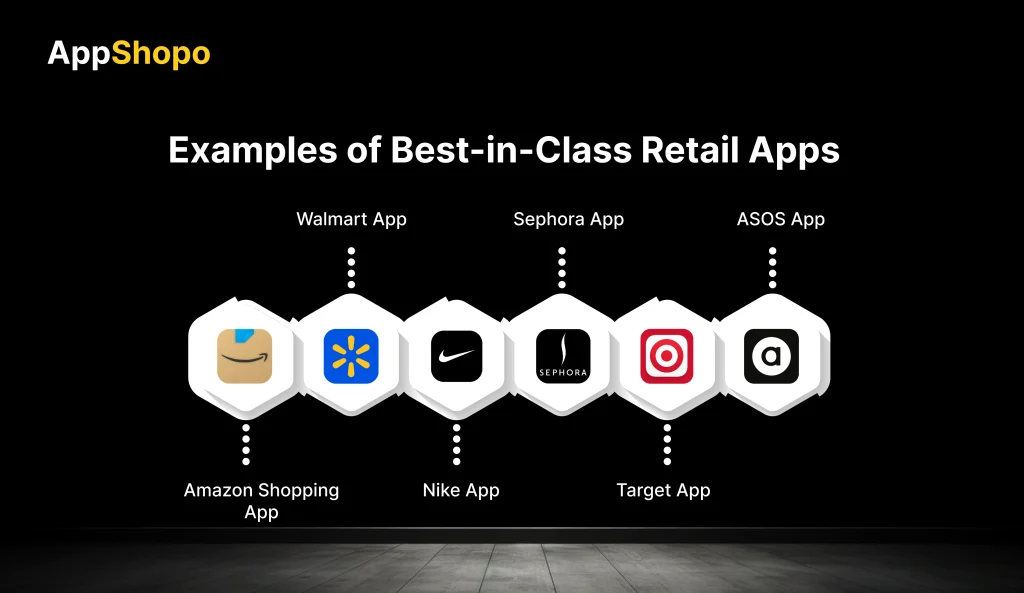
To understand what makes a Retail Store App truly successful, it helps to look at brands that are already setting the benchmark. The following six retail apps consistently stand out for performance, customer experience, and mobile-first innovation.
1. Amazon Shopping App
Amazon’s application is frequently ranked as the best among all mobile retail experiences. It puts customer needs on the top of the list and offers them a speedy, easy, and personalized shopping experience. The app does away with the hassle at each point in the customer journey, employing techniques like predictive search and personalized recommendations, one-tap checkout, and real-time delivery tracking. Amazon is a living example of how a retail store app can be turned into a daily-use utility instead of just a shopping channel.
Why it stands out:
- Ultra-fast browsing and checkout
- Deep personalization engine
- Seamless order tracking and returns
- Strong push notification strategy
- High repeat usage and retention
2. Walmart App
The Walmart app is a perfect case of omnichannel retail that is properly executed. It perfectly integrates the online shopping and physical stores by providing local stock, allowing curbside picking, and offering in-store services like barcode scanning. This app is an example of how a Retail Store App can mix digital and physical retail experiences while keeping the unchanged scale and efficiency.
Why it stands out:
- Real-time store-level inventory
- Online, pickup, and delivery integration
- Personalized deals and savings
- In-store shopping support
- Strong omnichannel execution
3. Nike App
Nike’s application has significantly evolved from the basic eCommerce platform. It combines shopping with content, communities, and exclusivity. The members are treated with privileges like early access to product drops, and they receive personalized recommendations, and through the storytelling of the brand, their emotional connection is deepened. In the case of Nike, the Retail Store App is seen as a means of driving loyalty by providing value that goes beyond just transactions.
Why it stands out:
- Member-only products and rewards
- Personalized content and recommendations
- Strong brand storytelling
- App-exclusive launches
- High engagement and loyalty
Also Read: Launch Shopify Fashion & Apparel Mobile App
4. Sephora App
The Sephora app is a very good example of a Retail Store App that can both eliminate purchase hesitation and boost customer engagement and average order value at the same time. By offering virtual try-ons, beauty tutorials, and loyalty rewards that are integrated, the app makes customers feel confident about their purchases.
Why it stands out:
- Virtual try-on experiences
- Integrated loyalty program
- Personalized beauty recommendations
- Educational content and tutorials
- Strong repeat purchase behavior
Also Read: Mobile App for Beauty and Cosmetics
5. Target App
The app of Target emphasizes the aspect of convenience and value. It has integrated digital coupons, quick checkout, order tracking, and in-store functionalities into one experience. The app is demonstrating how a Store App can make the routine shopping easy while at the same time attracting customers to come back often through the advantages of getting savings and not being bothered by the process of shopping.
Why it stands out:
- Digital coupons and offers
- Smooth mobile checkout
- Order tracking and pickup options
- In-store barcode scanning
- High usability for everyday shoppers
6. ASOS App
ASOS has created an application with the customer’s fashion-related needs as the main focus that facilitates finding what one likes and offering a personalized service. The app employs visual search, advanced filtering options, and customized style suggestions to maintain the interest of the users. ASOS exhibits that a Retail Store App could turn into a personal shopper in this case instead of merely a product listing.
Why it stands out:
- Clean, visual-first design
- Personalized style recommendations
- Advanced search and filters
- App-exclusive deals
- Strong engagement with younger audiences
Also Read: How to Turn a Shopify Store to Mobile App
How to Get Started With Your Own Retail Store App
Creating a successful Retail Store App goes beyond simply launching an application; it requires a well-thought-out strategy, the right technology, and a mobile-first mindset. The most effective apps, according to our team’s experience in assisting retail brands transition from mobile websites, take a systematic yet flexible approach that harmonizes business objectives, customer experience, and scalability. Below mentioned are the steps that show how to start off correctly and eliminate standard errors.
- Business Goals should be Clear: Define the expectations or main objectives for your Retail Store App. It can be anything like keeping customers for long, getting more sales from mobiles, or being less reliant on paid marketing.
- Analyze the Retail Readiness of Your Store: Take a look at the product data, accuracy of inventory, checkout process, and the support system for customers to make sure that your app is providing a good shopping experience, both in terms of reliability and consistency.
- Decide on the Main Features of the App: Concentrate on the basic features like fast browsing, seamless checkout, push notifications, and order tracking before introducing advanced functionalities in the future.
- Pick the Right App Solution: Go for a platform that supports quick deployment, real-time syncing of stores, customization, and scalability without the need for introducing a large number of technical resources.
- Develop for Mobile-First Experiences: Design for small screens, thumb use and fast shopping sessions, thus considering layouts, navigation, and interactions.
- Do Rigorous Testing Before Launch: Evaluate the devices’ issues that might reflect on the user’s good or bad reviews thus testing performance, checking out, and notifications across devices for usability.
- Develop a Strong App Launch Strategy: Use exclusive app offers, website promotion, email campaigns, and in-store visibility to create early adoption.
- Monitor Performance and Optimize Forever: Make use of app analytics and get to know the user behaviors, refine features, and so on, thus improving engagement and amplifying the dollars spent goal.
Conclusion
The mobile revolution has changed the whole scenario about how consumers find, connect, and make purchases from retail brands. The Retail Store App is not just a mere addition anymore; it is a powerful, strategic growth engine that facilitates interaction, loyalty, and revenue generation.
Yet, the process of creating and supporting an excellent retail app may appear to be a huge task without the proper solution. Subsequently, AppShopo is the right solution.
AppShopo makes it easy for retail brands to create and fully brand their mobile apps just like their existing stores without involving any technical headache. AppShopo equipping retailers with the ability to confidently kick off and grow their mobile app strategy through real-time product sync, quick checkout, push notifications, and customization tools.
If enhancing customer interactions, reducing costs on ads, and unlocking long-term retail growth are your aims, then investing in a Retail Store App backed by AppShopo is the wisest action you can take in this mobile-first era.
FAQs
1. Do retail brands really need a Retail Store App if they already have a mobile website?
Yes. A Retail Store App offers faster performance, push notifications, better personalization, and higher retention, which mobile websites alone cannot consistently deliver in competitive retail environments.
2. How long does it take to launch a Retail Store App?
With modern app platforms, most retail brands can launch a fully functional Retail Store App within weeks, depending on design requirements, integrations, testing cycles, and app store approvals.
3. Is a Retail Store App suitable for small and mid-sized retailers?
Absolutely. Retail Store Apps are no longer limited to large enterprises. Scalable platforms allow small and mid-sized retailers to launch cost-effective apps without maintaining large development teams.
4. How does a Retail Store App help increase repeat purchases?
Retail Store Apps enable push notifications, personalized offers, saved checkout details, and loyalty features that keep customers engaged, encourage repeat visits, and strengthen long-term brand relationships.
5. What are the most important features to include in a Retail Store App?
Core features include fast browsing, smooth checkout, push notifications, personalization, order tracking, and secure payments, which together create a seamless, high-converting mobile shopping experience.

Pankaj Arora
Founder, AppShopo

Pankaj Arora is a technology entrepreneur and the Founder of AppShopo, with over 10 years of experience in helping businesses transform websites into high-performing mobile apps. His expertise spans eCommerce app development, Shopify and WooCommerce integrations, mobile UX optimization, and scalable app delivery. Through AppShopo, Pankaj has enabled brands worldwide to launch fast, reliable Android and iOS apps that drive higher engagement, retention, and mobile sales.