Fashion App Developers for High-Converting Apps in 2026
Most fashion brands lose customers on mobile web before they ever reach checkout. A slow product page, a clunky size chart, three extra taps to pay, and the shopper is gone. Fashion app developers exist to fix exactly that gap, and the gap is bigger than most brands assume. Industry benchmarks compiled by MobiLoud put in-app conversion for fashion around 2.6%, against roughly 0.2% on mobile web, an 11x difference between the two channels. That’s not a rounding error. That’s the difference between an app that pays for itself in a year and a mobile site that quietly leaks revenue every month.
This isn’t a theory piece. It’s a breakdown of how fashion app developers actually build these apps in 2026: the features that move the needle, what a real project costs, the tech stack behind it, the process from discovery to launch, and how to pick the right team for your brand instead of the first agency that pitches you a deck. If you’re weighing whether an app is worth the investment, or you already know you need one and just want to understand what you’re paying for, this covers both.
Fashion is also a repeat-purchase category in a way most retail isn’t, and that changes the math on what an app is actually for. A customer who buys once on your website might never come back. A customer who downloads your app tends to stick around, and that’s where the real return shows up.
Quick Answer
- Since mobile web apps can’t match the functionality of native or hybrid apps (AI product recommendations, AR try-on, one or two tap checkout), fashion app developers are focusing on building native or hybrid shopping apps.
- Building simple native apps with just a catalog and cart cost about $30,000, while fully featured apps with AR, a loyalty program, and real-time inventory sync cost over $200,000.
- This solution is the best option for fashion and apparel brands that have a repeat customer base and want a shopping channel that won’t compete for customers’ attention in a web browser.
TL;DR
- In 2026, fashion app creators focus on AI, AR, and quicker checkouts to increase sales.
- Basic fashion apps typically cost between $30,000 and $50,000. AR and real-time sync features increase the cost to over $200,000.
- A good app developer knows AR, and payment SDKs, and is familiar with Shopify’s Storefront API and React Native or Flutter.
- Most fashion app projects go over budget because the discovery phase is skipped.
- The cost and speed advantage of dedicated developers or a small team over a large agency comes at a cost of losing some available skills.
Key Takeaways
- In fashion apps, customers can be more engaged with push notifications versus email because notifications appear in an app that the customer conveniently checks more frequently.
- AR-Try-on features have significantly reduced the return rate for customers because they can see and adjust the fit of the item before purchasing.
- Using cross-platform design frameworks such as react native to build apps results in approximately 50% less time building the app.
- Apps made using the Shopify platform and service are able to keep stock levels the same as on the web platform. Inventory is updated in real time on the app as stock on the site is updated.
- The primary obstacle for the app developer is getting the consumer to download the app, as opposed to using the service via the web.
Why Brands Are Turning to Fashion App Developers in 2026
Fashion is a repeat-purchase business. Customers don’t buy once and vanish. They come back for the next drop, the next sale, the next restock notification. That pattern is exactly what mobile apps are built for, and it’s why fashion app developers have become a priority hire rather than a nice-to-have.
A mobile website may accomplish the first sale, and that’s about it. It will do nothing for the tenth. Push notifications are unavailable on a browser tab. Wish lists do not save in the same way they do in an app. Lastly, a customer who is scrolling through Instagram will see your app sitting next to his Instagram app, and will click it, as opposed to a mobile website which is buried in the bookmarks.
That is the actual reason to hire fashion app developers. This is not because every brand has to have an app. This is primarily because brands who build a loyal customer base will have clients who will continue to buy, hence a company will lose potential revenue without a mobile app.
Also Read: How to Launch Shopify Fashion & Apparel Mobile App
What Fashion App Developers Actually Build: Core Features That Drive Conversions
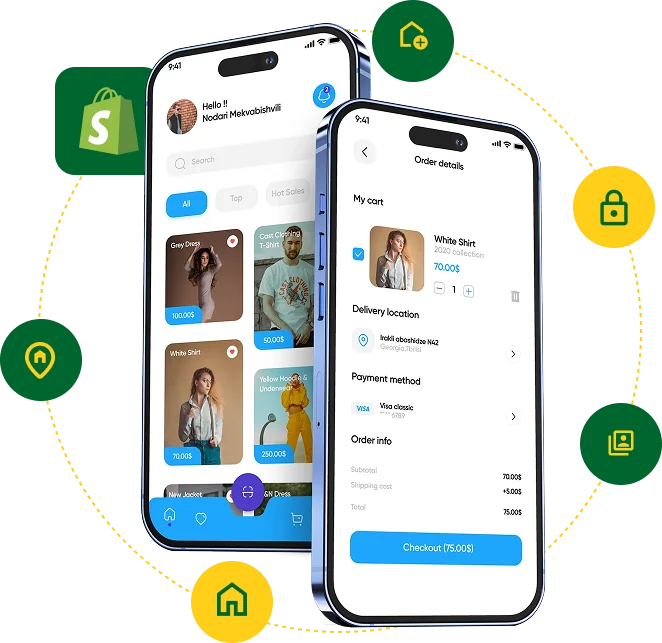
A feature list means nothing without the “why” behind it. Fashion app developers carefully consider every new feature they add because they build each functionality addition on steps they’ve identified shoppers drop off in their app. For example, shoppers might drop off because they are uncertain they are ordering the right size, they become impatient during the checkout process, or the app is closed and they forget about the items. The following are the most common features in fashion apps developed in 2026 along with the real reasons they exist.
1. AI Product Recommendations
An AI recommendation engine looks at what a customer browsed, bought, and skipped, then surfaces items they’re likely to want next. The benefit isn’t “personalization.” It’s a customer opening the app to a homepage that already looks like it was built for them, cutting the time between opening the app and adding something to cart.
Good fashion app developers tune this over the first few months post-launch. Recommendation engines are only as good as the data feeding them, and a brand’s first 60 days of app data rarely reflect true customer behavior yet.
2. AR Try-On
Augmented reality try-on lets a customer see how a jacket, shoe, or pair of glasses looks before buying. This one feature has moved from “nice extra” to standard request in 2026, mostly because it directly cuts return rates. A customer who tried on a shoe virtually and still ordered the wrong size is a much rarer event than one who guessed blind from a product photo.
Implementation isn’t cheap. It requires either a third-party AR SDK or custom computer vision work, and it adds real time to a development timeline. Worth it for footwear, eyewear, and outerwear brands. Less so for a brand that mostly sells basics like t-shirts and socks.
3. One to Two Tap Checkout
Every extra screen between “add to cart” and “order confirmed” costs conversions. Fashion app developers build checkout flows around saved payment methods (Apple Pay, Shop Pay, saved cards) so a returning customer can complete a purchase almost as fast as they decided to make it.
This sounds obvious until you look at how many fashion mobile sites still make a customer re-enter a shipping address they’ve used a dozen times.
4. Wishlist and Back-in-Stock Alerts
A wishlist keeps intent alive. Back-in-stock push notifications convert that intent into an actual sale the moment inventory reopens. Together, these two features turn browsing into a pipeline instead of a dead end, which matters enormously for fashion, where sizes and colors sell out constantly.
5. Loyalty and App-Only Drops
With loyalty tiers and app-only product launches, users now have something worth keeping their app for. Otherwise, users will just delete the app after their purchase. Usually, fashion app developers link this to the backend of the website’s loyalty program, so the points and tiers are the same for both the app and the website.
Read Also: Fashion eCommerce App Development Guide for Clothing Brands
The Tech Stack Fashion App Developers Use in 2026
The choice of tech stack impacts the speed of development, the scalability of the app, and the cost of app maintenance in the long term. Picking the wrong stack leads to having to rebuild the app within a couple of years, which costs more over time than if it was done correctly the first time.
In 2026, most app developers for fashion brands work with cross-platform frameworks instead of coding separate native app frameworks. The speed and reduced cost really work in favor of cross-platform development because most fashion app use cases of working with a product gallery, browsing, and app checkout do not require advanced graphics-based work to be done on the native app. Traditional cross-platform app frameworks do incur a small cost in performance, but that is a really small price to pay for the use cases that most fashion apps require.
| Layer | Common Choice | Why It’s Used |
| App Framework | React Native or Flutter | One codebase for iOS and Android, faster builds, easier long-term maintenance |
| Commerce Backend | Shopify Storefront API, WooCommerce, or custom | Keeps product, inventory, and pricing synced with the existing store |
| AR/Try-On | Third-party AR SDK or custom computer vision | Adds virtual try-on without building AR from scratch |
| Payments | Apple Pay, Shop Pay, PayPal, Stripe | Saved payment methods for one-tap checkout |
| Push & Retention | OneSignal, Klaviyo, or native push | Powers back-in-stock alerts, drop announcements, and cart recovery |
Brands running on Shopify have it easiest here. Their product catalog, pricing, and inventory already live in a system with a well-documented API, so fashion app developers can pull that data directly instead of building a separate content management layer from scratch.
Read Also: Top 15 Best Shopify Fashion & Clothing Store Examples
How Fashion App Developers Price a Project: Cost Breakdown
The price is the first concern for every fashion brand, and the truth is it totally depends on the requirements. A brand that sells simple everyday clothes and simple catalog operations pays much less than a brand that wants augmented reality (AR) try-on, real-time inventory across five (5) different locations and a custom-built loyalty engine.
The bare minimum a fashion brand would have to pay to access an app that has a product catalog, a shopping cart and a built-in payment system is between thirty to fifty thousand dollars (30,000 – 50,000). Such an app would essentially work for a Minimum Viable Product (MVP). An app or platform that has AR try-on, loyalty tiers and real-time inventory that works and syncs across multiple sales channels would cost over two hundred thousand dollars (200,000) and would go up depending on the custom integrations that are required.
Location matters. Development teams in major coastal tech hubs in the US have a much lower cost of development than teams in Eastern Europe, South Asia, and other US regions, while delivering the same level of quality. This is one of the most neglected ways brands end up overspending on the development of fashion apps.
| Factor | Custom Native Development | Cross-Platform / Managed Build |
| Typical Cost | $80,000 to $300,000+ | $30,000 to $150,000 |
| Timeline | 4 to 8 months | 6 weeks to 4 months |
| Best For | Brands needing deep custom features, unique UI, or non-standard integrations | Most fashion brands running standard e-commerce with a few custom touches |
| Maintenance | Two separate codebases (iOS/Android) to maintain | Single codebase, generally lower ongoing cost |
One honest trade-off worth naming: cross-platform development is faster and cheaper, but it can hit a ceiling on very graphics-heavy features like advanced AR. For most fashion brands that ceiling never actually gets tested. For a handful chasing cutting-edge AR fashion experiences, it’s a real constraint to plan around.
How Fashion App Developers Work: From Discovery to Launch
Skipping steps here is the number one reason fashion app projects blow past their budget and timeline. A rushed discovery phase means the dev team builds against assumptions instead of real requirements, and that always costs more to fix later than it would have cost to get right up front.
- Discovery and Scoping. Fashion app developers start by mapping the customer journey: how people currently shop on the website, where they drop off, what features actually matter for this specific brand. A jewelry brand needs different priorities than a sneaker resale platform. This phase typically runs one to two weeks.
- Design. UI and UX design comes next, usually built around the brand’s existing visual identity rather than a generic template. Fashion is a visual category first. A product page that looks flat or dated will tank conversions no matter how fast the checkout is underneath it.
- Development. The build phase is where the tech stack decisions from earlier come into play. For a cross-platform app with standard e-commerce features, this stage runs six to twelve weeks. Add AR try-on or custom loyalty logic, and that timeline stretches out.
- QA and Testing. Every screen gets tested across device sizes, both operating systems, and real payment flows before submission. Fashion apps in particular need heavy image and video testing, since product photography and lookbook content tend to be the heaviest assets in the app.
- App Store Submission. Apple and Google both review apps before they go live, and that review window (typically a few days to two weeks) isn’t fully in the developer’s control. Building in buffer time here avoids a launch date that slips at the last minute.
- Post-Launch Support. The job doesn’t end at launch. OS updates, certificate renewals, and bug fixes need ongoing attention, and this is where a lot of brands get surprised by costs they didn’t budget for upfront.
Common Challenges Fashion App Developers Solve
Building the app is only half the job. Fashion e-commerce comes with a set of problems that don’t show up the same way in other online categories, and a good developer plans for these from the start instead of patching them after launch. Sizing, stock, and heavy visual content all behave differently in fashion than in, say, electronics or home goods. Here are the challenges that come up most often, and how fashion app developers actually solve them.
1. High Return Rates
Fashion e-commerce has some of the highest return rates and much of it comes from the struggle of figuring out the correct size. AR try-ons, size guides based on the brand’s fitting data, and review photos pulled to product pages have been developed to help with sizing. While none of these solutions completely eliminate the need to return items, they work in conjunction to lessen the most annoying guesswork.
2. Inventory Sync Across Channels
Seeing an “out of stock” notification after adding an item to the cart is disappointing for a customer and results in a lost sale. Fashion app developers solve this by integrating the app directly with the same inventory systems that the website and any physical stores use. This means that sales and restocking are updated in the app and all systems in minutes instead of overnight.
3. Cross-Platform Feature Parity
It’s common for users to want the same experience, but there are distinct differences for iOS and Android users that are often mistaken by the developers using React Native and Flutter framework. Some of these differences are found in Apple Pay and Google Pay payment systems, App Store reviews, and push notifications, for which developers assume that they only need to build a single application for both Operating Systems and then forget the rest, but that is not the case. Developers still need to perform a lot of testing and tweaking for both Operating Systems.
4. Performance With Heavy Visual Content
Fashion apps are filled with media (image and video) as lookbooks, and product galleries just to name a few examples. The largest reason a fashion app is slow and laggy is due to unoptimized media. Regarding this, developers compress images, and use lazy loading which only pulls images as users scroll, as well as caching strategies to keep the app functional and fast even with a weak connection.
Also Check: Top Shopify Mobile App Builders Fashion & Apparel Brands Are Using
How to Choose the Right Fashion App Developers for Your Brand
Not every app developer understands fashion e-commerce specifically. A team that’s built ten delivery apps and one shopping app isn’t automatically the right fit, even if their general coding skill is strong.
Look for a portfolio with actual fashion or apparel clients, not just general e-commerce. Ask what platform their past fashion apps were built on, and whether they’ve handled AR try-on or size-guide integrations before, since these are the features that separate a generic shopping app from one built specifically for how fashion customers shop.
There’s also a real decision between a dedicated developer or small team, a freelancer, and a large agency. Large agencies employ many layers to an organizational bureaucracy. They inflate their cost structures. Freelancer lack large agency layers. As a result, a freelancer will bill at a lower cost. Bench strength is a primary consideration. A solo freelancer is not a solid team. A dedicated team of developers costs less, bills faster, and has optimal bench strength. Dedicated teams of developers, while varying in cost and speed, provide the best level of accountability.
At AppShopo, we provide dedicated team of fashion app and Shopify developers to fill service gaps.
Real Fashion Apps Built by Expert Developers
Once established fashion retailers use their apps effectively, a pattern emerges: app-exclusive early access to releases, push notifications timed with restocks and loyalty programs that reward app usage rather than purchases alone. Sneaker retailers especially rely heavily on app-exclusive release windows; limited stock combined with dedicated apps creates urgency that websites cannot replicate as easily.
Companies that realize real return from their apps tend to do so because of tight integration between their app and existing loyalty, inventory, and marketing systems they already use – even those that feature flashy features may underperform without proper integration between app and business systems. An add-on app with no such integration tends to underperform regardless of its attractive UI design.
Fashion App Trends Shaping Developer Priorities in 2026
AI styling assistants are the clearest trend line right now. Instead of just recommending products, some fashion apps now suggest full outfits built from a customer’s past purchases and current wardrobe, blurring the line between a shopping app and a personal stylist.
Social commerce integration is close behind. Fashion app developers increasingly create direct routes from social content (an influencer post or user generated video) directly into their checkout, eliminating steps between “I saw this” and “I bought this.”
Notable too is a growing global aspect. Fashion brands in the UK, Canada, Australia and UAE are investing heavily in apps just as fashion brands in the US are. Developers building for these regions should account for local payment methods, currency handling requirements and even multiple languages upfront rather than adding these features later.
Sustainability-focused features, like resale integration or wardrobe tracking, have begun appearing more in wardrobe and lifestyle-adjacent fashion apps; though this trend applies more specifically to certain niches than to fashion e-commerce as a whole.
Why Brands Choose AppShopo for Fashion App Developers
AppShopo connects fashion and apparel brands with dedicated developers who already understand Shopify, AR try-on, and the sizing and returns problems specific to this category. Instead of onboarding a generalist team and paying to educate them on fashion e-commerce, you get a developer or small team that’s already built this before.
That matters most in the areas covered above: syncing inventory correctly, building a checkout that doesn’t add friction, and picking a tech stack that won’t need a rebuild in two years. AppShopo’s model is built around hiring the right dedicated developer for your specific scope, not slotting your project into a large agency’s queue behind five other clients. Best for: fashion and apparel brands ready to move from mobile web to a dedicated app, without the overhead cost or ramp-up time of a big agency engagement.
Final Take
Fashion app developers aren’t selling a trend. They’re solving a specific problem: mobile web caps out at a certain conversion ceiling, and repeat-buying fashion customers respond to app-only drops, faster checkout, and push notifications in a way a browser tab never will. The 11x conversion gap mentioned earlier isn’t just some random statistic chosen at random to support our argument; rather it demonstrates how each piece of friction that slows a mobile web shopper down (re-entering credit card information, waiting for pages to load, losing items between sessions etc) doesn’t exist within well-designed apps.
That said, an app isn’t automatically the right move for every brand. A store with mostly one-time buyers and low repeat purchase rates won’t see the same payoff, since the entire case rests on customers coming back often enough for push notifications and loyalty features to matter. Be honest about where your brand sits before committing budget here.
If your brand already enjoys repeat customer base or can anticipate it forming, an app should pay for itself within 12-18 months at most; sometimes faster. The greater risk lies with hiring generalist developers who approach fashion apps as any other e-commerce app and fail to consider specific factors like sizing, returns or visual merchandiser details that affect conversion rate.
AppShopo can assist with hiring expert fashion app developers who know all about Shopify, AR try-on technology and apparel-specific UX so that when your app launches it will not require reconstruction a year later.
FAQs
1. How much does it cost to hire fashion app developers?
A basic fashion app with a catalog, cart, and payment gateway runs $30,000 to $50,000. A full-featured app with AR try-on, loyalty, and real-time inventory sync can cost $200,000 or more. The range depends heavily on which features you include and where your development team is based.
2. How long does it take to build a fashion shopping app?
Most cross-platform fashion apps launch in six weeks to four months, depending on scope. Adding AR try-on or custom loyalty logic extends that timeline. Custom native builds with heavier requirements can run four to eight months.
3. Do I need separate iOS and Android developers?
Not usually. Most fashion app developers in 2026 build on React Native or Flutter, a single codebase that runs on both platforms. This cuts development time and long-term maintenance cost compared to two separate native builds, though very graphics-heavy AR features can still hit a performance ceiling on this approach.
4. What’s the difference between hiring a dedicated developer and a large agency?
A dedicated developer or small team usually costs less and moves faster since you’re not paying for an agency’s account management overhead. The trade-off is less bench depth if someone on the team is unavailable. For most fashion brands, a small dedicated team offers the better balance of speed and cost.
5. Does my fashion app need AR try-on?
It depends on your product category. Footwear, eyewear, and outerwear brands see real return-rate benefits from AR try-on since it cuts sizing guesswork. Brands selling basics like t-shirts see less impact, since fit variance matters less there.
6. Can a fashion app sync with my existing Shopify store?
Yes. Fashion app developers typically connect the app directly to Shopify’s Storefront API, so product listings, pricing, and inventory update automatically between your website and app without manual duplication.

Pankaj Arora
Founder, AppShopo

Pankaj Arora is a technology entrepreneur and the Founder of AppShopo, with over 10 years of experience in helping businesses transform websites into high-performing mobile apps. His expertise spans eCommerce app development, Shopify and WooCommerce integrations, mobile UX optimization, and scalable app delivery. Through AppShopo, Pankaj has enabled brands worldwide to launch fast, reliable Android and iOS apps that drive higher engagement, retention, and mobile sales.