How Much Does eCommerce App Maintenance Cost Over Time?
Modern e-commerce models need to incorporate an eCommerce app if they want to be successful. The first step when creating an eCommerce app is to plan, design, build, and deploy the eCommerce app. Once eCommerce App has been created, eCommerce companies should continuously update and improve the infrastructure supporting the eCommerce App by regularly updating and optimizing their server system and improving their overall security in order to keep eCommerce app secure, reliable, and competitive.
If the e-commerce app is not adequately maintained, the app will begin to develop bugs and/or exhibit unacceptable security vulnerabilities, and/or there will be decreasing levels of consumer engagement within the e-commerce app, even if it was originally designed and built to perform well. With the continuous growth of mobile commerce, there is no option for a long-term maintenance strategy. According to statistics, more than 60% of total eCommerce sales are made through mCommerce, and mCommerce is expected to grow significantly over the next few years. Additionally, more than 70% of shoppers would rather use an eCommerce application to purchase online than a web browser due to the speed of purchasing, the personalized experience, and ease of purchasing through eCommerce applications. As consumer demand increases, businesses will be required to provide customers with reliable and up-to-date eCommerce applications.
Once a business understands the long-term expenses involved in maintaining an eCommerce application, it will be able to budget for it without having unexpected costs due to application maintenance being incurred. Application maintenance costs can include, but are not limited to bug fixes, security updates, hosting costs, enhancements of features, and compatibility with updated operating systems.
This blog post will look at the average cost of maintaining an eCommerce mobile app, different factors that affect those expenses, and practical ways companies can effectively manage app maintenance costs long-term while providing users with an excellent shopping experience.
TL;DR
- Maintaining an eCommerce mobile application guarantees functionality, security, and efficiency.
- Businesses should set aside 15%-20% of their development budget for on-going maintenance.
- Typical forms of maintenance include updates, hosting, bug fixes and security enhancements.
- Consistent application updates add to the overall experience of an end-user and maintain compatibility with other apps.
- Well-planned maintenance will reduce the overall long-term costs of operating your eCommerce mobile app.
Key Points
- An ecommerce mobile app requires regular maintenance to run smoothly and provide a seamless shopping experience. Updates, bug fixes, and performance monitoring help ensure the app remains functional, secure, and optimized for users over time.
- Most companies will typically budget 15% to 20% of the development cost each year for proper maintenance.
- E-commerce mobile application maintenance includes various types of services. Examples of some types of maintenance for ecommerce mobile applications include: server-hosting management, security updates, improving compatibility with current operating systems, and updating features.
- Ongoing maintenance of an ecommerce mobile application can prevent application crashes, improve loading times, and protect against data breaches by following data security best practices.
- If an ecommerce mobile application has a regular maintenance schedule and has a scalable infrastructure, the cost associated with managing the ecommerce mobile application over time will be greatly reduced.
Why eCommerce Mobile App Maintenance Is Important
The development of an e-commerce mobile app can be considered a major victory for any business that operates online; however, once an app is born, the only way that it’ll thrive will be through proper upkeep. Mobile apps must have ongoing enhancements made to them to maintain reliable operation, safety, and compatibility with the new electronics and operating systems that come onto the market.
Mobile technology is changing extremely quickly and there are always new devices or changes to the operating systems. Therefore, business operators should regularly update their e-commerce mobile applications. When an e-commerce mobile app doesn’t receive monthly maintenance, the app may start to function incorrectly, even if it was created well, because of performance issues, security vulnerabilities, and compatibility issues, all of which will ultimately take away from a user’s experience with the application.
Regular maintenance of an ecommerce mobile app provides several important benefits:
- Fixing Bugs/Technical Problems – The developer will resolve all bugs or technical problems that are causing your app to not perform to maximum capacity or to crash completely.
- Improving App Performance and Speed – Optimizing performance will guarantee faster loading times and easier navigation throughout the entirety of your app.
- Adding New Features/Updates – By frequently adding new features and continuing to improve on current features, it allows your company to continue to provide new methods of enhancing the shopping experience for users.
- Maintaining Security and Protecting User Data – Regular updating of security features gives users confidence that their personal data (such as Credit Card, Bank Account Number, etc.), as well as minimising the risk of an attack on your app due to malicious hacking.
- Ensuring Compatibility with New Versions of iOS/Android – Refreshing your app will guarantee its compatibility with the latest operating systems, as well as any other mobile device that has been created in the most current years.
Without proper maintenance, an ecommerce mobile app may experience frequent crashes, slow performance, security risks, and declining user engagement. Consistent maintenance ensures that the app remains reliable, secure, and capable of meeting evolving customer expectations.
Average Cost to Maintain an eCommerce Mobile App
E-commerce mobile app maintenance costs can greatly vary depending on factors such as the app’s features, the volume of users, server needs, and how often the app is updated or additional features are released. Industry experts advise that the maintenance budget for projects should be allocated 15 to 20 percent of the initial development budget. On average, companies spend anywhere from $5,000 to $25, 000 in annual maintenance costs. This breaks down to monthly rates of $500 to $2, 000 based on the size and functioning of their apps. The budget covers a range of items, including bug fixes, security fortifications, website hosting, performance tuning, and updates, ensuring system compatibility, which helps in the smooth running of the application.
For example:
| Development Cost | Estimated Annual Maintenance |
| $50,000 | $7,500 – $10,000 |
| $100,000 | $15,000 – $20,000 |
| $150,000 | $22,500 – $30,000 |
In many cases, maintenance expenses over several years can significantly increase the total cost of ownership of the app.
Some businesses also prefer monthly budgeting. Typical app maintenance costs range between $500 and $4,000 per month, depending on infrastructure and updates.
Estimated Annual Maintenance Cost Breakdown
An ecommerce mobile app is associated with many different kinds of technical and operational maintenance costs that are incurred to maintain the application’s security, speed, and overall functionality. The majority of these costs consist of server-related expenses, security improvements, regular updates, bug fixes, and functions/feature enhancements. The average company spends approximately 15% to 20% of the original development costs of their application, per year, on maintenance.
For instance, if your app costs $100,000 to create, your annual maintenance budget will range greater than or equal to $15,000 and less than or equal to $20,000, which varies depending on the app’s complexity, active user base, server requirements, the frequency with which the app is updated, or new features added.
There are a number of common ecommerce mobile app ongoing costs that you should plan for each year:
| Maintenance Task | Estimated Annual Cost |
| Hosting & Servers | $2,000 – $15,000 |
| Security Updates | $2,000 – $10,000 |
| OS Compatibility Updates | $3,000 – $8,000 |
| UI/UX Improvements | $4,000 – $12,000 |
| Feature Enhancements | $3,000 – $10,000 |
Key Factors That Affect eCommerce App Maintenance Cost
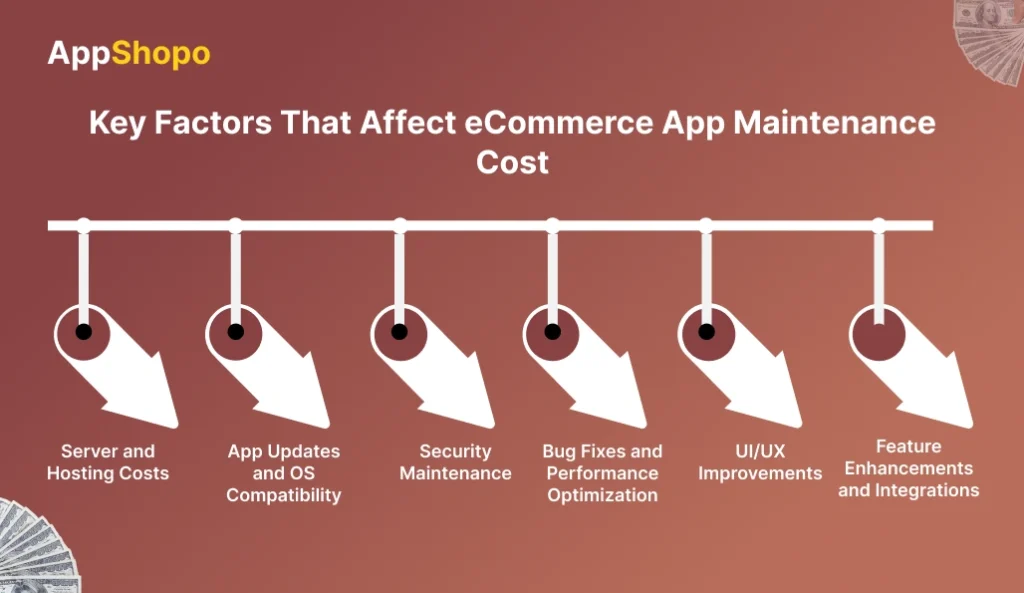
The budget for maintaining a mobile commerce application depends on hosting, app complexity, user volume, security, and update frequency, to name a few. On the other hand, regular maintenance, i.e, shooting bugs, updating the compatibility with different OSs, boosting the performance, etc., has a big share in the total expenditures.
1. Server and Hosting Costs
Server and hosting infrastructure play a fundamental role in the operation of an e-commerce mobile app at its best. These systems manage product catalogs, store user data, support e-commerce event ticketing features, and handle other types of online transactions. The cost depends on the amount of app traffic, the volume of storage needed, and the server performance specifications. Very active apps generally have to use more powerful cloud resources, which in turn results in the rise of hosting and ongoing maintenance costs in total.
Key components include:
- Cloud infrastructure for storing and managing app data
- Database management for products and user information
- Backup and recovery systems for data protection
- Content Delivery Networks (CDNs) for faster loading
2. App Updates and OS Compatibility
Mobile operating system updates, for example, those from Android and iOS, focus on improving security and functionality. E-commerce applications must be updated on a regular basis in order to remain compatible with these changes. The application achieves proper functionality through support teams who enable it to work across various device environments, which leads to improved performance and prevents system failures.
Maintenance tasks include:
- Updating APIs and software frameworks
- Adjusting app layouts for new devices
- Testing performance on multiple smartphones and tablets
3. Security Maintenance
Security maintenance is a must as e-commerce mobile applications handle very sensitive data of customers and payment details. Regular updating is one of the methods that are used to protect the platform from threats, hacking, and unauthorized access. Moreover, strong security measures will help companies in retaining customer trust and meeting the requirements of data protection regulations.
Security maintenance includes:
- Data encryption updates for secure transactions
- Payment gateway security patches
- Fraud detection and prevention systems
- Compliance with regulations such as GDPR
4. Bug Fixes and Performance Optimization
In fact, even mature ecommerce mobile apps might face glitches or drops in performance sometimes. Ongoing maintenance makes it possible for teams not only to keep an eye on the app but also to detect issues at an early stage and to fix them rapidly. Constant performance tuning results in speedy load times, seamless navigation, and an upgraded shopping experience that is dependable, which in turn allows firms to keep users happy and lower the risk of their app crashing.
Common monitoring areas include:
- App crashes and error logs
- Loading speed and responsiveness
- Server response time
- Memory and resource usage
5. UI/UX Improvements
Customer needs change frequently in eCommerce based on new technology and evolving shopping options, so making ongoing changes to your Mobile Application’s User Interface/User Experience (UI/UX) will provide customers with a better digital shopping journey/experience. Improvements in the design of your mobile application, its navigation, and its usability will result in higher levels of customer satisfaction, decreased customer churn rate, and increased sales conversion rates via your eCommerce Mobile Application.
Common improvements include:
- Simplified checkout process
- Personalized product recommendations
- Improved navigation and search functionality
- Updated visual design elements
6. Feature Enhancements and Integrations
Integration with CRM, analytics, or marketing tools. For any online company, the creation of an e-commerce mobile application is an essential accomplishment; however, this is only the beginning of the life cycle of the app. Long-term success relies on the continual maintenance and upgrade of mobile applications. Regular maintenance allows companies to keep their mobile application functioning properly, secure, and compatible with new smartphones and operating systems as they are released.
Examples of feature enhancements include:
- AI-based product recommendations
- Multiple payment gateway options
- Customer loyalty and reward programs
These ongoing improvements ensure that the ecommerce mobile app remains modern, scalable, and capable of meeting evolving customer expectations.
Also Read: Why B2B eCommerce Brands Need Mobile Apps to Scale
Tips to Reduce eCommerce App Maintenance Costs
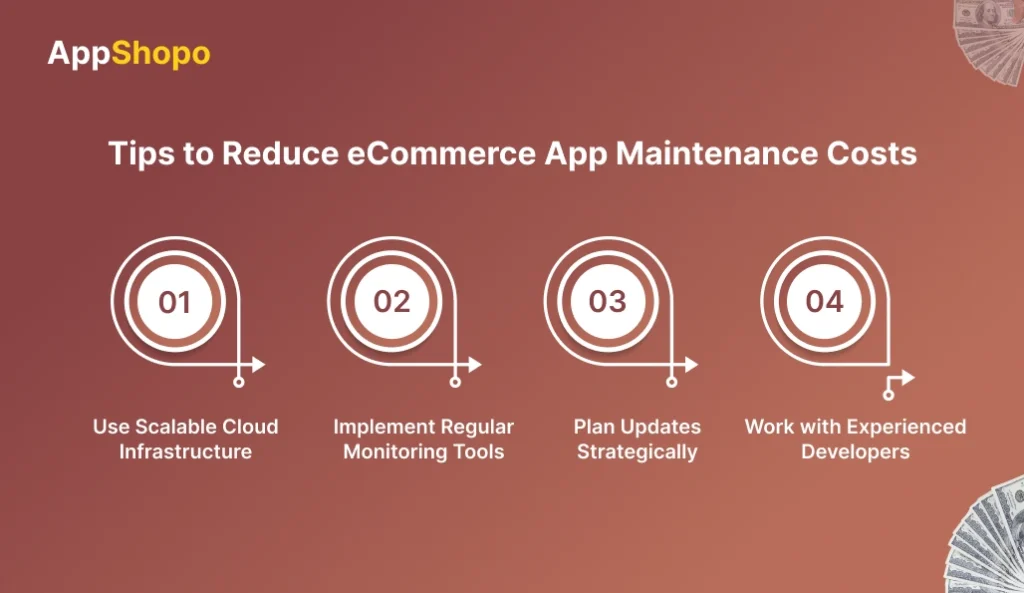
Running an ecommerce mobile app without a planned maintenance strategy could really shoot your costs to the ceiling. With the right set of technical practices and development strategy in place, firms can drastically slash their ongoing maintenance costs. Moreover, they can ensure that the app’s performance and security are not compromised while doing so.
Below are some effective strategies that help reduce e-commerce app maintenance costs.
1. Use Scalable Cloud Infrastructure
Using scalable cloud infrastructure enables businesses to scale up or down their server resources in line with the user traffic and demand. Companies don’t have to rely on expensive, large servers at all times; they can add or reduce the resources as per their requirements. Such flexibility not only helps in cutting down the hosting costs but also ensures that the e-commerce mobile app runs without any glitches during high traffic days like sales or promotions.
2. Implement Regular Monitoring Tools
Monitoring tools contribute significantly to detecting technical issues when they are still minor and can be resolved easily. Besides monitoring performance, these tools can also identify whether the app is crashing or evaluate the server’s response speed. By catching the problem early, programmers can resolve the issues in a timely manner, leading to minimal downtime and no need for costly emergency fixes that would have definitely spoiled the user experience.
3. Plan Updates Strategically
Regularly pushing out minor updates poses the risk of overloading the development team and hiking the maintenance costs. It is more advisable for the company to make arrangements for the rollout of updates containing the collection of changes to be rolled out at one go. With well-planned updates, the development team can be in a better position to effectively allocate resources, minimize operational disruptions, and have the implementation of new features and improvements run smoothly.
4. Work with Experienced Developers
Recruiting highly skilled developers or teaming up with an expert development firm plays a major role in minimizing the issues related to software maintenance in the long run. Proficient coders develop scalable and properly arranged programs that are less prone to breakage in the future. Moreover, an effective team of developers makes sure that the software is well-tested, that security measures are in place, and that the architecture is done in a manner that is not wasteful; all of these factors contribute to the reduction of the maintenance bill over time. In this way, enterprises can keep their e-commerce mobile app up-to-date without spending a fortune while still providing users with a very good experience.
Evaluation Criteria for Choosing an eCommerce App Maintenance Partner
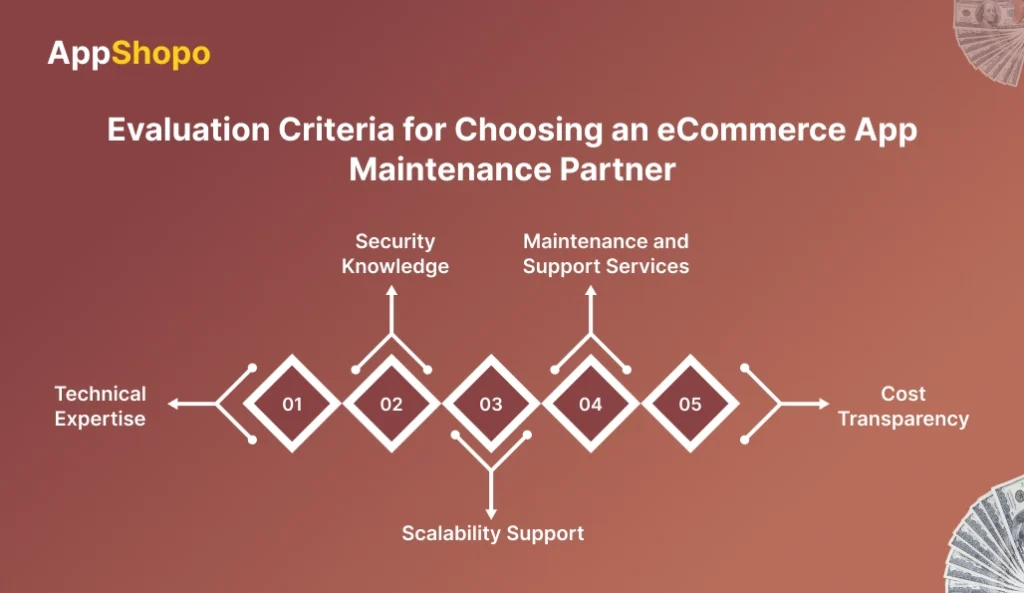
Selecting the right maintenance partner is crucial for ensuring the long-term performance and reliability of an ecommerce mobile app. Businesses should evaluate potential development teams carefully before making a decision.
1. Technical Expertise
The maintenance team should have strong experience in mobile app technologies, ecommerce platforms, and cloud infrastructure. Skilled developers can handle complex updates and ensure smooth app performance.
2. Security Knowledge
Since ecommerce apps manage sensitive customer data and payment information, the development team must follow modern security practices such as encryption, secure payment integrations, and data protection compliance.
3. Scalability Support
A reliable development partner should design and maintain systems that can handle increasing user traffic and growing product catalogs without performance issues.
4. Maintenance and Support Services
Continuous technical support ensures quick resolution of bugs, crashes, or security issues. A good maintenance partner provides proactive monitoring and reliable customer support.
5. Cost Transparency
Clear pricing models and maintenance plans help businesses manage budgets effectively and avoid hidden costs in the long term.
Also Read: eCommerce vs mCommerce vs AppCommerce
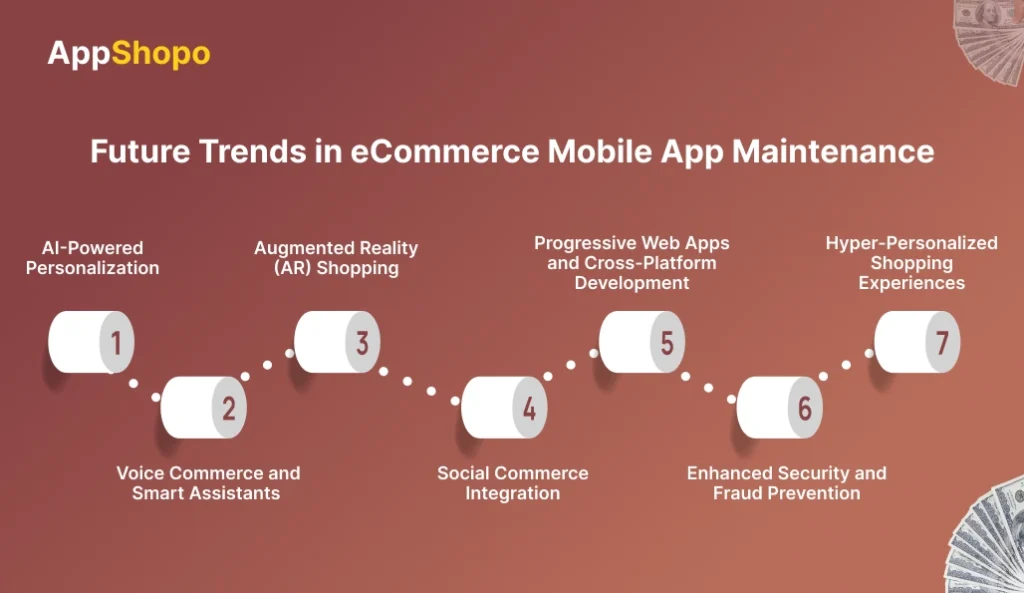
Innovative technologies and advancements in mobile infrastructure, combined with changing consumer behavior and evolving technological standards, will all contribute to the evolution of ecommerce mobile apps. As mobile commerce continues its rapid growth, companies need to modify their ecommerce mobile apps to add new capabilities and improve security features to be able to compete in this growing industry.
Industry reports state that mobile devices generate more than 57% of total global ecommerce sales, with forecasts for total mobile retail sales nearing $4 trillion globally, thus demonstrating the importance of mobile ecommerce applications for the growth of retail sales through the internet.
Because of this accelerated growth, ecommerce mobile applications will continue evolving using advanced technologies and more intelligent long-term maintenance strategies.
1. AI-Powered Personalization
Artificial intelligence will control all aspects of future ecommerce mobile applications. AI systems analyze user behavior, purchase history, and browsing patterns to provide personalized product recommendations and targeted offers. The system enhances customer engagement while it boosts the likelihood of customers making purchases.
2. Voice Commerce and Smart Assistants
Voice-enabled shopping is experiencing rising demand from customers. Users can use voice assistants like Alexa or Google Assistant to search for products, place orders, and track their deliveries. The voice-enabled ecommerce market is expected to reach over $151 billion because of its strong growth potential for voice commerce.
3. Augmented Reality (AR) Shopping
AR technology enables customers to see products before they make their purchase decisions. Customers can experience furniture dimensions in their personal spaces while testing virtual clothing. This shopping method creates an interactive experience that helps customers make better online purchasing decisions while decreasing product returns.
4. Social Commerce Integration
Social media platforms now function as effective ecommerce platforms. Users can purchase products from social platforms through in-app shopping, influencer marketing, and live product demonstrations. Social commerce will increasingly drive global ecommerce sales according to upcoming trends.
5. Progressive Web Apps and Cross-Platform Development
Businesses are increasingly adopting cross-platform technologies and Progressive Web Apps (PWAs) to reduce development and maintenance costs. These technologies allow companies to maintain a single codebase while delivering high-performance experiences across multiple devices.
6. Enhanced Security and Fraud Prevention
As ecommerce apps handle large volumes of financial transactions, security will remain a top priority. Future apps will integrate advanced security technologies such as biometric authentication, AI-based fraud detection, and stronger encryption systems to protect customer data.
7. Hyper-Personalized Shopping Experiences
E-commerce applications in the future will utilize hyper-personalization through instant suggestions of products and dynamic prices. In addition, e-commerce apps will provide users with a tailored shopping experience tailored to their specific needs based off of their preferences.
Ultimately, the future of e-commerce apps will be defined by personalization, automation, immersive experiences, and enhanced security. Companies that embrace these trends early will have a greater likelihood of providing customers with superior and innovative ways to shop and compete effectively in an ever-changing global mobile commerce environment.
Conclusion
E-commerce mobile app maintenance is an ongoing expense involving costs associated with updates, security, hosting, and improving performance. Generally, businesses can expect to spend 15 to 20% of the initial cost of development each year on maintaining their mobile application.
Expanding your budget for ongoing maintenance early on and combining this with a team of professionals with extensive experience provides a way to keep your e-commerce mobile app secure, able to support business growth, and user-friendly over time.
If you want to create or maintain an e-commerce mobile app, then consider AppShopo as your e-commerce app solution. AppShopo offers pre-built e-commerce apps, allowing you to launch and manage your mobile e-commerce app quickly while reducing prolonged development and maintenance costs. With scalable features and ongoing support, you can develop your online store while providing your customers with a smooth mobile shopping experience.
FAQs
1. How much does it cost to maintain an eCommerce mobile application?
Generally speaking, you can expect to spend 15-20% of your initial development cost per year on maintaining your eCommerce mobile application. Your business may spend anywhere from $5,000 – $25,000 annually on hosting, updating, bug fixing, improving security, and adding features to your application based on its functionality and the number of users accessing it.
2. Why is regular maintenance of an eCommerce mobile application necessary?
Regular maintenance ensures that your eCommerce mobile application remains secure, quick to load, and compatible with new operating systems. Regular maintenance also helps improve performance, address bugs, add new features, and keep customer information safe from cyber threats.
3. What influences the cost of maintaining an eCommerce mobile application?
The number of users accessing the application, the complexity of the application, the types of servers being used to host the application, the level of security that is required to protect the data, any third-party services that have been integrated into the application, and the frequency with which updates or enhancements are required will all affect the maintenance cost.
4. How frequently should an ecommerce mobile app receive updates?
Generally speaking, ecommerce mobile apps will need to receive regular updates every several months. Typical update activities for ecommerce mobile applications would be to improve the overall user experience, make the application work better on new Android & iOS updates, fix bugs and introduce new features. Regular updates will also foster a better overall user experience.
5. In order to decrease the maintenance cost of an e-commerce mobile app, what can companies do?
There are several common practices used by companies in order to minimize the maintenance cost on ecommerce mobile apps, these include implementing a scalable cloud-based infrastructure, implementing automated monitoring tools for your mobile application(s), proactively scheduling structured updates, developing a modular development architecture, and finally, working with an experienced development team that is able to build quality and maintainable applications.

Pankaj Arora
Founder, AppShopo

Pankaj Arora is a technology entrepreneur and the Founder of AppShopo, with over 10 years of experience in helping businesses transform websites into high-performing mobile apps. His expertise spans eCommerce app development, Shopify and WooCommerce integrations, mobile UX optimization, and scalable app delivery. Through AppShopo, Pankaj has enabled brands worldwide to launch fast, reliable Android and iOS apps that drive higher engagement, retention, and mobile sales.