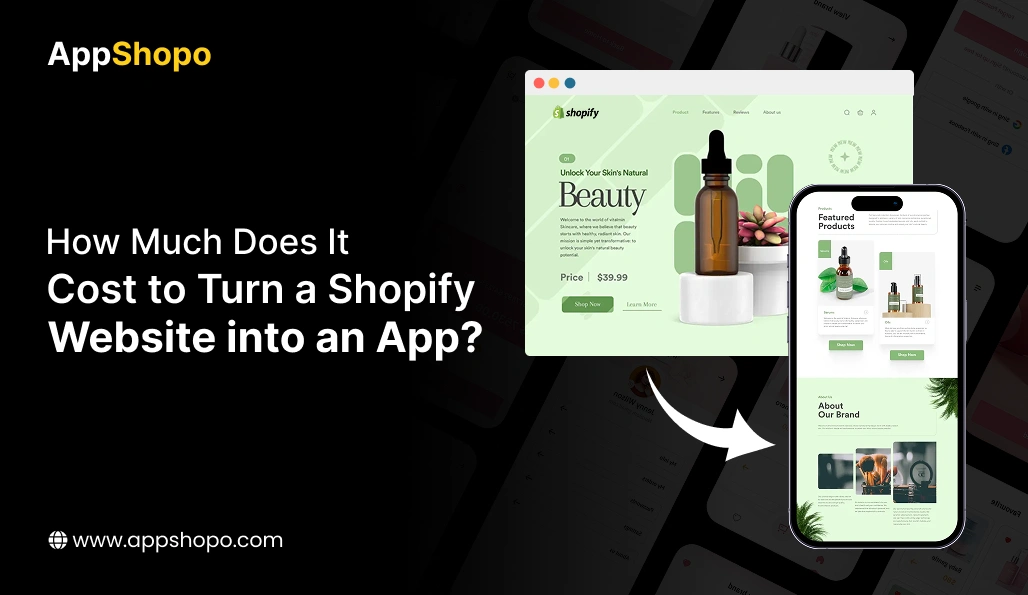
How Much Does it Cost to Develop a Custom Shopify Mobile App in 2026? (Full Pricing Guide)

Mobile commerce isn’t just “growing” in 2026, it has already become dominant. For Shopify brands, this shift has completely changed customer expectations. Shoppers now demand faster browsing, smoother checkout, and instant notifications about new products and offers. While a mobile-optimized website can attract visitors, it cannot match the retention power of a custom Shopify mobile app. Apps are built for repeat purchases, loyalty engagement, and long-term customer relationships, making them one of the smartest investments for brands seeking predictable growth beyond paid advertising.
As a result, more Shopify merchants are launching mobile apps—not to replace their websites, but to create a high-retention channel focused on returning customers. Before getting started, however, the key question is simple: What does it actually cost to build a custom Shopify mobile app in 2026? The answer depends on your chosen development approach, required features, store complexity, integrations, and launch timeline.
In this blog, you’ll get a clear and practical breakdown of Shopify mobile app development costs in 2026, including pricing ranges, feature-based cost comparisons, commonly overlooked expenses, and guidance on selecting the right solution for your business stage. Our team has delivered multiple ecommerce mobile app projects—from simple storefront apps to advanced builds with loyalty systems, push automation, and deep integrations—so this guide is designed to help you confidently understand the true cost of building a Shopify mobile app and scaling effectively.
TL;DR
- Shopify apps boost retention, repeat sales, and customer loyalty.
- App cost depends on features, integrations, and customization level.
- App builders are cheaper and launch faster than custom apps.
- Custom apps cost more but offer full control and scalability.
- Maintenance, ASO, and push strategy add long-term costs.
Key Points
- Shopify mobile apps help brands increase repeat purchases through faster browsing, smoother checkout, and push notification engagement.
- Shopify mobile app development cost varies widely based on features, UI/UX, catalog size, and advanced integrations needed.
- App builders offer affordable monthly pricing and quick launch, but customization and flexibility can be limited.
- Custom Shopify apps provide premium design, performance optimization, and deep integrations but require higher upfront investment.
- Hidden costs like app maintenance, OS updates, marketing assets, and push automation must be planned for long-term success.
Why Shopify Brands Build Mobile Apps in 2026 (Even with a Mobile Website)
Shopify themes are already mobile responsive, which makes them perfect for first-time visitors. But in 2026, high-performing ecommerce brands are not only focused on “mobile-friendly design”; they are focused on retention, repeat purchases, and customer lifetime value through a Shopify mobile app strategy.
And this is exactly where a mobile app for a Shopify store becomes a competitive advantage, helping brands improve retention through Shopify mobile app development and build stronger customer engagement with a custom Shopify app.
Mobile commerce has grown massively. According to Statista, worldwide m-commerce sales have reached around $2.07 trillion, and mobile commerce now makes up about 57% of all ecommerce sales globally. This clearly shows that customers are already buying more from phones than ever before.
For Shopify stores specifically, mobile dominates traffic. Shopify’s own data confirms that mobile accounts for over 50% of ecommerce traffic, proving that customer attention has shifted heavily toward smartphones. In simple words: your buyers are already on mobile, so the smartest brands are now building mobile experiences that increase repeat orders.
Also Read: eCommerce vs mCommerce vs AppCommerce
When a Shopify mobile app becomes valuable
A Shopify mobile app becomes a strong growth channel when:
- Your store depends on repeat buyers (beauty, fashion, consumables, lifestyle)
- You run frequent promotions and need a direct customer channel
- You have a loyalty/VIP program and want stronger engagement
- You want to reduce cart abandonment and increase purchase frequency
- You need a smoother checkout flow for returning customers
The biggest difference: Push notifications
The most powerful advantage of an app is push notifications, because they allow you to reach customers instantly, without depending on ads, Instagram reach, or email open rates. For any Shopify mobile app, push notifications are one of the strongest retention tools and a key part of Shopify app marketing.
With a mobile website, push notification capability is limited and inconsistent. But with a native Shopify mobile app, push becomes a reliable marketing engine for:
- Abandoned cart recovery
- Flash sale alerts
- New arrivals & drops
- Price drop notifications
- Win-back campaigns
- Restock reminders
Extra benefits of mobile apps (beyond push)
Mobile apps are also built to deliver better customer experience and long-term loyalty:
- Faster browsing and smoother UX for returning users
- Home screen placement (brand recall improves naturally)
- Saved login, addresses, preferences, quicker repeat orders
- More personalized shopping experiences (recommendations + feeds)
- Better customer stickiness through app-only deals and loyalty rewards
As Wikipedia defines it, mobile commerce is the buying and selling of goods and services using wireless handheld devices like smartphones and tablets. In 2026, it’s not just a trend, it’s how customers prefer to shop.
Shopify Mobile App Cost in 2026: Realistic Price Range
The total cost depends heavily on what you mean by “build.”
Some brands use platforms that convert their Shopify store into a mobile app. Others build from scratch with native code, while some choose Shopify to mobile app builder tools or ready-made solutions. Others hire agencies for polished, high-performance products, and some brands build internal teams when they want full customization and control.
Here are the realistic market ranges in 2026:
| Approach | Typical Cost | Best For | Timeline |
| App builder / SaaS platform | $49–$1,500 per month | Fast launch, low risk | 1–4 weeks |
| Freelancer / offshore team | $20,000–$100,000 | Budget custom build | 3–8 months |
| Professional agency | $100,000–$350,000 | Quality delivery + scaling | 3–9 months |
| Enterprise / Shopify Plus app | $300,000–$500,000+ | Large brands, deep integrations | 6–12 months |
| In-house development | $200,000–$600,000+ yearly | Product-led brands | Ongoing |
The right choice depends on your store size, repeat purchase rate, required integrations, and timeline.
1) Shopify App Builders (Lowest Cost, Fastest Launch)
- Estimated cost: $49 to $1,500/month
- Timeline: 1–4 weeks
- Best for: Small to mid-size Shopify brands
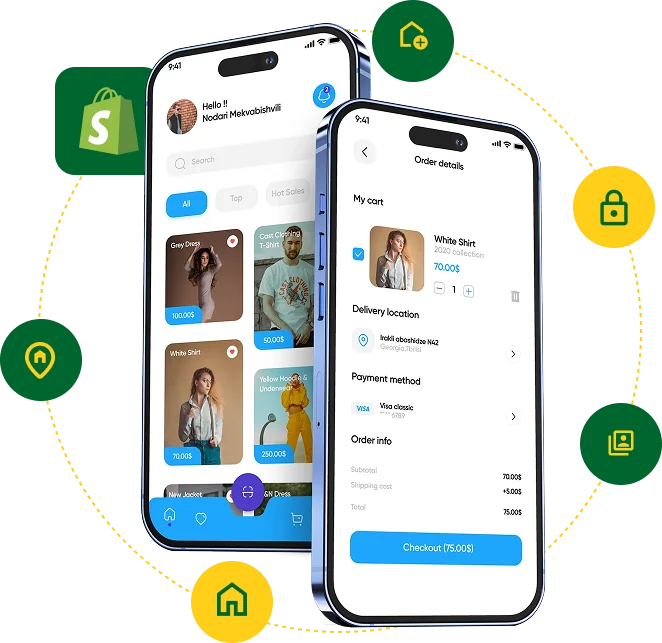
Shopify app builders are platforms that connect to your store and generate Android and iOS apps. These are not “fully custom” builds, but they deliver speed and convenience, and many brands choose them because they can launch quickly and start generating ROI through push notifications and retention. AppShopo is a strong example of this approach, helping businesses convert their Shopify website into a professional mobile app quickly, with an app-like experience designed to support better engagement and repeat purchases.
What you typically get with an app builder
Most Shopify app builder plans include:
- Android and iOS mobile apps
- Shopify product and collection sync
- Search, filters, cart, and checkout
- Customer accounts
- Basic push notifications
- Simple themes and branding controls
- Analytics integration
Typical pricing tiers
You’ll usually see pricing like
- Starter: $49–$199/month
- Growth: $299–$799/month
- Enterprise: $999–$1,500+/month
Some platforms charge additional fees for add-ons like automation, segmentation, advanced push journeys, or premium support.
Pros
- Minimal upfront cost
- Fast time-to-market
- Low technical risk
- Built-in maintenance and updates
- Easier publishing help
Cons
- Limited customization compared to fully custom apps
- Some features locked behind higher plans
- Less flexibility for unique flows
- You are dependent on the platform
When this is the best option: If you want an app live quickly and you are mainly focused on retention and growth, this is often the highest ROI option.
2) Freelancer or Offshore Shopify App Development (Budget Custom Build)
- Estimated cost: $20,000–$100,000
- Timeline: 3–8 months
- Best for: Brands that want custom UI but have tight budgets
A budget custom build means hiring freelancers or offshore teams to develop your Shopify app. This approach gives you more customization than app builders, but it also increases risk and requires management.
Typical developer rates in 2026
Rates vary by region:
- South Asia: $20–$50/hour
- Eastern Europe: $35–$70/hour
- Latin America: $35–$80/hour
- North America: $80–$150/hour
What you can expect for $20K–$100K
In a successful build, you can get:
- Custom UI/UX design
- Shopify integration for products/orders
- Cart and checkout
- Login and profile
- Push notifications
- Basic analytics setup
- App store launch support
The risks most brands face
Budget custom builds often struggle due to:
- Weak QA/testing
- App store review delays
- Documentation gaps
- Future updates becoming expensive
- Lack of long-term ownership planning
Many brands underestimate how much coordination is needed. You may need to write detailed specs, manage deadlines, test builds weekly, and handle release issues.
When this is the best option: If you have internal technical leadership (or a strong PM) and you need more customization than an app builder provides.
3) Professional Agency Development (Premium Custom App)
- Estimated cost: $100,000–$350,000
- Timeline: 3–9 months
- Best for: Scaling Shopify brands that want performance, stability, and a premium UI
Professional agencies are expensive because they do more than “code the app.” They deliver a product process and higher quality.
What agencies typically provide
- UI/UX research and design
- Product planning and roadmap
- Clean architecture and scalable codebase
- Full QA testing cycle
- App store compliance handling
- Integrations with marketing and loyalty tools
- Maintenance options and long-term iteration support
Why agency builds cost more
You pay for:
- Senior engineers
- Dedicated QA
- Strong delivery process
- Better performance optimization
- Stronger app store approval success rate
- Reduced risk
When this is the best option: If your brand is scaling fast and the app will be a major channel, an agency build can be worth the investment.
4) Enterprise Shopify Plus Mobile App (Advanced Builds)
- Estimated cost: $300,000–$500,000+
- Timeline: 6–12 months
- Best for: Shopify Plus brands with complex operations and integrations
Enterprise apps are not just “mobile storefronts.” They are ecosystems that connect shopping experience, customer identity, personalization, loyalty, and backend systems.
Enterprise features often include
- Personalized shopping feed
- AI product recommendations
- Advanced search
- Multi-language and multi-currency
- Membership tiers
- Subscriptions
- Deep integration with ERP/CRM/WMS
- Custom backend services
- Advanced analytics dashboards
These apps are expensive because they require architecture planning, backend work, security, and advanced testing.
5) In-House Shopify App Development (Highest Control)
- Estimated cost: $200,000–$600,000+ per year
- Timeline: ongoing
- Best for: Product-driven companies where app is central strategy
In-house development means hiring your own team and building everything internally. It gives maximum control, but costs compound quickly.
A typical in-house setup includes:
- iOS developer
- Android developer
- Backend engineer
- UI/UX designer
- QA engineer
- Product manager
In addition to salaries, costs include:
- Devices for testing
- CI/CD and development tools
- App store release operations
- Continuous updates
This option is only logical when your app is a long-term strategic product and you plan frequent improvements.
Feature-Based Shopify App Cost Breakdown (2026)
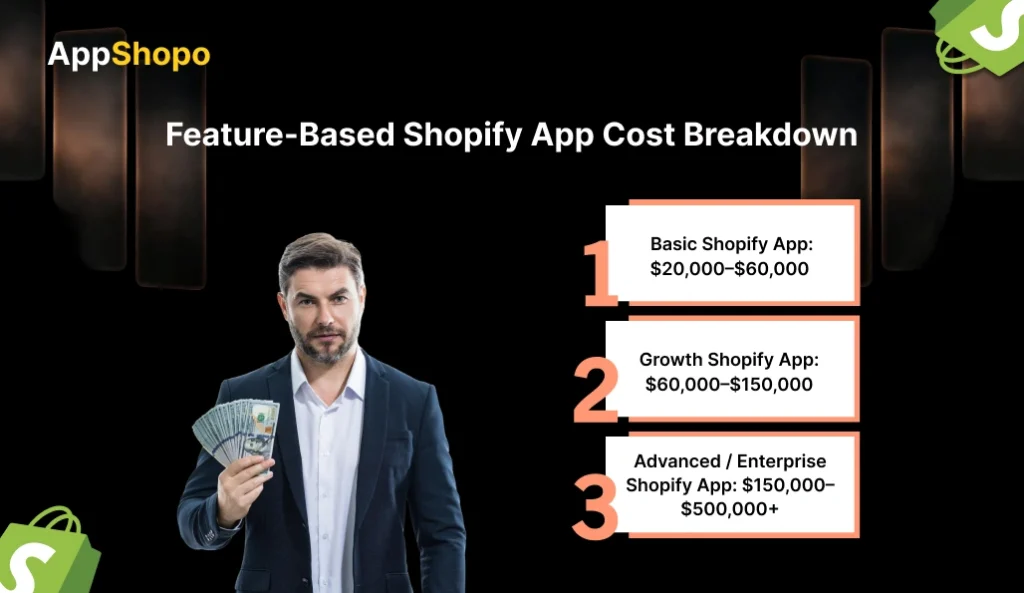
One of the most accurate ways to estimate the cost of a custom Shopify mobile app in 2026 is to define the scope of the app. Most Shopify mobile app development cost increases are not because of the storefront screens but because of advanced features like automation, personalization, loyalty systems, subscriptions, and enterprise integrations that require deeper Shopify app development work.
Below is a realistic, feature-based Shopify mobile app pricing breakdown that Shopify brands commonly fall into:
1) Basic Shopify App: $20,000–$60,000
A basic Shopify mobile app focuses on delivering a clean shopping experience with essential ecommerce functionality. This tier is ideal if you want to launch quickly, test adoption, and start building a mobile user base.
Includes:
- Home screen and collections
- Product listing and product detail pages
- Search and basic filters
- Cart and checkout flow
- Customer login and account section
- Basic push notifications (manual campaigns)
Best for: early-stage stores and brands testing the mobile app channel.
2) Growth Shopify App: $60,000–$150,000
A growth-stage app is built for retention and repeat purchases. It includes advanced engagement features that help brands generate more revenue from existing customers, especially through automation and loyalty experiences, similar to businesses that convert their Shopify store into a mobile app, use Shopify to mobile app builders, or turn their Shopify website into a fully branded app to boost engagement and repeat revenue.
Adds:
- Wishlist and saved items
- Loyalty program integration
- Reviews and ratings integration
- Advanced push automation (customer journeys)
- Abandoned cart push flows and win-back sequences
- Analytics dashboards (events, funnel tracking)
- Audience segmentation and targeting for campaigns
Best for: scaling Shopify brands that want consistent repeat revenue and stronger customer lifetime value.
3) Advanced / Enterprise Shopify App: $150,000–$500,000+
Enterprise Shopify mobile apps go beyond standard storefront features. They are built for complex businesses with large catalogs, international selling requirements, and deep integrations across tools and internal systems—especially for Shopify Plus mobile app needs. This tier typically includes custom Shopify app development with backend services and advanced performance optimization for scalability, similar to brands that convert their Shopify store into a mobile app when full control, flexibility, and high-performance integrations are required.
Adds:
- AI recommendations and personalization
- Advanced search, filtering, and sorting for large catalogs
- Subscription management and recurring billing workflows
- Membership tiers and exclusive in-app experiences
- Multi-language and multi-currency support
- ERP/CRM/WMS integrations (inventory, fulfillment, customer data)
- Custom backend services and APIs
- High-performance caching, speed optimization, and scalability
Best for: Shopify Plus brands, global stores, and high-volume catalogs that need enterprise-level performance and integrations.
Key takeaway: The “app screens” rarely drive the biggest cost in a custom Shopify mobile app. The real budget jump in Shopify mobile app development cost happens when you add automation, personalization, subscriptions, loyalty systems, and enterprise Shopify app integrations, because those features require more planning, backend work, and testing during Shopify app development.
Key Factors That Increase Shopify Mobile App Cost (2026)
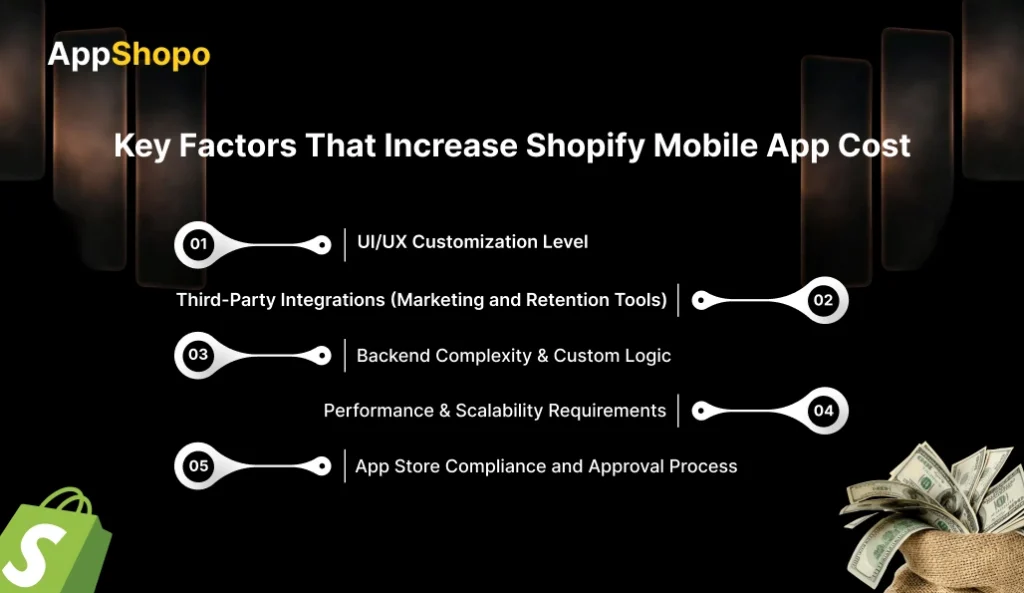
Shopify mobile app pricing can vary dramatically. Just a basic Shopify mobile app will set you back a few thousand dollars, whereas a completely custom-designed Shopify mobile app for an enterprise can easily reach a few hundred thousand. The discrepancy is pretty much due to the factors of complexity, customization, and long-term scalability that all have a say in the final overall cost of Shopify mobile app development and Shopify app development pricing.
Below are the biggest factors that increase the cost of Shopify mobile app development in 2026:
1) UI/UX Customization Level
If your goal is more than a basic storefront app and you want a premium in-app shopping experience, costs increase quickly.
Custom UI/UX work includes:
- Fully custom layouts and navigation flows
- Unique product pages and collection views
- Animations, micro-interactions, and advanced design components
- Personalized home screens or feed-style browsing
The more “designed” the app is (instead of template-based), the more time is required for UX planning, design systems, and testing across devices.
2) Third-Party Integrations (Marketing and Retention Tools)
Integrations are one of the most common reasons Shopify app budgets go up.
Even if the app looks simple on the front end, connecting it properly with business tools requires backend work, API configuration, authentication, data syncing, and testing.
Common integrations include:
- Klaviyo (email and push automation)
- loyalty platforms (Smile.io, LoyaltyLion, Yotpo, etc.)
- subscription tools (Recharge, Bold Subscriptions, etc.)
- reviews and ratings (Judge.me, Loox, Yotpo, etc.)
- CRM/ERP systems (HubSpot, NetSuite, SAP, custom CRMs)
Each integration adds time for setup, mapping, error handling, and performance testing
3) Backend Complexity & Custom Logic
If your app depends on custom backend logic, it becomes much more expensive than an app that simply displays Shopify catalog data.
Examples of costly backend complexity:
- custom product recommendation logic
- personalized feeds and ranking systems
- dynamic pricing rules or tiered pricing
- custom discount engine
- complex loyalty rules and membership tiers
- syncing with internal inventory systems
These features require backend infrastructure, APIs, and long-term maintenance planning.
4) Performance & Scalability Requirements
Performance optimization is a major cost driver, especially for Shopify brands with large catalogs, heavy traffic, or international customers.
Large stores need:
- caching layers for faster loading
- optimized product listing rendering (infinite scroll, lazy loading)
- efficient filter and search handling
- faster checkout and cart updates
- better media optimization (images, banners, videos)
Performance is not a one-time task; it requires testing, monitoring, and fine-tuning
5) App Store Compliance and Approval Process
Publishing on the Apple App Store and Google Play Store is not just “upload and done.” App store guidelines are strict in 2026, and compliance can impact both time and budget.
Cost increases due to:
- privacy policies and permission compliance
- tracking disclosures and user consent flows
- Apple review rejections and resubmissions
- device testing requirements
- app metadata, screenshots, and listing optimization
For iOS especially, the approval process can require additional UX tweaks, documentation, and multiple submission rounds.
Hidden Costs Most Shopify Brands Forget (2026)
When Shopify brands plan a mobile app, most budgets focus heavily on build costs like design, development, and launch. However, the true Shopify mobile app development cost goes far beyond the initial release, similar to brands that convert their Shopify store into a mobile app and later discover ongoing operational expenses.
Apps are living products that require regular updates, technical support, feature improvements, and marketing efforts to stay competitive. Many brands underestimate these factors and eventually face unexpected post-launch expenses, including continuous Shopify app maintenance costs, performance optimization, and long-term scalability investments.
Below are the most common hidden expenses Shopify merchants overlook when estimating their Shopify mobile app investment in 2026. These cost factors also apply to brands that convert their Shopify store into a mobile app and continue maintaining and optimizing it after launch.
1) Maintenance, Bug Fixes, and OS Updates
iOS and Android updates happen constantly. Each major OS release can create compatibility issues that must be fixed to avoid crashes, performance drops, or app store warnings.
Maintenance typically includes:
- bug fixes and stability improvements
- device compatibility updates (new iPhones/Android models)
- security patches
- fixing broken third-party integrations
- performance improvements over time
Typical monthly maintenance budgets:
- Small app: $500–$2,000/month
- Mid-level app: $2,000–$8,000/month
- Enterprise app: $10,000+/month
Maintenance is not optional; it’s what keeps the app stable and store-compliant long term.
2) App Store Accounts, Platform Fees, and Tools
To publish and maintain your app, there are recurring platform fees and account costs that should be included in budgeting.
Common costs include:
- Apple Developer Program membership fee (annual)
- Google Play Developer account fee (one-time)
- Paid third-party services (analytics, crash reporting, automation tools, etc.)
These amounts are not huge individually, but they become part of the ongoing app ownership cost.
3) Push Notification Strategy and Retention Setup
A mobile app without a push strategy often fails to deliver ROI. The main reason Shopify brands build apps is retention, so push campaigns and automation are essential, not optional.
Costs may include:
- automation and segmentation tools
- customer journey setup (welcome, cart recovery, win-back)
- push notification templates and copywriting
- campaign calendar planning (weekly/monthly promotions)
- testing push timing and targeting
If you do not plan for this, you may end up with an app that has installs but low repeat revenue.
4) Marketing Assets and App Store Optimization (ASO)
Even if you build a great app, people still need a reason to download it. App store presentation plays a big role.
Your app listing generally requires:
- Professional screenshots
- App preview video (optional but high-impact)
- Icon and branding kit
- Store description optimization and keyword targeting
- App launch creatives (website banners, ads, emails)
This is one of the most ignored areas, but it directly affects installs and adoption.
5) Customer Support, Feedback Handling, and Iteration
Once your app goes live, real users will:
- Report bugs
- Request new features
- Complain about UX flow issues
- Ask for improvements based on device-specific behavior
To manage app reputation and reviews, you need resources for:
- Quick bug fixing
- Small improvements and UI adjustments
- Handling feedback loop from reviews/support tickets
- Minor upgrades based on customer behavior
This ongoing iteration often determines whether the app becomes a long-term revenue channel or stays an underused project.
Is a Shopify Mobile App Worth It in 2026?
For most ecommerce brands, a mobile app becomes profitable not because it looks premium, but because it improves what matters most in 2026: retention and repeat revenue through a strong Shopify mobile app strategy, similar to brands that convert their Shopify store into a mobile app to increase repeat engagement and long-term customer value.
A mobile website is great for discovery—customers find you through ads, Google, social media, or referrals. But once they leave, bringing them back consistently can be difficult and costly. That’s where a mobile app for Shopify store transforms engagement and improves retention, similar to brands that convert their Shopify store into a mobile app to increase customer stickiness and repeat interactions.
A Shopify mobile app helps brands build direct customer relationships and generate consistent revenue from repeat buyers, improving overall Shopify mobile app ROI and long-term repeat revenue. This approach is similar to brands that convert their Shopify store into a mobile app to strengthen retention, increase engagement, and drive sustained business growth.
How Shopify apps deliver ROI
A Shopify mobile app typically improves business results by helping you:
- Convert more returning shoppers, because the experience is faster and more convenient
- Drive repeat purchases through push notifications, which are instant and highly direct
- Increase customer lifetime value (CLV) by encouraging reorders and better retention
- Strengthen loyalty programs through in-app rewards, points, VIP tiers, and exclusives
- Improve checkout speed for repeat customers, using saved preferences and smoother flows
In simple terms: apps help you sell more to the customers who already trust your brand, without paying again for every visit.
When a Shopify mobile app is truly worth it
A Shopify app is usually worth the investment in 2026 if:
- You have strong repeat purchase behavior (customers buy multiple times per year)
- You run frequent promotions, launches, drops, or seasonal campaigns
- You have (or plan to create) a loyalty/VIP program and need higher engagement
- Your paid ads are expensive, and you want to grow through retention instead of constant acquisition
Brands in categories like fashion, beauty, wellness, lifestyle, and consumables typically see the strongest ROI because they naturally benefit from repeat ordering and customer loyalty.
Conclusion
By 2026, a Shopify mobile app will no longer just an optional add-on for e-commerce brands; it will have become a powerful retention channel. While a mobile-friendly website helps attract new visitors, a mobile app brings customers back through faster browsing, seamless checkout, loyalty engagement, and direct communication via push notifications. For brands focused on repeat purchases and long-term growth, a custom Shopify mobile app can increase customer lifetime value and reduce reliance on expensive paid marketing.
The cost of building a Shopify mobile application varies based on scope, custom design requirements, integrations, and performance expectations, all of which directly impact the overall development investment. Some brands choose Shopify app builders for speed and affordability, while others invest in custom Shopify app development teams for advanced functionality and premium design.
If you’re looking for a faster and more cost-effective way to launch without lengthy development timelines, AppShopo is a strong option. It helps Shopify brands quickly convert their store into a professional Android and iOS mobile app, delivering an app-like shopping experience that boosts engagement and repeat revenue, without the heavy upfront costs of fully custom development.
Also Read: Shopify Mobile App Builder vs Custom Development
FAQs
1. How much does it cost to build a Shopify mobile app in 2026?
The cost of building a Shopify mobile app in 2026 can range from $49–$1,500 per month using app builders to $20,000–$500,000+ for fully custom development. Pricing varies based on features, UI/UX complexity, integrations, store size, and performance needs, similar to brands that convert their Shopify store into a mobile app depending on project scope and scalability requirements.
2. What factors increase Shopify mobile app development cost?
The primary cost drivers include custom UI/UX design, third-party integrations such as loyalty programs, Klaviyo, and subscriptions, backend development, performance optimization for large catalogs, and App Store compliance requirements. As features and workflows become more advanced, the overall Shopify mobile app development cost increases, similar to brands converting their Shopify store into a mobile app with complex functionality and scalability needs.
3. Is a Shopify app builder cheaper than custom app development?
Yes. A Shopify app builder is generally more affordable because it provides pre-built templates and faster deployment. It lowers initial development costs but may restrict deep customization. In contrast, custom Shopify app development requires a higher investment but offers complete control over design, features, performance, and integrations—ideal for brands converting their Shopify store into a fully customized mobile app experience.
4. What are the hidden costs of Shopify mobile apps after launch?
Hidden costs often include ongoing maintenance, OS compatibility updates, bug fixes, and technical support. Brands also invest in push notification tools, automation workflows, marketing creatives, app store optimization, and continuous customer feedback improvements. These post-launch expenses are essential to keep a Shopify mobile app stable, competitive, and profitable over the long term.
5. Can AppShopo help convert a Shopify store into a mobile app?
Yes. AppShopo helps Shopify brands convert their website into a professional Android and iOS mobile app quickly. It delivers an app-like shopping experience with smooth navigation, stronger engagement, and faster deployment timelines. This makes it a cost-effective alternative to fully custom development and is ideal for brands that want to convert their Shopify store into a mobile app efficiently.

Pankaj Arora
Founder, AppShopo

Pankaj Arora is a technology entrepreneur and the Founder of AppShopo, with over 10 years of experience in helping businesses transform websites into high-performing mobile apps. His expertise spans eCommerce app development, Shopify and WooCommerce integrations, mobile UX optimization, and scalable app delivery. Through AppShopo, Pankaj has enabled brands worldwide to launch fast, reliable Android and iOS apps that drive higher engagement, retention, and mobile sales.