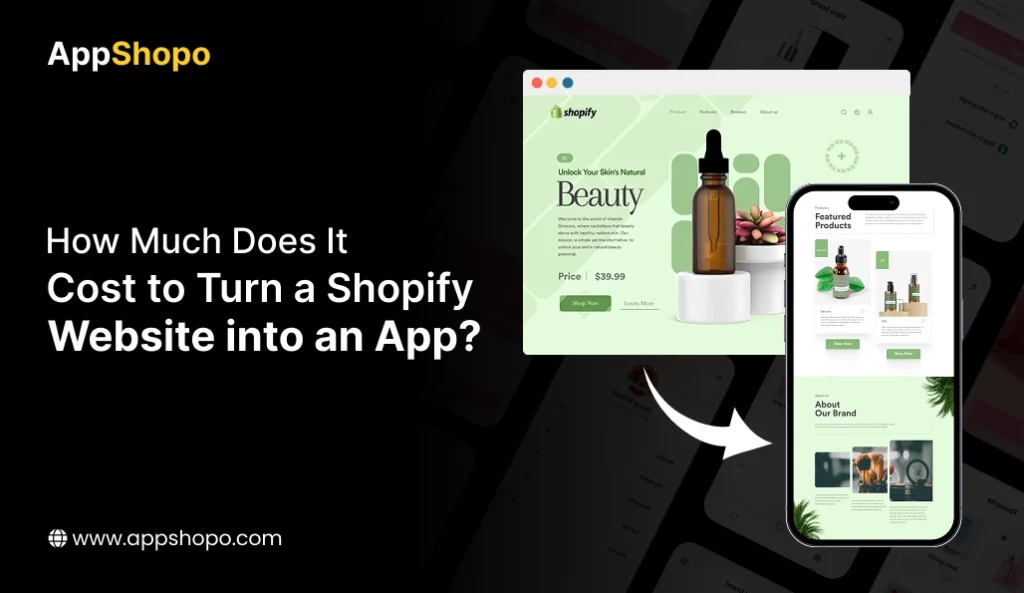
How Much Does It Cost to Turn a Shopify Website into an App?
Ask any developer about mobile app development costs, and the answer is usually the same: “It depends.” That explanation makes sense when you’re building a complex tech platform from scratch. But for ecommerce brands already selling on Shopify, the situation is very different.
At present, over 70% of ecommerce traffic comes from mobile-first users, which makes mobile apps a definite growth area for online stores. Even more convincing is the fact that mobile apps offer up to 3 times better conversion rates than mobile websites, thereby providing brands with considerable advantages in sales and retention.
Interaction is also significantly enhanced. Push notifications generate 310 more interactions than email marketing, thus enabling brands to remain in customers’ minds. As a result, customers who use apps are more frequently purchasing and also demonstrate a greater degree of brand loyalty, while repeat customers are significantly more willing to make purchases through apps than using mobile browsers.
If you already run a Shopify store, you’re not starting from zero. Your product catalog, checkout, branding, and mobile-optimized site are already built. In fact, your Shopify website is nearly 90% of a mobile app.
In 2026, the question isn’t whether or not to make a mobile app out of your Shopify store; the question is how much the app will cost, what approach will yield the best value, and how soon you can launch without impacting your revenue.
This blog is based on hands-on experience and practical knowledge of ecommerce and app development professionals who partner with Shopify merchants daily to determine cost, timelines, and actual results.
TL;DR
- Shopify app costs range from $50 monthly to $200,000+.
- DIY app builders offer affordability but demand ongoing effort.
- Custom Shopify app development delivers flexibility at a high cost.
- Faster app launches directly improve mobile revenue growth.
- Total cost includes time, maintenance, and the delayed opportunity.
Key Points
- The cost of turning a Shopify store into a mobile app varies depending on how you do it. It can be anywhere from less than a hundred dollars if you use DIY tools to tens of thousands for a custom, built solution.
- If you go for a DIY Shopify app builder, you will be saving money on the initial costs, but you will have to do the setup yourself, compromise on features, and keep on managing it internally.
- A custom Shopify mobile app development will give you full control over the app, but you will have to wait a long time, prepare a big budget, and maintain developer dependence for maintenance.
- Managed conversion platforms simplify app creation, handling updates, app store compliance, and performance optimization.
- The real Shopify mobile app development cost includes opportunity cost, especially revenue lost during slow or delayed launches.
How Much Does It Cost to Turn a Shopify Store Into an App?
Turning a Shopify website into a mobile app typically costs anywhere from $50 per month to over $200,000, depending on the solution you choose. In 2026, Shopify merchants generally follow three main paths based on budget, customization needs, and launch timelines. Costs vary widely depending on how tailored the app is and how quickly you plan to go live.
- Custom Shopify app development – Typically $50,000 to $200,000+
- DIY Shopify app builders – Usually $50 to $1,500+ per month
- Managed Shopify app conversion platforms – Around $800–$1,500 setup plus $300–$800+ monthly
Each option offers a different balance of cost, speed to launch, customization, and long-term maintenance, making it essential to evaluate the total cost of ownership—not just the upfront price.
Option 1: Custom Shopify Mobile App Development
The process of custom Shopify mobile app development requires an organization to select either an external agency or its internal development team to create complete native mobile applications that will operate on both iOS and Android platforms through Shopify APIs. Your business needs special screen designs, which require unique coding for each feature to create custom workflows that provide total system control and operational flexibility.
Cost Breakdown
- Upfront development: $50,000–$200,000+
- Timeline: 6–12 months (sometimes longer for complex apps)
- Ongoing maintenance: 15–25% of the initial build cost per year
- Additional costs:
- Quality assurance (QA) testing
- OS updates for iOS and Android
- Shopify API changes
- Feature enhancements and bug fixes
Why It Costs So Much
With custom development, all functions of the current Shopify website must be recreated from scratch, including product catalog browsing, cart functionality, the checkout process, and user account management,, but using native mobile code. The project requires a full team comprising UI/UX designers, frontend developers, backend developers, QA testers, and project managers who will be collaborating for months until the project is finalized.
Pros
- Full control over design, features, and user experience
- Ability to build complex or proprietary workflows
- No dependency on third-party platforms
Cons
- Extremely high upfront investment
- Long development and launch cycles
- Continuous reliance on developers for updates and fixes
Who It’s Best For
Large or enterprise Shopify brands with:
- Very specific, non-standard requirements
- Internal technical teams or large budgets
- Long-term app roadmaps beyond standard ecommerce
For most Shopify merchants, this approach is unnecessarily expensive, especially when the Shopify website already handles core ecommerce functionality effectively.
Also Read: How to Create an eCommerce App
Option 2: DIY Shopify App Builders
Merchants can create iOS or Android applications with a do-it-yourself (DIY) Shopify application builder by utilizing ready-made templates, visual editors, and pre-built features. The app will sync products, collections, and checkout automatically, which facilitates rapid and cost-effective development of the app. The downside to this type of development is that customization is more limited, and as merchants’ stores grow and require more advanced functionality or use a higher-tiered plan, costs increase substantially.
Typical Shopify App Builder Pricing
- Starter plans: $50–$150/month
- Mid-tier plans: $300–$1,500/month
- Advanced plans: $2,000+/month for high-volume brands
How They Work
The mobile app framework links your Shopify store with a mobile application, and it syncs products and collections automatically. Merchants can personalize the app, turn on push notifications, and handle content via one dashboard. Nevertheless, you will be held accountable for app submission, maintenance and updates, monitoring, and ensuring compliance with Apple and Google platform rules.
Pros
- Low upfront cost
- Faster launch than custom development
- No coding knowledge required
Cons
- Limited customization beyond templates
- Time-intensive setup and ongoing management
- Costs rise quickly as you unlock advanced features
The Hidden Cost
When it comes to DIY builders, they would probably seem cheap initially; however, if you really consider the cost, it also includes your time insidedesigning layouts, handling updates, fixing problems, and dealing with feature restrictions. As the stores become larger and more shops are on the way to the higher-priced tiers, the cost gap with managed solutions gets smaller.
DIY builders are best for merchants who want hands-on control and are comfortable trading time and flexibility for lower upfront spend.
Option 3: Managed Shopify App Conversion Platforms
Managed Shopify app conversion platforms take a different approach. Instead of rebuilding your store, they convert your existing Shopify mobile website into fully native iOS and Android apps—while handling setup, updates, and app store submissions for you.
This option sits between DIY tools and custom development in terms of pricing, effort, and flexibility.
Cost Structure
- One-time setup fee: ~$800–$1,500
- Monthly subscription: $300–$800+
- Launch timeline: 3–4 weeks
What’s Included
- Native iOS and Android apps
- Automatic syncing with your Shopify store
- App store publishing and compliance
- Ongoing maintenance and OS updates
Pros
- Fastest time to market
- Minimal manual effort required
- Maintenance and updates included
- Predictable, scalable pricing
Cons
- Less customization than fully bespoke apps
- Ongoing subscription cost
Why Many Brands Choose This Option
The majority of scaling Shopify brands find managed platforms to be the best mix of cost, speed, and long-term ownership. Besides the low initial investment, you get a great mobile app experience without the technical issues that come with traditional platforms.
Shopify Mobile App Cost Comparison (2026)
The price of a mobile app on Shopify in 2026 will largely depend on which route of development you take. Upfront costs, monthly charges, time needed for release, and continuing maintenance would be some of the factors that definitely influence the overall cost of the conversion of a Shopify store into a mobile app. The table below serves to show the differences in price, effort, and scalability of custom development of a Shopify app, using DIY app builders for Shopify, and using managed app conversion platforms for Shopify.
| Approach | Upfront Cost | Monthly Cost | Time to Launch | Ongoing Effort |
| Custom Development | $50k–$200k+ | High (ongoing maintenance) | 6–12 months | High |
| DIY App Builders | Low or none | $50–$1,500+ | 2–6 weeks | Medium–High |
| Managed Platforms | ~$800–$1,500 setup | $300–$800+ | ~4 weeks | Low |
Hidden Costs Shopify Merchants Often Miss
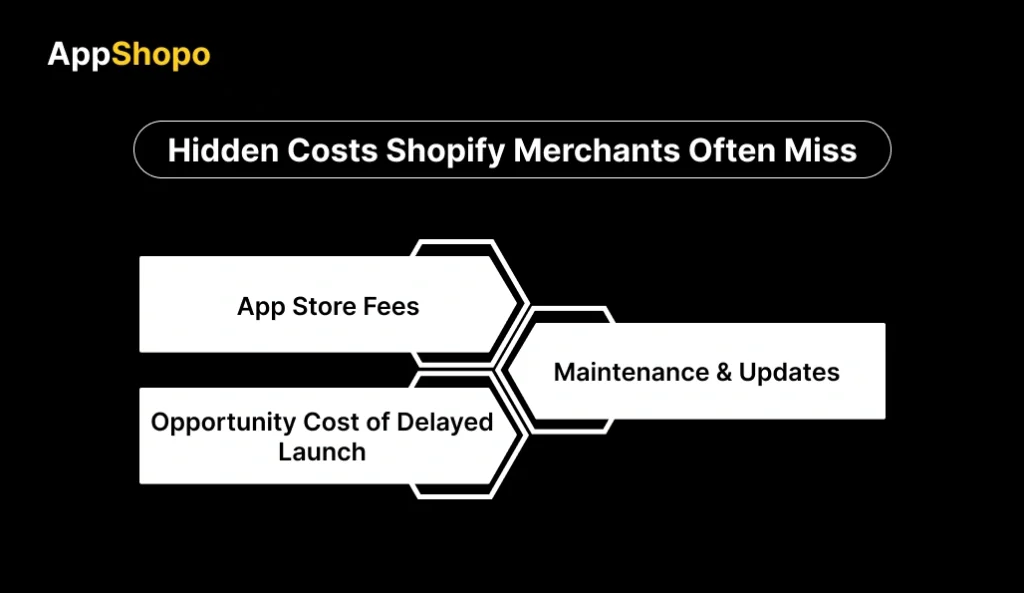
While merchants often think about the visible cost, such as the setup fee or monthly subscription, when calculating the Shopify mobile app development cost, the reality is far different. Turning a Shopify store into a mobile application is a process that involves numerous hidden expenses that can seriously affect the return on investment over the long term.
(1) App Store Fees
To publish and maintain a Shopify mobile app, merchants must pay mandatory platform fees:
- Apple Developer Program: The membership is ~$99 per year, and it is necessary to publish and keep apps on the Apple App Store.
- Google Play Console: There is a ~$25 one, time fee to publish apps on Google Play.
While these costs are relatively low, they are unavoidable and should be included in any accurate Shopify app cost estimate.
(2) Maintenance & Updates
Ongoing maintenance is one of the largest hidden Shopify app costs, especially for custom-built solutions.
- iOS and Android OS updates: Can cost $2,000–$10,000+ per year for custom apps, depending on complexity.
- Shopify API changes: May require additional developer work costing $1,000–$5,000+ annually.
- Performance and security fixes: Often add $1,500–$7,000 per year in developer or QA costs.
With custom Shopify mobile app development, these expenses require paid developer support. Managed Shopify app conversion platforms typically include maintenance, updates, and compatibility fixes within the monthly subscription—reducing surprise costs.
(3) Opportunity Cost of Delayed Launch
The most expensive cost is often invisible: lost revenue due to delays.
Delaying your app launch can lead to:
- Lower repeat purchases, potentially costing thousands per month in lost returning customer revenue
- Missed push notification revenue, which can drive 10–20% of repeat sales
- Reduced customer lifetime value, especially for mobile-first shoppers
For growing Shopify brands, even a 1–3 month delay in launching a mobile app can translate into tens of thousands of dollars in missed revenue.
Why These Costs Matter
Adding up the cost for app development and marketing, as well as the potential loss of income if you decide to close your Shopify store, helps you get a lot closer to the reality of how much it is going to cost you to switch your Shopify site to a mobile app.
Those merchants who are prepared for the hidden costs avoid running over budget, are quicker to launch, and get the most from their Shopify mobile app investment in the long run.
Which Shopify App Option Is Right for You?
It’s not only a matter of getting the cheapest deal when you choose how to make a Shopify mobile app. The most suitable choice should depend on your business objectives, the stage of your company, your in-house abilities, and your need for speed in results. Often, the market entry time and the overall cost of ownership are much more important than going for very high customization.
Below is how to decide which Shopify app option fits your business best.
(1) Testing Mobile Demand: DIY Shopify App Builders
If you’re still validating whether a mobile app makes sense for your store, DIY Shopify app builders can be a practical starting point.
This option works well if:
- You want to test mobile app demand with minimal upfront investment
- Your store has relatively simple requirements
- You’re comfortable managing setup, updates, and app store submissions
DIY builders generally charge between $50 and $1,500+ per month, which makes them affordable for small Shopify stores. But if your store expands, the Shopify app builder cost can escalate rapidly, and the hours internally used for managing the app will become a big factor.
Best for: Early-stage or small Shopify merchants validating mobile app ROI.
(2) Fast Launch, Low Effort: Managed Shopify App Conversion Platforms
If your goal is to launch quickly with minimal operational effort, managed Shopify app conversion platforms are often the best fit.
This option makes sense if:
- You want a fast time to market (often 3–4 weeks)
- You don’t want to manage technical updates or maintenance
- You value predictable, all-inclusive pricing
Managed platforms usually involve a moderate setup fee and $300–$800+ monthly cost, but they include maintenance, OS updates, and performance optimizations. This reduces long-term risk and keeps the Shopify mobile app development cost predictable.
Best for: Growing ecommerce brands focused on speed, stability, and scalability.
(3) Complex Enterprise Needs: Custom Shopify App Development
For large businesses with highly specific requirements, custom Shopify mobile app development may be the right choice.
This option is suitable if:
- You need deep customization or proprietary features
- Your workflows go far beyond standard ecommerce
- You have the budget and internal resources to support long-term development
The cost of developing custom applications starts at $ 50,000 and can reach up to $ 200,000, with additional annual maintenance expenses. Custom development offers maximum flexibility in development but results in higher project costs, which require extended time periods and pose the greatest technical challenges.
Best for: Enterprise Shopify brands with complex, non-standard use cases.
Final Recommendation
E-commerce brands make their final decisions based on three elements, which include speed, reliability, and return on investment. Your organization will start generating income from repeat customer purchases, together with push notification revenue plus increased customer lifetime value after you launch your product. Your company needs to pick between two mobile app development methods, which will help you achieve your upcoming expansion goals based on your current organizational development stage.
Conclusion
In 2026, turning a Shopify website into a mobile app won’t be considered just an optional upgrade. For the brands that want to be competitive in the mobile-first eCommerce world, it’s a necessary step. Mobile apps contribute directly to the brand growth in the long term as they offer higher conversion rates, more robust customer retention, and better engagement.
The cost of making a Shopify store into a mobile app varies greatly, depending on your choice. Hence, it could be anywhere from $50 per month to over $200,000. However, in reality, the matter is not about going for either the cheapest or the most complex one. The main thing is to decide on a solution that can juggle the Shopify mobile app development cost, time to launch, maintenance effort, and the impact on revenue.
Most e-commerce brands should choose between fast market entry with basic system requirements or complete system customization. Through quick launch, businesses gain the ability to send push notifications, which improve customer retention and increase customer lifetime value without creating extra demands on their operational capacity.
One of the indications that merchants indeed treat mobile apps differently is that Appshopo and similar platforms are confirming this change visually through their actions. They no longer perceive mobile apps as products of long development cycles but more as tools that can tremendously improve efficiency, scalability, and cost-effectiveness.
Moreover, Shopify merchants, if picking the appropriate techniques, will be able to optimize their existing stores to a great extent and turn them into mobile apps, which not only enhances the sales but also have the capability of smooth scaling and supporting the expansion far beyond 2026.
The finest Shopify mobile application is not necessarily the most costly one; it is the one that matches your business today and will be able to accommodate your growth tomorrow.
Read More: Best Tools to Turn Your Website into a Mobile App
FAQ
1. How much does it really cost to turn a Shopify store into a mobile app?
People can create mobile applications for their Shopify stores through basic DIY application builders, which charge $50 monthly, but complete Shopify mobile application development requires a budget that exceeds $200000. E-commerce brands that are growing their business select solutions that enable rapid market entry while still maintaining essential features and controlling upcoming maintenance expenses.
2. Is a Shopify mobile app worth it for small or mid-sized stores?
Yes. The Shopify mobile application provides substantial benefits to small and mid-sized enterprises by enhancing customer loyalty and user interaction and increasing customer lifetime value. Mobile applications deliver better conversion rates than mobile websites while allowing push notifications, which serve as one of the most effective ecommerce marketing methods. Your budget requirements and business development stage should determine which option you should select.
3. What is the cheapest way to convert a Shopify website into an app?
The cheapest method of converting a Shopify website into a mobile app is to use a DIY Shopify app builder platform that has a basic monthly subscription charge of $50 to $150. The tools in this category provide users with only fundamental functions because they prevent users from customizing their systems, and the tools demand additional manual effort to handle business expansion.
4. How long does it take to launch a Shopify mobile app?
Launch time depends on the approach. The custom Shopify app development process requires 6 to 12 months for completion, while DIY app builders need 2 to 6 weeks, and managed Shopify app conversion platforms need approximately 3 to 4 weeks for launching. The majority of merchants benefit from faster market entry because it results in faster returns on investment and reduced opportunity costs.
5. Do I need ongoing maintenance after launching a Shopify app?
Yes. All Shopify mobile applications need continuous support because both iOS and Android platforms receive updates, Shopify API changes, and security updates require implementation. Custom apps require developers to receive ongoing payment for their work. Managed platforms include both maintenance and updates as part of their monthly charges, which helps users to forecast their financial obligations with greater accuracy.

Pankaj Arora
Founder, AppShopo

Pankaj Arora is a technology entrepreneur and the Founder of AppShopo, with over 10 years of experience in helping businesses transform websites into high-performing mobile apps. His expertise spans eCommerce app development, Shopify and WooCommerce integrations, mobile UX optimization, and scalable app delivery. Through AppShopo, Pankaj has enabled brands worldwide to launch fast, reliable Android and iOS apps that drive higher engagement, retention, and mobile sales.