Shopify Mobile App Builder vs Custom Development: Making the Smart Choice in 2026
Mobile applications are an essential means of communication for Shopify brands, with them being the major reason for the retention of customers, repeat purchases, and long-term loyalty in the year 2026. The e-commerce market is being revolutionized by mobile-first shopping, and it is now the time for Shopify sellers to think about their next step and decide whether they would rather go with a Shopify mobile app builder for making their app or opt for custom app development based on their overall budget.
The experience gained by our team working with different Shopify brands like fashion, beauty, wellness, food, and general retail has been the basis for this blog. The intention is not to promote one method over the other but rather to offer practical assistance that directs you towards the solution in 2026 which is in tune with your business reality, growth stage, and operational complexity.
Global e-commerce sales are forecast to hit $6.4 trillion worldwide in 2026. Here are some numbers that tell the story of e-commerce sales worldwide.
In both cases, Shopify mobile app builders and custom development, you can expect successful results. The genuine distinctions are revealed in the explanations of which choice is appropriate for which label, the justifications of why it is more suitable for certain brands than others, and the identification of the party that gains the most from each route. This guide shall help you to clearly and confidently draw that line.
TL;DR
- Mobile apps drive retention, repeat purchases, and long-term Shopify growth.
- App builders enable fast launches with predictable costs and lower risk.
- Custom development offers full control but requires higher investment.
- Using speed to market as a tactic results in quicker installation processes, faster gathering of insights, and quicker validation of ROI claims.
- The combination of different methods offers the best balance for speed, flexibility, and long-term scalability.
Key Points
- Shopify mobile apps are now obligatory for the mobile-first commerce industry, as they are the main means of retention, personalization, and repeat purchases.
- Shopify mobile app developers are great for brands that want to launch quickly, have standard ecommerce features, and have manageable ongoing costs.
- Building a custom app is proper for brands that need a lot of integrations, unique workflows, and full control over their mobile experience.
- A quicker launch leads to earlier user data collection, faster experience optimization, and efficient mobile ROI validation for brands.
- A hybrid approach lets brands start off easy, minimize risk, and gradually increase app complexity with the development of business needs.
What is a Shopify mobile app builder?
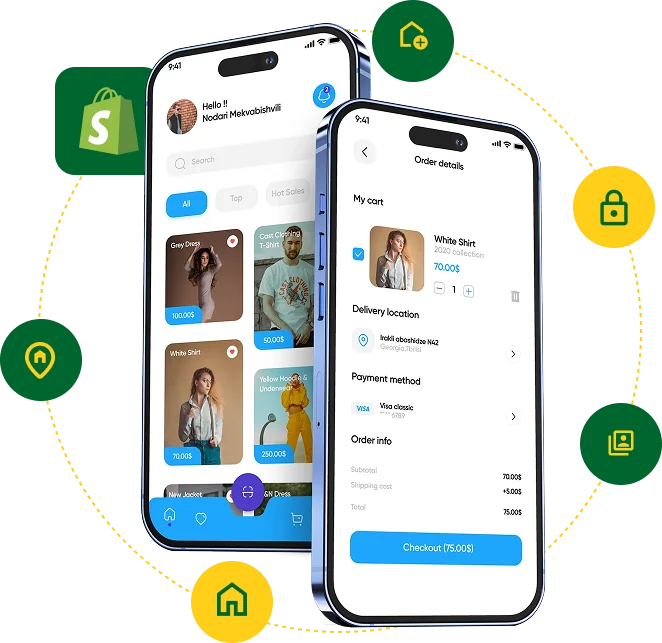
A Shopify mobile app builder is a tool that lets online retailers develop mobile applications for both Android and iOS through a seamless connection to their Shopify store. Rather than developing an application from the ground up, companies take advantage of the existing ecommerce parts, changing layouts, and the integration of the services to gain the benefits of faster launching, cost cutting on the development, and also being able to still rely on the performance while concentrating on the expansion and the customer engagement.
Common features offered by app builders
- Automatic product, collection, and inventory sync
- Ready-made home, collection, and product layouts
- Shopify checkout integration
- Push notifications and basic segmentation
- Discount and coupon support
- App store submission assistance
- Ongoing maintenance and updates
The biggest advantage is speed to launch with predictable costs.
What is custom mobile app development for Shopify?
Custom development is the practice of making a mobile application that precisely fits the user’s requirements by using Shopify APIs and creating specific backend logic. This technique demands the participation of professionals like designers, mobile developers, and QA engineers who work together to provide extraordinary user experiences, handle difficult integrations, and keep the app alive through continuous updates, testing, and performance optimization.
What custom development enables
- Fully unique UI and branded experiences
- Advanced personalization logic
- Custom workflows for subscriptions, loyalty programs, or bundles
- Thorough integrations with enterprise resource planning (ERP), customer relationship management (CRM), warehouse management system (WMS), or analytical tools
- Exceptional performance and scalability optimization
The benefit is control and differentiation, but it comes with higher cost and complexity.
In 2026, ecommerce sales are expected to account for about 21.1% of total global retail sales, up from 20.5% in 2025—showing continued expansion of online shopping’s share of the overall retail market.
Also Read: Retail Store App for Growth in the Mobile Era
Shopify Mobile App Builder vs Custom Development: Core comparison
The comparison reveals the real differences between using Shopify mobile app builders and custom development. App builders facilitate faster launch timelines, less risk, and clear costs, which makes them suitable for small and medium-sized businesses as well as aspiring brands. On the other hand, custom development gives the utmost freedom and power, but the tradeoff is a greater financial commitment, extended periods, and continuous technical responsibility.
| Factor | Shopify Mobile App Builder | Custom Development |
| Time to launch | Days to weeks | 3–6+ months |
| Upfront investment | Low to moderate | High |
| Ongoing costs | Subscription-based | Maintenance and development costs |
| Feature flexibility | Limited to platform | Highly flexible |
| Design control | Template-driven | Fully custom |
| Maintenance | Included by provider | Brand-owned |
| Risk level | Lower | Higher |
| Best suited for | SMBs & scaling brands | Mature & enterprising brands |
Cost considerations in 2026
In 2026, the cost differences between app builders and custom development are substantial. App builders provide predictable, subscription-based pricing with a minimal upfront investment, whereas custom development needs higher initial budgets, additional maintenance costs, and long-term technical resources to be able to support continuous updates and scalability.
| Cost Area | App Builder | Custom Development |
| Initial setup | Minimal | Significant |
| Development effort | Included | Major expense |
| Design iterations | Limited | Extensive |
| Testing & QA | Standardized | Deep, manual + automated |
| Updates & OS changes | Included | Ongoing responsibility |
| Feature expansion | Plan upgrades | New development cycles |
Practical insight:
Most brands underestimate long-term maintenance costs in custom builds. Builders remove that operational burden.
Speed to market: a critical advantage
Based on our experience with Shopify brands, an earlier launch of a mobile app not only secures but also gives very good competitive advantages. Brands can start to build their app install base sooner, which means that the brand’s visibility in the customer’s purchasing lifecycle also gets longer. The faster the app is installed on the customer’s phone, the sooner the brand will be able to communicate directly through push notifications alongside offers and updates that are personalized to the customers.
One more benefit of the app launch is that it coincides with the gathering of the actual user behavior data. The companies have an opportunity to monitor customer interaction with the app in the areas of browsing, searching, and buying; thus, they can make improvements based on the data collected rather than through assumptions. This approach takes less time, and it is more convenient for groups to work on the increments, designs and promotions and also to confirm the investment return faster.
Shopify mobile app builders are specifically designed to support rapid deployment. By applying widely accepted e-commerce designs, utilizing ready-to-use parts, and standardizing Shopify integrations, they cut down development and testing time to a large extent. On the other hand, custom development projects are often delayed because of changing requirements, complicated third-party integrations, numerous design iterations, and prolonged QA and app store review cycles, thus making speed to market a key factor in the competition of 2026.
Performance and user experience: does custom always win?
Not necessarily. App builders can deliver reliable and well-optimized ecommerce experiences because they are built around proven shopping flows that have been tested across many brands. These standardized patterns often result in stable performance and smooth user journeys.
Custom apps can outperform builders only when performance is intentionally prioritized and properly funded. This requires strong architecture, continuous optimization, and ongoing testing. Without that investment, custom apps may offer flexibility but not a clear performance advantage.
| UX Scenario | Better Choice |
| Standard shopping flows | App Builder |
| Storytelling-heavy brands | Custom |
| Complex navigation logic | Custom |
| Fast repeat ordering | App Builder |
| Highly experimental UX | Custom |
Customization Limits: Where Builders May Fall Short
Builders for the Shopify mobile app are very efficient for usual cases of ecommerce, but their restrictions are more noticeable as the business logic of a brand becomes more intricate. The builders are made in such a way as to cater to many merchants who have common needs, which implies that they are very much at home when the requirements are in line with the usual e-commerce processes.
Challenges arise when a brand needs highly specific functionality. Features such as complex bundle builders with custom pricing rules, advanced loyalty gamification with tiered logic, or unique subscription flows often go beyond what most builders can support. Similarly, deep integrations with ERP or CRM systems, custom operational workflows, or highly specialized analytics and attribution tracking may be restricted or unavailable.
In case these features are fundamental to your enterprise from the very start, not as future upgrades, custom development will be the path to choose. It provides complete management over the logic, connections, and data circulation without being limited by the restrictions of the platform.
Integrations: simplicity vs complexity
This table highlights how integration capabilities differ between app builders and custom development. App builders handle Shopify core data and popular marketing tools well but offer limited support for industry-specific systems and custom middleware. Custom development provides stronger flexibility for complex integrations and multi-system orchestration.
| Integration Type | App Builder | Custom |
| Shopify core data | Strong | Strong |
| Popular marketing tools | Often supported | Fully supported |
| Industry-specific tools | Limited | Fully possible |
| Custom middleware | Weak | Strong |
| Multi-system orchestration | Limited | Strong |
Ownership and long-term flexibility
This comparison shows how ownership and control differ between the two approaches. App builders place code ownership and parts of the roadmap with the platform, increasing vendor dependency but simplifying management. Custom development gives brands full ownership, greater control, and more freedom to scale, at the cost of higher responsibility.
| Aspect | App Builder | Custom |
| Code ownership | Platform-owned | Brand-owned |
| Roadmap control | Shared | Full control |
| Vendor dependency | Higher | Lower |
| Scaling freedom | Moderate | High |
Which Option Is Right for Your Brand?
The optimal solution is dependent on how your mobile application plays into your overall business strategy.
Pick a Shopify mobile app builder in case speed and efficiency are your main concerns. App builders are perfect for companies that want to get their product out quickly, manage with a fixed cost, and use standard ecommerce features that already have a track record of success. They are particularly effective when the app’s main purpose is to improve user retention, boost repeat sales, and establish a direct communication channel without the need for complicating the technology used.
If your mobile app is not merely a sales channel but rather a killer feature, then consider opting for custom development. Custom development fits well when there is a need for large-scale system integration, special workflows, or very interactive user experiences. This technique is usually selected by companies that can afford the high costs and have the patience to wait for a longer period and are willing to take on the tech responsibility for the app’s upkeep, support, and improvement in the long run.
Also Read: Top Shopify Sales Growth Strategies
A stage-based recommendation
This stage-based approach helps align mobile app strategy with business maturity. Early-growth brands benefit from app builders for fast launches and lower risk. Scaling brands often choose builder or hybrid models for flexibility, while mature or enterprise brands favor custom or hybrid solutions for deeper integrations and long-term control.
| Brand Stage | Recommended Approach |
| Early growth | App Builder |
| Scaling | Builder or Hybrid |
| Mature/Enterprise | Custom or Hybrid |
Why Shopify Brands Are Investing in Mobile Apps in 2026
By 2026, Shopify brands will put a lot of money into the development of mobile apps, as the expectations of the customers will already be way more than just mobile websites. Customers are expecting quick, user-friendly and personalized services similar to those offered by consumer apps they use every day and which are of the highest quality. Mobile applications allow the companies not only to have full control over the customer but also to keep the customer through making the purchases easy and communicating directly. The websites would still be very important for the purposes of ranking and being discovered, but the mobile apps would be the ones to take care of dealing with the customers, thus winning their loyalty and eventually becoming a channel for the company’s growth through long customer lifetime value.
Key reasons include:
- Faster performance than mobile websites: Mobile applications are more efficient by providing fast loading times, user-friendly navigation, and less hassle in browsing, cart, and checkout experiences.
- Personalized product suggestions and saved preferences: Applications leverage customer activity and past transactions to recommend suitable items, keep track of likes, and make shopping sessions easier.
- Seamless payment and quick reordering: Retained delivery addresses, credit cards, and one-click reordering have a great impact on reducing customer effort and enhancing purchase repeatability.
- Unified loyalty programs and special offers: Mobile apps offer a unique place for clients to earn rewards, get discounts, or participate in exclusive promotions that enhance their connection with the brand.
- Real-time communication via push notifications: Push notifications provide a means for instant, direct communication without having to resort to paid advertising or relying on third-party services.
The Hybrid Approach (Most Practical in 2026)
In 2026, many Shopify brands adopt a hybrid approach to mobile app development to balance speed, flexibility, and risk. Rather than committing immediately to costly custom builds, brands launch quickly using Shopify mobile app builders to start generating installs, engagement, and revenue. This approach allows teams to validate real business impact using live data. As the app proves its value, brands selectively invest in customization, scaling complexity only when necessary. This phased strategy supports sustainable growth while preserving capital.
Why the hybrid approach works:
- Faster initial launch with lower investment: App builders help brands enter the market quickly without large upfront development costs or long timelines.
- Early access to real user behavior data: Live usage data replaces assumptions, enabling smarter decisions around features, UX, and monetization.
- Selective customization based on performance: Brands invest only in high-impact features like loyalty, personalization, or navigation improvements.
- Reduced risk and controlled spending: Early-stage costs remain predictable while avoiding overbuilding features that users may not need.
- Scalable transition to custom development: Custom development is introduced only when the app becomes mission-critical or a competitive differentiator.
Conclusion
Choosing between a Shopify mobile app builder and custom development is ultimately a strategic decision, not a technical one. In 2026, brands that succeed are those that prioritize speed, efficiency, and customer lifetime value while keeping risk and costs under control. Shopify mobile app builders offer a practical way to launch quickly, validate results, and build direct engagement through mobile apps without heavy technical complexity.
Custom development remains valuable for brands that require deep integrations, unique workflows, and full ownership of their mobile experience. However, for many Shopify merchants, a phased or hybrid approach—starting simple and scaling based on real data—delivers the best outcomes.
This is where AppShopo plays an important role. AppShopo helps Shopify brands launch high-performing mobile apps quickly, focus on retention and repeat purchases, and scale app capabilities as their business grows. By choosing a solution aligned with your current needs and future goals, you set a strong foundation for sustainable growth in 2026 and beyond.
FAQs
1. Is a Shopify mobile app builder suitable for small businesses?
Yes. Shopify mobile app builders are ideal for small and growing businesses because they offer fast launches, predictable pricing, and essential ecommerce features. They help brands improve retention and repeat purchases without requiring large budgets or ongoing technical resources.
2. When should a Shopify brand choose custom mobile app development?
Custom development is best when the mobile app is a strategic differentiator. Brands needing deep integrations, unique workflows, advanced personalization, or full control over UX, performance, and data ownership benefit most from investing in custom development.
3. Can a Shopify brand switch from an app builder to custom development later?
Yes. Many brands follow a hybrid approach, launching first with an app builder to validate ROI and user behavior, then transitioning partially or fully to custom development once the app becomes mission-critical and requirements become more complex.
4. Do app builders limit performance compared to custom apps?
Not necessarily. App builders deliver optimized, reliable ecommerce performance using proven patterns. Custom apps can outperform builders only when performance is intentionally prioritized, properly funded, and continuously optimized with strong technical ownership.
5. How does AppShopo help Shopify brands in 2026?
AppShopo helps Shopify brands launch Android and iOS apps quickly, focus on retention and repeat purchases, and scale app features as the business grows—making it a practical choice for brands entering or expanding AppCommerce in 2026.
Also Read: eCommerce vs mCommerce vs AppCommerce

Pankaj Arora
Founder, AppShopo

Pankaj Arora is a technology entrepreneur and the Founder of AppShopo, with over 10 years of experience in helping businesses transform websites into high-performing mobile apps. His expertise spans eCommerce app development, Shopify and WooCommerce integrations, mobile UX optimization, and scalable app delivery. Through AppShopo, Pankaj has enabled brands worldwide to launch fast, reliable Android and iOS apps that drive higher engagement, retention, and mobile sales.