A Simple Guide to Native Mobile App Development

Mobile developers and companies are hard at work every day designing mobile applications that can satisfy the increasing demands of users. Nowadays, mobile apps have become an essential part of our lives for communication, entertainment, shopping, and work. The pace at which people are depending on mobile apps is breaking records and going beyond expectations.
Statista estimates that there will be more than 300 billion downloads of mobile apps by 2025 globally. This enormous number clearly shows that not only do we want more mobile applications, but we are also seeing incredible growth in mobile applications, with the overall mobile application market expected to grow to nearly $756 billion by 2027. These estimates show that mobile application revenues will be significantly growing across all industries.
As a result of recent rapid market expansion, most businesses today are looking for more options to improve the user experience within the mobile application space. One of these options is to build high-quality native applications using mobile development tools and platforms. Compared to other types of mobile applications (such as web, hybrid, etc.), native applications have better performance and better security. This is due to the native applications being designed to leverage all available features within the device, providing them with a competitive advantage within the current digital marketplace.
Within this guide, you will learn everything from what a native application is and how native applications work to the key benefits of native applications and the reasons why native applications continue to lead the mobile application industry.
TL;DR
- Native applications are programmed for use on either the iOS platform (Apple) or the Android platform (Google).
- As such, they provide high performance, speed, and reliability when running on these mobile operating systems.
- Native applications also enable full access to a wide variety of device functionality, including cameras, GPS, and built-in sensors.
- In addition to this, native applications provide a superior user experience to web apps or hybrid apps.
- Because of these application characteristics, native apps are ideally suited for companies that desire to create scalable, high-quality applications.
Key Points
- Mobile App growth has grown dramatically, with billions of mobile Apps downloaded across the globe, thus allowing businesses to successfully reach their target market or customers and develop relationships with them via engagement and connectivity through Mobile Apps.
- Native Apps are written to execute specifically for a particular platform, providing performance improvements with optimal execution times through OS Specific functionality.
- Native Apps adhere to OS-specific design guidelines, which enable the user to interface with the App using familiar interfaces, which create a positive user experience.
- Native Apps provide more secure environments for data loss through embedded OS features, such as data encryption and secure data storage, as well as measures to protect against vulnerabilities (or malware) and reduce risks from Cyber Threats.
- In addition, many Native Apps can be operated offline (or with low connectivity), allowing users access to key feature sets and content where there is no Internet Access.
- As Native Apps are designed to meet high-performance, resource-intensive requirements, Native Apps are the perfect type of App to utilize for Application types such as Gaming and Video Streaming Applications, as well as Enterprise Solutions that require a high degree of scalability, reliability and speed.
What Are Native Mobile Apps?
Native mobile applications are uniquely created exclusively for an operating system such as Apple’s iOS or Google’s Android OS, unlike web applications or hybrid apps, which can be used across multiple platforms. The programming languages and frameworks used to create native mobile applications are unique to the platform on which they will run. This allows for full integration of a native mobile app with both the hardware and the operating system of the device.
Developers typically develop a native mobile app for either the iOS or the Android operating system. By doing this, each app will perform optimally, will be able to easily and seamlessly utilize all of the functionality and features available through the respective devices for which the app was designed, and therefore will provide an optimal user experience. In addition to providing an optimal user experience by developing two native mobile apps, one for the iOS and one for the Android operating system, the developers can ensure that each version will provide the fastest response time, be the most stable, and have the longest ability to interact with one’s respective device.
Apps on mobile devices can be downloaded from a legitimate app source like the App Store (Apple) or Google Play. All apps that are published in these sources pass through an in-depth quality assurance cycle and rigorous security checks and must meet defined performance metrics before being available to users. Because these apps go through such thorough testing, all end-users are provided access only to safe, reliable applications that meet extremely high quality standards.
Native mobile applications provide developers with the ability to access the full capabilities of their device’s hardware through the Native Application Programming Interface (API) of each Platform, enabling application developers to build applications with advanced capabilities and features; for example, applications that access the device’s GPS feature can provide real-time location tracking to users, provide push notifications to users, use biometric authentication to validate the identity of the user, and perform background tasks seamlessly.
Additionally, because native applications are compiled to machine code, they are able to execute at a very high rate of speed (i.e., instant response) and require significantly lower processing power than web-based applications. Therefore, native applications are generally better suited for applications that require high-performance processing, including gaming, video streaming, financial technology (FinTech), and enterprise application solutions.
Also Read: Cost to Turn Shopify Website into an App
Platform-Specific Development
Native apps rely on dedicated technologies for each operating system:
The main languages to program iOS apps are Swift or Objective-C through the Xcode development environment provided by Apple. Working with these two technologies allows the programmer to use the full range of Apple architecture tools such as stable frameworks, tight security, and high-performing execution of Apple products. Besides, it ensures a uniform and easy-to-use interface on all devices.
Application development on the Android platform is done with either Java or Kotlin and uses Android Studio, along with a vast number of other libraries available through the Android Developer community. This ecosystem gives developers the ability to build applications that scale well, provide flexibility, and have many features that can be used across an entire range of different types of Android devices.
By building an application based on each operating system’s specific requirements, developers will see a smoother app to device performance; developers can make optimizations based on specific platform specifications; developers can develop security elements unique to their application and provide for seamless integration with all of the software and hardware components of the devices on which the applications run.
How Native Mobile Apps Work
Native applications or mobile device-specific apps refer to apps that are installed physically on your mobile device, mostly through official sources like the Apple App Store or Google Play Store. Since native apps run directly on the device, they tend to operate faster and more efficiently as compared to web-based applications.
Native applications use the native operating system of your mobile device via the operating system’s platform-specific APIs (Application Programming Interfaces) to communicate directly with your device. Because of this direct link to the native operating system, native applications have access to hardware features and system features without needing to go through an external layer like a web browser or other application.
This means they can fully utilize features such as the following:
- Camera: Native apps provide quick and efficient use of your device’s camera by allowing you to take photos, record video, scan QR codes and enable other functions, such as Augmented Reality (AR) and Video Calling, with very high levels of performance and low levels of delay.
- GPS: Native apps make use of built-in location services to provide precise and real-time tracking of a user’s current location(s), navigation directions, and location-based services (such as directions to nearby gas stations) as well as offer personalized content based on where a user is located.
- Microphone: Native apps have the ability to take audio input for various purposes, such as taking voice commands, recording audio (for example, an audiobook), performing video conferencing, and providing other voice-related features (such as virtual assistants and speech recognition).
- Push Notifications: Native apps can deliver real-time notifications/alerts/updates to users’ devices while they are not using the app, which increases user engagement with the app and improves communication with users.
Native applications can use Hardware and Device API’s directly to offer smooth operation and provide a seamless user experience. They are compiled natively (specifically for the platform), so they execute faster, respond to user interactions fast, and provide fluid animations.
They are able to run background processing, save data locally, and even support offline mode for some features. This will ensure reliability and the ability to continue to work, regardless of bad or no internet connectivity.
Overall, by having a tight integration of the native application with the Operating System and Device Hardware, they can perform, respond, and provide functionality far exceeding that of any other type of application.
Key Features of Native Mobile Apps
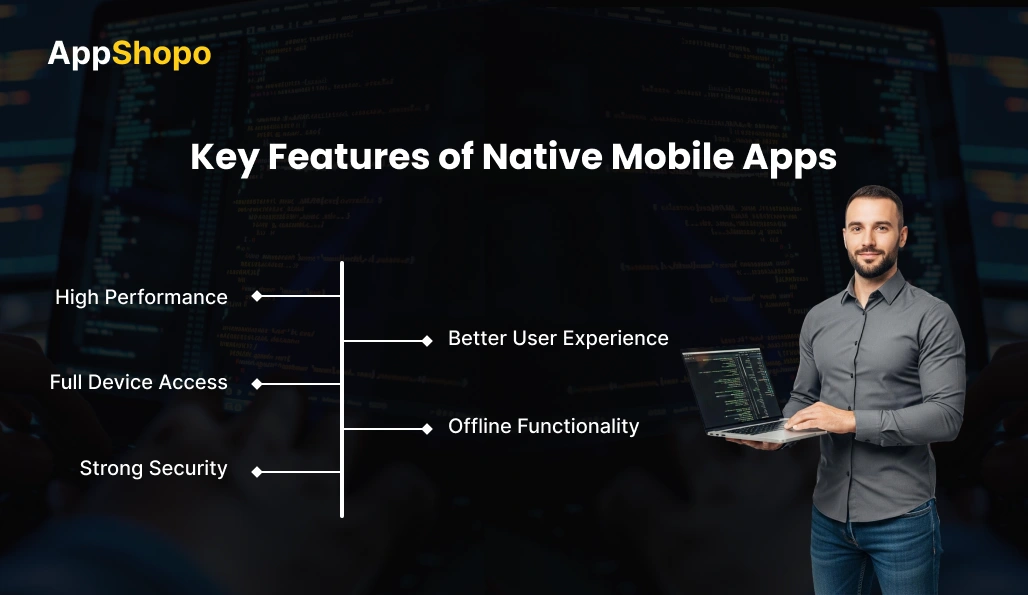
Native apps stand out because of their powerful capabilities and optimized performance. Some key features include:
1. High Performance
Native apps have been designed specifically for a platform and can therefore optimize all aspects of their operations from code execution through to UI rendering. Native apps are compiled to machine code, resulting in faster execution, faster loading, and immediate response to user actions, resulting in smooth animations, very little lag time, and efficient use of device resources (CPU and memory). As a result, native apps are well-suited for performance-based applications like video games, video streaming, and real-time applications.
2. Better User Experience
Design principles like Apple’s Human Interface Guidelines or Androids Material Design help to create a consistent look and feel across platforms visually. This way, when users use the native app, they’ll find it intuitive and engaging as the layout, navigation, and interaction are very familiar to them. In this scenario, users’ expectations regarding gestures, transitions, and UI components will be met, leading to a more natural, uninterrupted, and enjoyable experience, which in turn is likely to result in higher levels of user satisfaction and retention.
3. Full Device Access
A native application can use all the hardware and software capabilities of an operating system because there are built-in APIs available to interact with all the native features that exist on that device’s platform, including, but not limited to, the camera, GPS, microphone, various sensors, storage, Bluetooth, etc. Developers are able to use all of these features to create more advanced capabilities than just native features alone, including things such as real-time navigation, image recognition, biometric security, and IoT integration, which results in an app experience that is more engaging and interactive than ever before.
4. Offline Functionality
One more advantage of native apps lies in their ability to operate offline. Since native apps are allowed to cache or use databases to save data directly on the device, by doing so, a user is given the chance to at least view the content or carry out a particular activity without having access to the internet. Not only does this improve the value of native apps in regions where there is little or no internet, but it also guarantees a consistent and uninterrupted user experience.
5. Strong Security
The use of platform-specific security features and protocols in native applications increases security for all users. Native applications use secure data encryption methods and authenticate users by biometrics. In addition, many native applications use industry-standard data storage techniques to keep user information safe. App stores use standards to impose strict security protocols when selecting which native applications to allow into their store. By using these methods to ensure that applications are secure, it decreases the likelihood of malware, vulnerabilities, and other unauthorized access to user data, particularly when dealing with sensitive user information.
Advantages of Native Mobile App Development
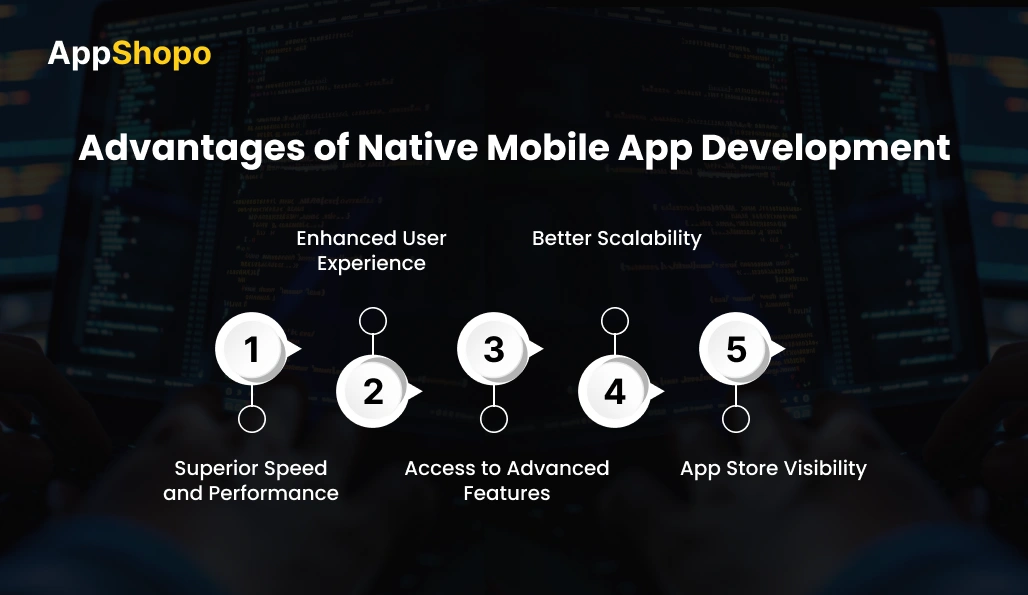
Choosing native app development comes with several benefits:
1. Superior Speed and Performance
Because of their native app build process, apps created as native apps are fast, responsive, and efficient thanks to how they were designed and developed specifically for the hardware they run on. Native apps are also compiled down to machine code for quick execution and improved performance speed. This gives users speedy loading, easy navigation, and almost no lag time for app users accessing complex apps/games/real-time services with heavy amounts of traffic or data use.
2. Enhanced User Experience
Users of native apps experience a seamless and recognizable user experience due to adherence to the design standards of their respective platforms. When users use native apps, all the user interfaces are consistent with what each platform’s device provides in terms of all of the elements, gestures, and navigation that an end user is accustomed to using. This familiarity will enhance the usability of the app, thus enhancing the user’s satisfaction while improving user engagement and retention rates.
3. Access to Advanced Features
Native applications will have access to device-specific features (i.e. camera, GPS, microphone, and sensor) and will have the highest level of capabilities for interaction between the user and the devices (i.e. push notifications and biometric identification). Developers will be able to develop more types of applications that will allow them to have more advanced capabilities (i.e. real-time tracking, secure login, and personalized user experience).
4. Better Scalability
Native applications are very scalable and flexible, which helps them provide new features, integrate more third-party services, and accommodate increasing user demands easily. The architecture of native applications is very reliable and allows long-term growth. Because of this architecture, companies can enhance and build upon their native applications continuously.
5. App Store Visibility
Publishing native applications via authorized applications stores, including the Apple App Store and Google Play Store, enhances the visibility of these applications and increases their potential to reach consumers. An application store is an authorized venue for customers to locate, purchase, provide customer feedback on, or download an application, and it provides customers with a reliable platform on which to do their research before purchasing an application. Not only does this enhance the credibility of an application, but it also allows businesses to create a larger potential audience for themselves through higher search rankings, featured apps, and user reviews.
Native Apps vs Other App Types
Understanding how native apps compare with other app types helps clarify their value and helps businesses choose the right development approach.
| Feature | Native Apps | Web Apps | Hybrid Apps |
| Performance | High – Fast, smooth, and optimized for each platform | Moderate – Depends on browser and internet speed | Moderate – Better than web, but not as fast as native |
| Device Access | Full – Access to all hardware and system features | Limited – Restricted access via browser | Partial – Can access some device features through plugins |
| Internet Dependency | Not always – Can work offline or with limited connectivity | Required – Needs constant internet access | Partial – Some features work offline |
| Development Cost | Higher – Separate apps for iOS and Android | Lower – Single codebase for all platforms | Medium – Shared codebase with some platform-specific work |
Key Takeaway
For optimal performance, speed, security and user experience, the best option is native apps. Native apps are great for high-functioning, complex applications requiring seamless integration with device hardware.
Low-cost, simple web apps work through a web browser and provide a viable solution to app development. Hybrid apps offer development solutions that fall between cost and performance with the additional benefit of compatibility across many different platforms.
When Should You Choose Native App Development?
Developing native mobile applications stands as the most effective solution for users who need superior performance and reliable operation and optimal user experience. Native applications serve as our primary recommendation because they provide three major advantages:
1. High-Performance Applications (e.g., gaming, streaming apps)
Native apps are suited perfectly for the applications that are of high speed, smooth animations, and real-time processing. Thus, gaming apps, video streaming platforms and photo processing apps with AR capabilities are what come to mind as the only ones to be capable of fast rendering with minimal lag. Native development is the key to ensuring peak performance that comes from leveraging the hardware and system resources of a device at the maximum.
2. Apps Requiring Deep Hardware Integration
If your app requires deep use of device features like camera GPS sensors, BLE, or biometric authentication, native development is the best option. Besides the fact that allows close communication with the hardware components without any trouble, it enables you to perform different functions that depend on the hardware. Some of these functions are real-time navigation, health tracking; environmental IoT setups, and secured authenticating systems.
3. Businesses Focused on Premium User Experience
Native apps are ideal for those clients whose main priority is to deliver a high-quality and beautifully designed user experience. Since they are developed by following the design guidelines of the targeted platform, they ensure that not only the navigation is very user-friendly, but also the interactions are smooth and the whole interface is very consistent. Therefore, the users will be happier, they will also use the app more, and the time that they will spend with the app will also be longer.
4. Large-Scale or Enterprise-Level Applications
Native applications are most appropriate for complicated and extensive applications that are required to manage large numbers of users, massive data sets, and advanced features. Enterprise software, financial technology platforms, and online shopping apps natively. have proven advantageous, as this method is scalable, very secure, and capable of accommodating regular updates and integrations.
Challenges of Native Mobile Apps
While native apps offer many advantages, they also come with some challenges:
1. Higher Development Cost (Separate Apps for iOS and Android)
Native app development requires developers to create separate applications for each platform including iOS and Android. Native app development requires companies to invest in multiple codebases together with necessary tools and additional development resources. The total expenses for developing native applications exceed those needed to create web or hybrid applications. This situation applies especially to startups and small businesses that possess only minimal financial resources.
2. Longer Development Time
Developing native applications involves creating them per platform, which provides additional time for the full cycle. In that manner, each phase, coding, testing and releasing, is done separately, thus increasing the length of time it takes to complete from beginning to end. Add that to the fact that an extensive and/or complicated application will likely take longer to get to the marketplace than an app that is not as extensive and/or complicated.
3. Requires Platform-Specific Expertise
Developing a native app necessitates expert level skill in the platform’s language/framework/tool thingy (e.g., using Swift for iOS or Kotlin for Android). Hiring or training people to work on both platforms is often an expense that will cause an increase in your total allocation of resources towards app development.
4. Maintenance and Updates Effort
Native apps are a bit harder to keep up to date since you need a separate update, bug fix, and feature for each platform. Typically, two versions of an app can be kept matching and updated at all times by continuous working, collaboration with developers, and spending money in assisting the consistent matching.
Yet the benefits provided by the native mobile applications in terms of stability, user experience, performance, and security often serve as a strong enough reason that many companies find them to be worth the investment.
Future of Native Mobile Apps
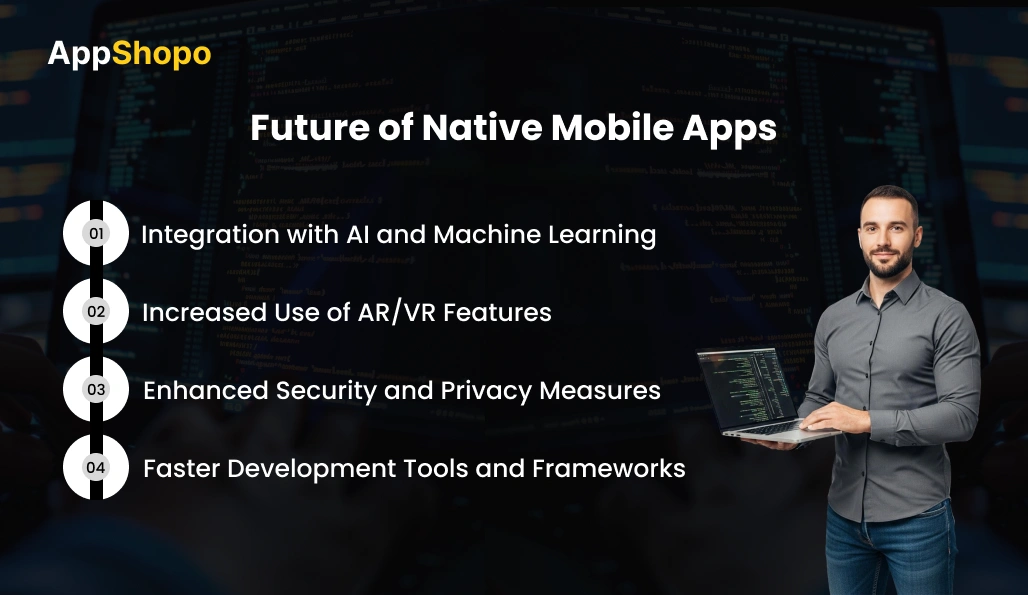
Native apps are for sure evolving and adapting to many different new innovations as mobile technology is growing rapidly. Here are some key trends that are leading native mobile app development in the future:
1. Integration with AI and Machine Learning
Artificial Intelligence (AI) and Machine Learning (ML) are gradually becoming a vital part of native apps, helping to produce intelligent and highly customized user experiences. With the help of AI features, native apps have the ability to perform a wide range of functions right at the device level, including chatbots, voice assistants, recommendation engines, and predictive analytics. This method of processing not only makes the applications more efficient but also substantially boosts the quality of the outcomes, without jeopardizing the satisfaction of users.
2. Increased Use of AR/VR Features
Augmented Reality (AR) and Virtual Reality (VR) are ways of changing the interaction of users with mobile apps. Native apps are capable of combining with AR/VR technologies in a way that is quite natural, so they can provide the users with the experiences that are immersive especially in the areas of gaming education retail, and real estate. Developers, with the help of tools such as ARKit and ARCore, are able to come up with the applications that are not only visually very attractive but also highly interactive.
3. Enhanced Security and Privacy Measures
As data privacy continues to grow increasingly important to people, developers of native apps have responded by enhancing the security implemented in their applications. Examples of enhancements include the implementation of stronger encryption protocols, the usage of biometric technology to gain access, and increased usage of local (on-device) data processing instead of server-based (cloud) solutions. Native platforms also continue to create new privacy policies or enhance existing policies in an effort to provide safeguards for user data and build user confidence.
4. Faster Development Tools and Frameworks
Currently, there are many tools and frameworks available that enable faster and more efficient development of applications for all operating systems. SDKs with improved features, component reuse, and improved debugging capabilities are enabling developers to create applications faster while still ensuring that applications perform at a high level. Modular development and automation will also help to streamline the development process.
Native mobile applications will continue to be the preferred method of choice for delivering the best performance, closely integrating with the device, and delivering the highest quality of the user experience in the future. As technology continues to evolve, native mobile applications will continue to be a critical component in developing the next generation of digital solutions.
Also Read: Best Website to App Conversion Tools
Conclusion
The most powerful way to build high-quality mobile apps is through native mobile application development. By using platform-specific technologies, native applications have the ability to perform exceptionally well and provide great user experiences while providing complete functionality for all device capabilities.
Although the amount of time and resources involved with native app development are usually higher than other development methods, the long-term benefits make this method worth the investment for companies looking for long-lasting, scalable mobile app solutions.
Appshopo provides services to transform your native app development project into an efficient final product. Appshopo develops native mobile applications for iOS, Android platforms which deliver fast, secure and user-friendly performance that meets your business needs. Appshopo provides reliable mobile app development solutions for startups and enterprises which need dependable future-ready applications.
FAQs
1. What is Native Mobile Application?
A native mobile application is software built specifically for a particular mobile operating system, such as Android or iOS. It is developed using platform-specific languages and tools, ensuring high performance, better user experience, seamless integration, and full access to device features like camera, GPS, and notifications.
2. Why are Native Mobile Applications Faster?
Native mobile apps can be much faster than other types of apps because they are designed and built for only one platform. Because of this, native mobile apps are compiled into machine code, which allows them to access the hardware of the device directly, whereas other types of mobile apps execute as interpreted code. Therefore, native mobile applications run much faster, perform more smoothly, have less time required to load, and provide users with a much more responsive experience.
3. Are Native Mobile Applications better than Web Mobile Applications?
Generally speaking, native mobile apps are better than web-based mobile applications. Native mobile apps have better performance, user experience and functionality than web-based mobile apps. Native mobile applications also provide faster performance, work offline, and can fully integrate with all the capabilities available on the user’s device. On the other hand, web-based applications are typically less expensive and easier to maintain, which makes them more suitable for basic applications and allows them to be used by a greater audience.
4. Do native applications need to have an internet connection?
Not necessarily, native application functionality can be retained when they are not connected to the web with the aid of on device data storage, though some functionalities, such as updating information in real-time or utilizing cloud-based or web-based services, do need an active internet connection to function appropriately.
5. Is the cost of developing a native application high?
As with native application development, separate applications will need to be created for use on iOS and Android devices, meaning that developing and maintaining both applications will take more time and cost more money. However, in most instances the investment in time and money spent on developing a native application for each operating system will pay off with the application providing improved performance, improved security and an overall better user experience.

Pankaj Arora
Founder, AppShopo

Pankaj Arora is a technology entrepreneur and the Founder of AppShopo, with over 10 years of experience in helping businesses transform websites into high-performing mobile apps. His expertise spans eCommerce app development, Shopify and WooCommerce integrations, mobile UX optimization, and scalable app delivery. Through AppShopo, Pankaj has enabled brands worldwide to launch fast, reliable Android and iOS apps that drive higher engagement, retention, and mobile sales.