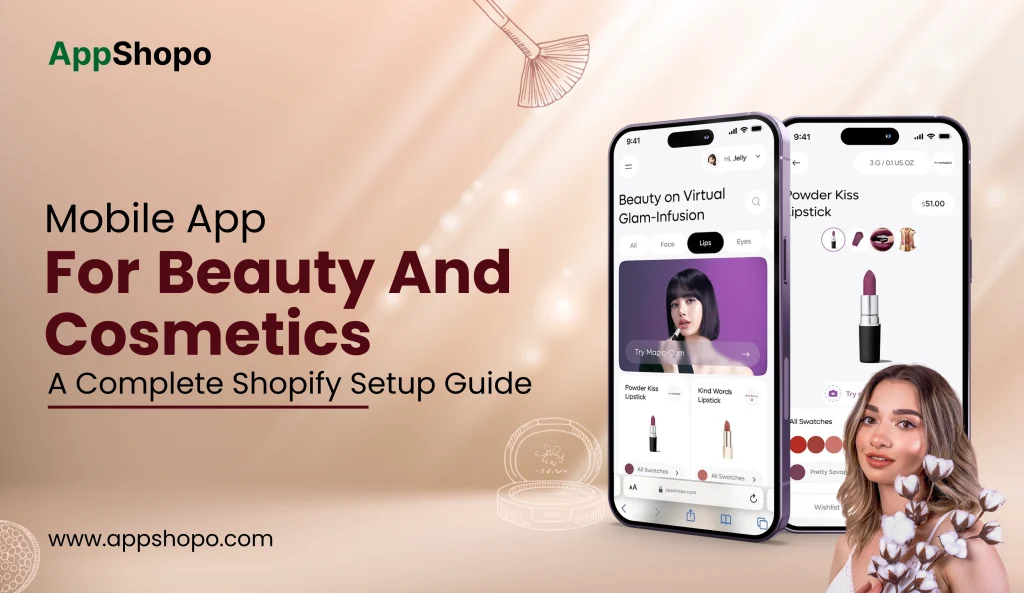
Mobile App for Beauty and Cosmetics: A Complete Shopify Setup Guide
The beauty and cosmetics sector has always been a game of innovation, trends, and emotional bonds. Still, the way customers discover, assess, and buy beauty products has undergone a complete revolution in the last couple of years. Beauty consumers today predominantly use mobile gadgets as their first point of contact with the cosmetic brands. This impacts not only the product research and tutorials but also the repeat purchases and brand loyalty.
A Shopify-powered beauty and cosmetics brand can no longer afford to have a mobile-optimized website as its only outlet. Buyers are looking for quicker services, customized recommendations, special access, and hassle-free reordering, all of which are best provided through a mobile app dedicated to them.
Shopify has served 875 million shoppers globally and powered more than US $1.4 trillion in cumulative sales through its merchants, showing the platform’s extensive reach and commerce impact.
The blog is built on our team’s familiarity with Shopify beauty and cosmetics brands, and it gives you a complete picture of the process of making a top-notch mobile application. The process includes strategic planning, assessing Shopify readiness, layout implementation, integrating features, and launching for optimizing growth that is sustainable post-launch.
Also Read: How to Turn a Shopify Store to Mobile App
TL;DR
- Beauty shoppers expect fast, personalized, mobile-first brand experiences
- Shopify websites alone cannot drive long-term beauty customer retention
- Mobile apps increase repeat purchases and customer lifetime value
- Push notifications outperform email and social media for engagement
- AppShopo simplifies launching scalable Shopify beauty mobile apps
Key Points
- A devoted mobile application allows cosmetic enterprises to create direct, customized, and repeatable client interactions beyond the cultivated online sales websites.
- Adequate Shopify store preparation is very important for smooth app functioning, real-time data synchronization, and a customer-friendly mobile shopping experience.
- Beauty-oriented, customization, and product discovery designs have a dramatic impact on the conversion rates and brand trust in mobile apps.
- Push notifications and app-only bonuses are mighty instruments for keeping customers, re-engagement, and less dependence on paid marketing channels.
- AppShopo provides a mobile app solution that is scalable, performance-oriented and designed for the long-term growth of beauty and cosmetics brands on Shopify.
Also Read: Top Shopify Sales Growth Strategies
Why a Mobile App Is Essential for Beauty and Cosmetics Brands
The process of buying beauty and cosmetics is very personal, mainly because it is a visual and habitual activity. The customers do not limit themselves to a single product but rather incorporate it into their daily routines, buy the basics again, try out the newest releases, and remain emotionally attached to the trusted brands. A mobile app supports this behavior far more effectively than a mobile website.
A mobile application, in contrast to websites, totally depends on paid traffic and external media that are heavily used. It establishes a direct, owned channel between the brand and the customer. It gives beauty brands the opportunity to offer a quicker, more interactive shopping experience that is not just coming from generic browsing but feels personalized according to the individual needs.
A well-built beauty and cosmetics mobile app enables brands to:
- Deliver a faster and smoother shopping experience: Native mobile apps offer quick loading times, are more comfortable for the cashier, and have a more attractive user interface that is very important for beauty content since it is very visual.
- Personalize content according to skin type, preferences, and purchase history: Display product relations, regimens, and suggestions via an app to charm customers, thus raising a conversion rate.
- Communicate with customers directly via push notifications: Brands can promptly announce new products, replenish stocks, provide special discounts and remind customers of their routines without depending on email open rates or social media algorithms for communication.
- Encouragement of periodic purchases with reminiscing, rewards, and exclusivity: Mobile apps are always associated with higher repeat purchase frequency, and reminders for replenishment, app-only discounts, and loyalty rewards are some of the ways how mobile apps do that.
- Build a long-term connection with a brand that is not reliant on paid ads and social media: Beauty brands that manage the customer relationship are less affected by the increasing cost of ads and unstable third-party channels, as they successfully create customer loyalty that lasts over a long period.
At its core, a mobile application turns a beauty company that focuses mainly on sales into an engaging digital ecosystem that is based on relationships. In this ecosystem, the customer engagement, retention, and lifetime value are all increased gradually over time.
Step-by-Step Guide to Building a Mobile App for Beauty and Cosmetics on Shopify
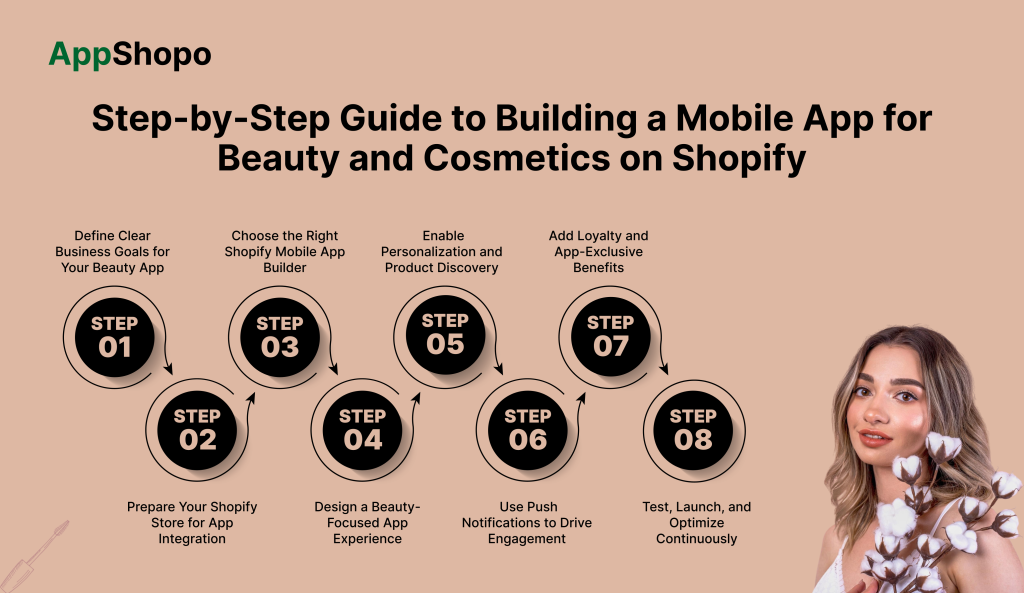
Creating a good beauty and cosmetics mobile app is a time-consuming process with many parts that must be done one after the other. The foundation for our team’s previous partnership with Shopify beauty brands is built on the concept of success through the articulation of clear business goals, proper preparation of the Shopify store, choosing the right app platform, and applying beauty-focused design, personalization, and continual optimization. This kind of approach always brings along great performance, better customer involvement, and long-lasting growth.
Step 1: Define Clear Business Goals for Your Beauty App
Prior to developing a mobile application for beauty and cosmetics, brands need to explicitly state the purposes the application is going to serve. According to our team, apps that are built with clear commercial and retention goals have better performance capability than those done aimlessly. Clear objectives influence the selection of features, the design process, and the overall growth strategy.
- Increase repeat purchase frequency
- Improve customer lifetime value (CLTV)
- Market the latest or limited editions.
- Reduce its dependency on selling through paid advertising.
- Advance the brandʼs reliability and loyalty.
Step 2: Prepare Your Shopify Store for App Integration
Your Shopify store acts as the operational backbone of a mobile app for beauty and cosmetics. Based on our implementation experience, even the best-designed apps underperform if the store setup is weak. Proper preparation ensures stable syncing, faster performance, and a frictionless customer experience inside the app.
- Mobile-optimized product images
- Clear, benefit-focused descriptions
- Well-structured collections and categories
- Accurate inventory and variants
- Optimized checkout and payments
Step 3: Choose the Right Shopify Mobile App Builder
Not all app builders are suited for beauty and cosmetics brands. From working with multiple Shopify merchants, we’ve seen that the right app platform must balance visual storytelling with performance and scalability. This decision directly impacts app speed, flexibility, and long-term usability as your brand grows.
- Real-time Shopify synchronization
- Native mobile speed and performance
- Push notifications for engagement
- Flexible branding and customization
- Scalable infrastructure for growth
Step 4: Design a Beauty-Focused App Experience
The quality of a design is a major factor in consumer perception of a mobile app dedicated to beauty and cosmetics. Based on our experience, consumers of beauty products link the aesthetic appeal and the visibility of the products to the brand’s quality and credibility. An application that is aesthetically pleasing will lead to the customers’ curiosity, their trust, and consequently, their repeated usage.
- Clean, premium layouts
- Easy navigation with minimal friction
- Strong product visuals
- Highlight bestsellers and routines
- Consistent brand colors and fonts
Step 5: Enable Personalization and Product Discovery
The key driver of success for any mobile app in the beauty and cosmetics area is personalization. Personalized recommendations and curated collections, as per user behavior patterns that we have noticed, are great in alleviating the customer’s decision-making effort. Personalization makes the customers feel recognized, thus increasing the customer’s readiness to buy and the customer’s loyalty to the business in the long run.
- Personalized product recommendations
- Collections by skin type or concern
- Recently viewed and repeat products
- Smart bundles and offers
- Improved discovery experience
Step 6: Use Push Notifications to Drive Engagement
Push notifications are considered the most powerful engagement channels inside the beauty and cosmetics mobile app. According to our experience, brands that follow push notifications’ strategy get many more repeat purchases and are more re-engaged in comparison with email-based marketing, but at the same time, they control their marketing costs effectively.
- New launch and restock alerts
- Flash sales and limited offers
- Replenishment reminders
- Loyalty rewards and exclusives
- Re-engagement of inactive users
Step 7: Add Loyalty and App-Exclusive Benefits
Push notifications may be found in a mobile app for beauty and cosmetics as one of the most efficient ways of engaging users. From our experience, those brands that apply push notifications in a well-planned manner succeed in getting more repeat purchases and re-engagement in comparison to email-heavy strategies, all the while keeping their marketing expenses within manageable limits.
- Reward points for purchases
- App-only discounts
- Early access to collections
- Special offers for loyal customers
- Increased customer retention
Step 8: Test, Launch, and Optimize Continuously
The opening of a beauty and cosmetic mobile app is just the start. According to actual launches, continuous testing and optimization are necessary for keeping performance and relevance. User behavior monitoring and feature refinement keep the app developing in line with customer expectations and business growth.
- Test checkout, syncing, and usability
- Validate push notification delivery
- Ensure app store compliance
- Analyze user behavior data
- Optimize features and campaigns regularly
By 2025, mobile phones accounted for 77 % of e-commerce website visits, showing how dominant mobile devices are in online shopping behavior.
Key Features Every Beauty & Cosmetics Mobile App Must Have
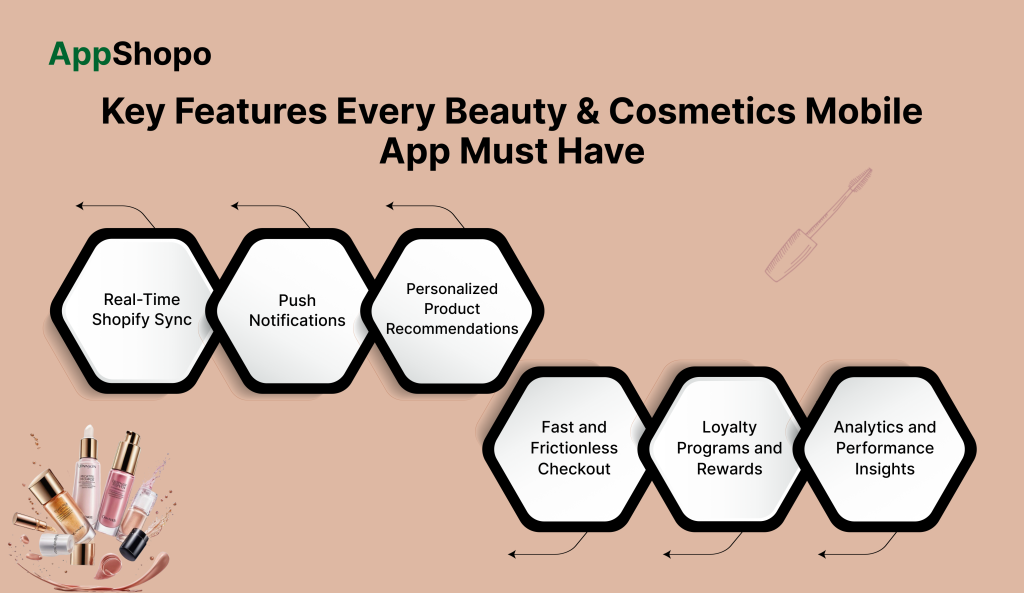
The success of a mobile app for beauty and cosmetics is not indicated by the number of features it possesses but rather by the effectiveness of those features in supporting customer behavior, retention, and eventually long-term growth. Real-world experience has shown that the following features are necessary for creating a beauty app with excellent performance on Shopify.
1. Real-Time Shopify Sync
Real-time synchronization guarantees the same level of consistency concerning products, pricing, inventory, customer data, and orders across Shopify store and mobile app. This eliminates the problems of buying unavailable items, pricing conflicts, or slowness in processing orders. For cosmetics companies that keep launching and restocking their products, real-time sync is of utmost importance for precision in operations and building customers’ trust.
2. Push Notifications
The beauty application push notifications are very powerful and effective user engagement tools. They immediately notify the companies regarding new arrivals, restocks, limited-time discounts, and reminders for repurchase. Unlike emails and social media, push notifications are delivered directly to customers’ devices, which results in faster responses and increased repeat purchases.
3. Personalized Product Recommendations
The modern consumer in beauty insists on personalization. The applications need to suggest items considering the customers’ browsing history, past purchases, skin characteristics, or likes. It is not only that personalized suggestions drive away decision fatigue and elevate sales rates but also that such shopping feels less like a general one and more like an individual experience, which is critically needed in the area of skin care and make-up.
4. Fast and Frictionless Checkout
Speed is the major factor in mobile commerce. Not only that, a rapid and comfortable checkout procedure reduces the number of customers who abandon their shopping carts but also increases sales. The presence of choices like storing various addresses, choosing one payment option, and one-touch checkouts has made a seamless buying trip, more so for the beauty customers who have been there before.
5. Loyalty Programs and Rewards
The beauty industry largely relies on repeated sales for its success. Customer retention, through the offering of rewards points, tiered advantages, and discounts only for app users, is made easier by incorporating loyalty programs in the marketing strategy. A mobile application acts as a non-intrusive medium where the tracking of rewards and loyalty reinforcement are done smoothly without creating any barriers.
6. Analytics and Performance Insights
Brands understand in a very clear way the methods of customer interaction with the application through analytics. By means of data like product views, conversion rates, repeat purchases, and the efficacy of push notifications, brands are enabled to take decisions based on data. Subsequently, the beauty brands can endlessly enhance content, campaigns, and the user experience, thus achieving better results.
How a Mobile App Improves Retention & Lifetime Value in Beauty
While websites are effective for acquisition, mobile apps excel at retention. In the beauty and cosmetics industry, where routines, replenishment, and brand loyalty matter, a mobile app plays a direct role in increasing customer lifetime value (LTV) and reducing long-term acquisition costs.
1. Encourages Repeat Purchase Behavior
There are usually set times when beauty products are bought again. A mobile app highlights past purchases, alerts for restocking, and provides exclusive incentives to make reordering very easy. All this convenience leads to more frequent purchases without the need for an extra marketing budget.
2. Supports Habit-Driven Beauty Routines
Skincare and beauty routines are formed through habits. By making the brand always visible on the consumer’s device, giving timely reminders, and displaying routine-based collections, mobile applications support these habits. Gradually, the application turns into a customer’s daily or weekly beauty trip.
3. Reduces Customer Acquisition Cost (CAC) Over Time
With the rising cost of paid advertising, it is not sustainable to depend entirely on ads. A mobile application avails re-engagement of customers to brands through push notifications and in-app campaigns directly, thus making repeat sales much cheaper than through the usage of paid channels.
4. Builds an Owned Audience
Unlike social media or marketplaces, a mobile app gives brands full ownership of their customer relationship. There are no algorithm changes, platform fees, or visibility limitations. This owned channel enables consistent engagement, long-term communication, and predictable revenue growth.
5. Increases Customer Lifetime Value (LTV)
By combining personalization, loyalty rewards, push notifications, and ease of reordering, a mobile app increases how often customers buy and how long they stay connected to the brand. Higher engagement naturally leads to higher lifetime value and stronger brand advocacy.
Conclusion
The beauty and cosmetics mobile application is already considered a necessity in the competition instead of a luxury. Nevertheless, the app’s performance is determined by the quality of its building, its optimization, and the alignment with the Shopify store and brand objectives.
AppShopo gives power to beauty and cosmetics brands to create high-performance Shopify mobile apps that are speed, usability, and retention focused. AppShopo provides brands with customer loyalty and repeat buying through smooth Shopify integration, strong push notifications, easy-to-use design, and the ability to grow.
If the beauty brand wishes to lessen its reliance on paid advertisements, improve the customer lifetime value, and gain full control over the mobile customer journey, then AppShopo will be the perfect partner to support its future growth plans.
FAQ
1. Do beauty and cosmetics brands really need a mobile app?
Yes. A mobile app for beauty and cosmetics helps brands increase repeat purchases, deliver personalized experiences, and build direct customer relationships—something mobile websites alone struggle to achieve in a competitive, retention-driven beauty market.
2. Is a mobile app better than a mobile-optimized Shopify website?
A mobile app offers faster performance, push notifications, personalization, and loyalty features that websites cannot match. Apps are significantly more effective for retention, reordering, and long-term customer engagement in beauty and cosmetics
3. How long does it take to launch a Shopify beauty mobile app?
Most Shopify beauty apps can be launched within a few weeks, depending on store readiness, design customization, and app store approvals. Proper Shopify preparation significantly speeds up development and ensures a smoother launch process.
4. How do push notifications help beauty brands grow?
Push notifications allow beauty brands to send instant alerts for launches, restocks, offers, and reminders. They outperform email and social media by driving higher engagement, faster responses, and increased repeat purchases at lower marketing costs.
5. Are mobile apps expensive to build and maintain?
Modern Shopify app builders make launching a mobile app for beauty and cosmetics cost-effective. Compared to rising ad spend, mobile apps often deliver higher ROI by improving retention, customer lifetime value, and owned audience engagement.

Pankaj Arora
Founder, AppShopo

Pankaj Arora is a technology entrepreneur and the Founder of AppShopo, with over 10 years of experience in helping businesses transform websites into high-performing mobile apps. His expertise spans eCommerce app development, Shopify and WooCommerce integrations, mobile UX optimization, and scalable app delivery. Through AppShopo, Pankaj has enabled brands worldwide to launch fast, reliable Android and iOS apps that drive higher engagement, retention, and mobile sales.