How to Take Your Shopify Brand Global in 2026: A Complete Expansion Guide

Global trade has turned out to be a primary growth channel that modern brands cannot do without. Customers in 2026 will no longer be limiting their buying to local vendors; they will be hunting for first-rate items from the brands of the entire globe. The shift has unlocked a major door for merchants using Shopify to go global and create revenue streams that are sustainable and diversified.
Shopify is now one of the world’s most powerful selling platforms and has developed quite a few technologies that support an international payment system, set different prices according to currencies, make storefronts accessible to various locations, and manage huge operations. Nevertheless, just technology is not always enough to succeed. A global reach necessitates not only a roadmap but also an operational capacity and a thorough understanding of the local customer expectations.
According to Wikipedia, mobile commerce now accounts for the majority of global eCommerce traffic, especially in mobile-first regions. Shopify further reports that it enables merchants to sell across 175+ countries, making global expansion both accessible and scalable for brands in 2026.
This blog explains how to build and operate an international Shopify brand in 2026 using a simple, practical, step-by-step framework. The blog very much reflects the experiences our group has had with Shopify brands in various areas, sectors, and different levels of development. Rather than just relying on theorizing or conducting brief trials for expansion, the blog is centered around the strategies that have been tried and tested for sustained growth, customer loyalty, and the ability to operate in global markets without disruptions and on a larger scale than before.
TL;DR
- Global expansion helps Shopify brands unlock new demand beyond saturated domestic markets.
- Shopify supports international selling, but strategy and execution drive real success.
- Market selection, localization, and payments are critical to global conversions.
- Mobile-first experiences significantly improve international engagement and retention.
- Sustainable global growth depends on retention, not just customer acquisition.
Key Points
- Assess Shopify store readiness before expanding to avoid scaling operational issues.
- Go through international marketplaces in a smart way counting on demand, logistics, and data as your allies.
- Adapt price, content, and payment process to establish a connection with customers all over the world.
- Build reliable shipping and fulfillment to support repeat international purchases.
- Track market-level performance metrics to optimize and scale profitably.
Why Global Expansion Matters for Shopify Brands
Worldwide sales have not only opened up new markets but also led to price hikes in saturated areas to maintain the same level of spending. For most Shopify brands, the first step of the domestic market going slow happens at this stage.
In 2026, world expansion will be significant because global customers have developed an unprecedented level of comfort with purchasing from overseas brands. Logistics, digital payments, and mobile commerce have taken away most of the barriers that made the international market inaccessible. Shopify, with its integrated international selling platform, is the one that takes away the pain of building an international sales infrastructure from scratch.
Not just in terms of revenue, but also in terms of global market economies, one of the ways that global expansion guards against risk for Shopify brands is through the diversification of markets. A certain region may be going through an economic or seasonal slowdown, but that will not affect international markets, which then can be used as a stabilizer for the overall performance.
A Step-by-Step Framework to Take Your Shopify Brand Global
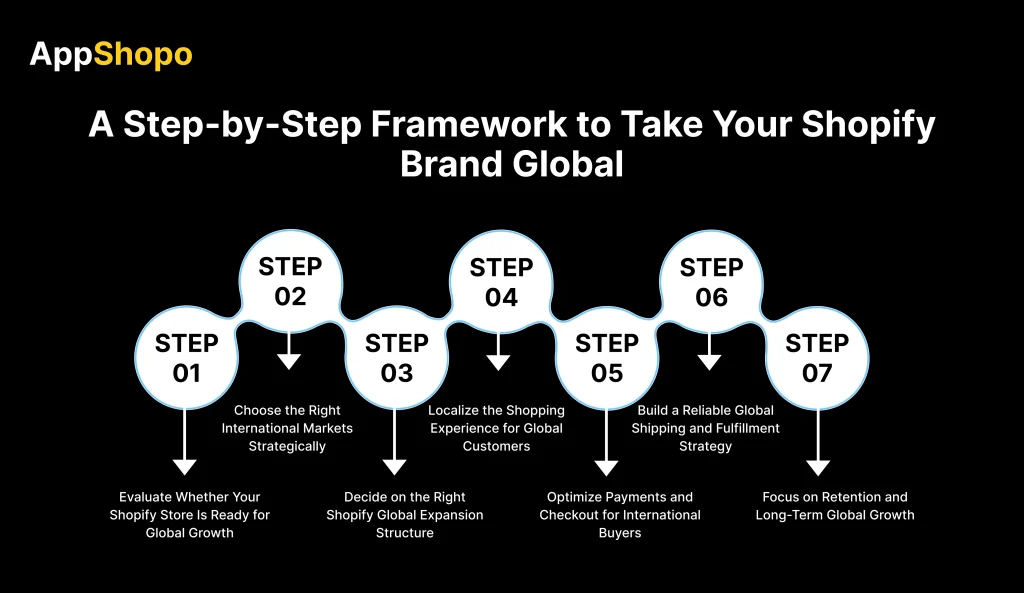
Going global with a Shopify brand is not only about vision but also about an organized and strict approach. The next seven steps illustrate a realistic method for brands to assess their readiness, select suitable markets, adapt experiences to local tastes, and responsibly increase their operations. Risk reduction, better execution, and sustainable global growth rather than short-term expansion are the main focuses of each step.
Step 1: Evaluate Whether Your Shopify Store Is Ready for Global Growth
Your Shopify store should be strong from the operational side before going global. The worldwide expansion leads to a rise in the complexity level in the areas of inventory, fulfillment, customer support, and marketing. When the base is not strong, the issues will be huge in no time.
A Shopify store that’s ready for the global market generally has steady sales, good demand, and reliable operations. The company website’s performance should be fast on mobile devices, payment should be easy, and product placement should be easy to understand. Pricing should already include the costs for margins, shipping, and returns.
Also, it is essential to verify whether your internal personnel are capable of handling the increased operational demands. Resurrecting and dealing with the management of these challenges right from the start does not only mean that you will be saving yourself but also the company from making costly mistakes later on.
Key readiness checkpoints:
- Reliable inventory and order fulfillment
- Optimized mobile and checkout experience
- Clear brand messaging and pricing strategy
- Scalable customer support processes
Also Read: Shopify Store to Mobile App
Step 2: Choose the Right International Markets Strategically
Among the most critical errors committed by Shopify brands is the simultaneous entry into many markets. The top global brands choose their markets depending on data, not on their own ideas.
The selection of the market should look at the factors like demand, competition, shipping and regulatory requirements. By analyzing the existing traffic data, international inquiries, and past orders, the market where interest is already present can be identified. A launching pad made of markets that have language or cultural similarities usually helps in reducing friction during the initial phase of expansion.
Reliability and cost of shipping are also two very important factors. Those markets which have predictable logistics and reasonable delivery times are easier to serve and are therefore likely to generate high customer satisfaction. The payment methods should be those which are supported by Shopify in order to have smooth checkout experiences.
Market selection factors:
- Product demand and category fit
- Shipping timelines and fulfillment reliability
- Local payment preferences
- Regulatory and tax complexity
- Competitive landscape
Step 3: Decide on the Right Shopify Global Expansion Structure
Shopify offers flexibility in how brands structure their international operations. Choosing the right setup ensures scalability without overwhelming internal teams.
Numerous brands originate from one and the same Shopify store that is set up for selling internationally. Amazing thing about this way of doing things, besides being able to manage products, stock, and content in one place, is that it also enables the use of several currencies and languages at the same time. The intra-continental market scenario changes in terms of the volume of transactions and the sales of products, so some brands open their stores in certain locations, and, on top of that, their localization efforts in the lucrative markets are even more precise.
Choosing the proper architecture is dependent on the size of the business, the available capital and the future plans. Getting into complexity too early raises costs and the likelihood of operational failure.
Common Shopify expansion models:
- Single global store with international settings
- Separate regional stores for major markets
- Hybrid approach combining both
Step 4: Localize the Shopping Experience for Global Customers
Localization is the main factor affecting conversion rates. It is a fact that customers tend to feel more inclined to buy when the shop appears to them as friendly and trustworthy. Localization is a process that consists of changing the language, prices, images, and message for every single market. It is not enough just to translate the content. The product descriptions, promotions, and customer communication should reflect the culture and the local buying habits.
By indicating the prices in the local currency, friction is reduced and at the same time, transparency is increased. Letting customers know shipping costs, delivery times, and the return policy are also means to gain their trust. Localization creates an impression among international customers that they are valued and not considered a necessary evil.
Core localization elements:
- Language-specific content
- Local currency pricing
- Region-appropriate imagery and messaging
- Transparent shipping and returns
Step 5: Optimize Payments and Checkout for International Buyers
The checkout experience is a major contributor to the conversion rates globally. Customers from around the world are pretty quick to leave their carts when payment options that they prefer are not provided or when the pricing is uncertain.
By the year 2026, customers are going to want several different payment options like local cards, digital wallets, and “buy now pay later” solutions, to be available. Shopify has a wide array of payment options for different countries, but they have to be set up properly for each particular country.
Being open about the whole process is just as critical. To steer clear of misunderstandings, taxes, duties, and the costs of shipping should all be displayed at the checkout. A fast, mobile-friendly checkout creates trust and eliminates the barriers for customers from the global market.
Checkout optimization priorities:
- Support for local payment methods
- Transparent pricing and taxes
- Mobile-first checkout design
- Secure and familiar payment experience
Step 6: Build a Reliable Global Shipping and Fulfillment Strategy
Cross-border product movement is one of the most difficult things to do in global business. Customer satisfaction and their chances of coming back are mainly determined by three factors: delivery speed, cost, and reliability.
Most of the Shopify merchants opt for one of the three options: centralized, regional, or hybrid fulfillment model. Centralized fulfillment is manageable during initial stages, but it could cause slowness in the delivery times. On the other hand, regional fulfillment speeds delivery but requires more complex inventory management.
No matter what model is chosen, communication must be very clear. Customers have to be informed about the delivery date of their orders, and the tracking process should be very easy. Moreover, a simple returns process contributes to the building of trust.
Fulfillment considerations:
- Delivery speed versus cost balance
- Reliable carriers and tracking
- Transparent delivery timelines
- Simple international returns
Step 7: Focus on Retention and Long-Term Global Growth
Acquiring international customers requires significant investment. Retention ensures that investment pays off over time.
The customer-centric method that was not limited to a single sale but rather aimed at the creation of lasting relationships was already in place by the year 2026 for the brands that had won with Shopify. They are dependent on customer retention through individualized communication, uninterrupted post-purchase assistance and engagement techniques that are tailored to the specific areas and that efficiently turn occasional buyers into regular customers.
The application of retention methods not only decreases the dependence on paid ads but also raises the lifetime value in all markets. Companies that make retention practices their first choice are in a position to go global while at the same time getting more stability.
Retention strategies include:
- Personalized follow-up communication
- Loyalty and repeat-purchase incentives
- Consistent global customer experience
- Ongoing value beyond the first order
How Mobile Commerce Accelerates Global Shopify Growth
Mobile commerce has shifted its position from being a mere supportive channel to being the very base of the eCommerce market’s global expansion. The website performance on mobile devices influences the success of entering and growing in the international market directly for Shopify-based brands. A comprehensive description of the three pillars that turn mobile commerce into a growth accelerator for global Shopify brands is given below.
1. Mobile Commerce as the Primary Growth Engine for Global Expansion
In numerous international markets, particularly in Asia, Africa, and Latin America, mobile devices are the primary and frequently exclusive means of internet access for customers. Desktop usage is almost nonexistent, whereas smartphones rule the roost for discovering, comparing, and making purchases of products.
This truth is a straightforward directive for brands on Shopify:
If your mobile experience is unsuccessful, your global strategy is unsuccessful.
Mobile-first commerce accelerates growth by:
- Easing discovery: Social media ads, influencer links, and chatting applications are all opened directly on mobile phones.
- Increasing conversion rates: Quick load times, finger-friendly navigation, and easy checkout processes cause less abandonment.
- Making real-time interaction possible: Brands can now communicate instantly through push notifications, SMS, and in-app messaging even if they are in different time zones.
- Encouraging repeat actions: Mobile shoppers are not only buying more often but also making smaller purchases, which eventually lead to increased lifetime value if experiences are tailored.
When Shopify stores prioritize mobile UX, optimized product pages, localized mobile payments, and fast checkouts, they unlock markets that desktop-first brands struggle to reach.
2. Measuring and Optimizing Global Performance on Shopify
It is impossible to manage global expansion with the help of mixed up or averaged data. Different countries show different performances mainly because of the variations in the mentioned factors i.e. culture, purchasing power, logistics, and device behavior.
Successful Shopify brands consider every market as a separate business unit.
The following vital metrics should be kept an eye on for each region:
- Conversion rate by country: Identifies where mobile UX or pricing needs improvement.
- Average order value (AOV): Reveals purchasing behavior differences across regions.
- Customer acquisition cost (CAC): Helps evaluate marketing efficiency per market.
- Shipping speed and fulfillment performance: Directly impacts mobile shopper trust and repeat purchases.
By tracking these metrics individually, brands can:
- Optimize pricing and promotions locally
- Improve checkout and payment options per region
- Adjust logistics partners where delivery friction exists
- Invest more aggressively in high-performing markets
This continuous optimization transforms global expansion from a risky experiment into a scalable, data-driven growth system.
3. The Long-Term Strategic Value of Going Global on Shopify
Global expansion is not just about short-term revenue; it is a long-term strategic investment in brand durability.
Shopify brands that expand internationally gain:
- Diversified revenue streams: A single economy or region is no longer the sole revenue source.
- Stronger brand equity: Globality, in a way, enhances the company’s trustworthiness and legitimacy.
- Operational resilience: The gradual decline in local market demand is countered by the increase in other places.
- Competitive defensibility: The international infrastructure already set up is hard for new competitors to copy.
In 2026, Shopify brands that are globally known and already have their presence everywhere will still be the local competitors that are only selling locally and cannot survive because they have not yet adapted to localization, logistics complexity, and mobile-first customer behavior by then.
Gradually, this global presence gives the brands a sustainable competitive advantage, which allows them to grow quicker, ride out the ups and downs of the market, and be relevant for a long time.
Also Read: eCommerce vs mCommerce vs AppCommerce
Conclusion
One of the best ways to promote sustainable growth is to take your Shopify brand global in 2026. The factors that can lead to success are preparedness, market choice based on strategy, proper localization, dependable fulfillment, and customer retention as a primary focus.
Shopify has given the tools that are necessary for international selling, but the disciplined execution and continuous optimization are the ones that will eventually give long-term results. This is where solutions like AppShopo become highly important. Through the development of high-performance mobile apps for Shopify brands, AppShopo helps the companies to optimize their global customer engagement and thus drive repeat purchases via direct communication; hence, retention-led growth among worldwide markets is supported by AppShopo.
Companies that leverage the global e-commerce capabilities of Shopify along with the customer retention tools like AppShopo are in a better situation for making their presence felt beyond borders, creating strong customer connections, and staying in competition for a long period. The global market growth is primarily about smart expansion and not just going on a worldwide spree.
FAQs
1. Would expansion into global markets be a good decision for Shopify brands in 2026?
Yes. In 2026, cross-border commerce is standard behavior for consumers. Logistics networks are faster, international payments are frictionless, and Shopify offers mature tools for multi-currency, localization, and international operations, making global expansion a scalable and strategic growth decision.
2. What are the necessary steps a Shopify brand must take before entering international markets?
Before going global, brands must ensure stable operations, mobile-optimized storefronts, reliable fulfillment partners, and transparent pricing. Internally, teams should prepare for multiple time zones, customer support expectations, tax compliance, and operational complexity to avoid growth bottlenecks as demand scales.
3. Can small or medium-sized Shopify brands succeed with international selling?
Absolutely. Shopify enables small and mid-sized brands to sell globally without enterprise-level infrastructure. By starting with one or two markets, validating demand, and gradually scaling localization, payments, and fulfillment, smaller brands can expand internationally in a controlled, profitable, and low-risk manner.
4. How much localization is required to succeed globally on Shopify?
Localization is essential for trust and conversions. Customers expect local language, familiar pricing, regional payment methods, relevant messaging, and realistic delivery timelines. Even partial localization significantly improves credibility, while fully localized experiences consistently outperform generic global storefronts in conversion and retention.
5. How can Shopify brands maintain profitability while expanding globally?
Profitability comes from selecting the right markets, maintaining transparent pricing, optimizing shipping costs, and delivering fast mobile experiences. Strong retention strategies, such as repeat purchase incentives and personalized communication, increase customer lifetime value, ensuring global growth remains sustainable rather than cost-heavy.

Pankaj Arora
Founder, AppShopo

Pankaj Arora is a technology entrepreneur and the Founder of AppShopo, with over 10 years of experience in helping businesses transform websites into high-performing mobile apps. His expertise spans eCommerce app development, Shopify and WooCommerce integrations, mobile UX optimization, and scalable app delivery. Through AppShopo, Pankaj has enabled brands worldwide to launch fast, reliable Android and iOS apps that drive higher engagement, retention, and mobile sales.