Dropshipping 2026: Definition, Process & How It Works Step-by-Step
The dropshipping model has become one of the most accepted worldwide eCommerce business methods. It initially aimed to sell products over the Internet with minimum costs but has since grown to become a sophisticated retail strategy consisting of global suppliers, automation, and digital-first consumer behavior. By 2026, dropshipping is no longer about opening stores quickly but developing brands that are customer-oriented and sustainable.
The main reason for dropshipping’s continued appeal to entrepreneurs is its provision of a simpler path to online business, which is cut off in many traditional ways. So, there is no need for you to produce goods, rent storage spaces, or arrange logistics for shipping. Manufacturing, storing, and shipping are thus left to suppliers, while you do the marketing, pricing, and customer experience.
On the other hand, the dropshipping market in 2026 will be tougher than ever. The quality of speed, trust, and usability on mobile that customers expect is now substantially raised. Winning will, therefore, require a profound understanding of the dropshipping model and smartly implementing it in a way that sees the business growing over the long term.
All explanations, insights, and best practices shared in this guide are written based on our team’s experience working with eCommerce and dropshipping businesses, along with industry-aligned practices commonly used by successful stores today.
TL;DR
- Mobile-first shopping defines customer expectations in 2026
- Shopify apps outperform mobile websites in speed and UX
- Fashion brands gain higher engagement through app experiences
- Push notifications drive repeat purchases and loyalty
- Shopify apps are now a growth necessity, not an add-on
Key Points
- Mobile apps load faster and convert better than mobile browsers, delivering smoother experiences that reduce friction and increase completed purchases.
- In-app features improve retention and lifetime value by encouraging repeat visits, loyalty behavior, and consistent engagement beyond one-time transactions.
- Personalized shopping journeys boost fashion brand performance through tailored recommendations, curated collections, and behavior-driven experiences shoppers expect in 2026.
- Apps enable direct communication without paid ads using push notifications and in-app messaging to reach customers instantly and cost-effectively.
- A Shopify app strengthens long-term brand competitiveness by future-proofing mobile strategy and meeting evolving customer expectations in app-first commerce.
What Is Dropshipping?
Dropshipping is a cutting-edge strategy in eCommerce that permits a merchant to sell without having a physical store stocked with products because the supplier is the one sending the goods. Therefore, the merchant, after getting a purchase order from a customer, sends the order to the supplier along with the shipping information, and then the supplier himself packs and ships the product to the end customer.
In a modern dropshipping business:
- The seller owns the brand and customer relationship
- The supplier manages inventory and logistics
- The seller controls pricing, marketing, and experience
The main reason for the change in business practice to dropshipping is that it has freed the entrepreneurs from the previous restrictions of investing in and managing warehouses and allowed them to focus on the areas of growth, branding, and customer engagement.
The year 2026 sees dropshipping at its zenith which is built on platforms like Shopify and aided by mobile apps that enable repeat purchases, quicker checkouts, and personalized interaction, the areas where AppShopo is of great importance.
Understanding the Dropshipping Business Model
The dropshipping business model is based on an easy yet strong principle: sales and fulfillment are separated. By letting suppliers take care of the storage and shipping of the goods, companies can have a much lower initial investment and, at the same time, fully control the branding and customer experience.
1. No Inventory Ownership
In dropshipping, sellers do not purchase or store products in advance. Inventory is kept with the supplier and is pulled only after a customer places a order. This method lowers financial risk, storage costs, and operational complexity.
2. Revenue Structure
Dropshipping revenue is generated through margin-based pricing. Profit is calculated as the difference between:
- The retail price paid by the customer
- The wholesale cost charged by the supplier
- Ongoing business expenses such as marketing, platform tools, and transaction fees
This structure allows sellers to scale without tying up capital in inventory.
Also Read: Website to App Conversion Tools
3. Responsibility Distribution
Although suppliers manage fulfillment and shipping, the seller remains fully accountable for the customer-facing side of the business, including
- Customer communication and support
- Order accuracy and issue resolution
- Handling returns and refunds
- Delivering a consistent and trustworthy brand experience
As a result, dropshipping simplifies operations but still demands strong ownership and customer-focused execution.
The Dropshipping Process Explained in Detail
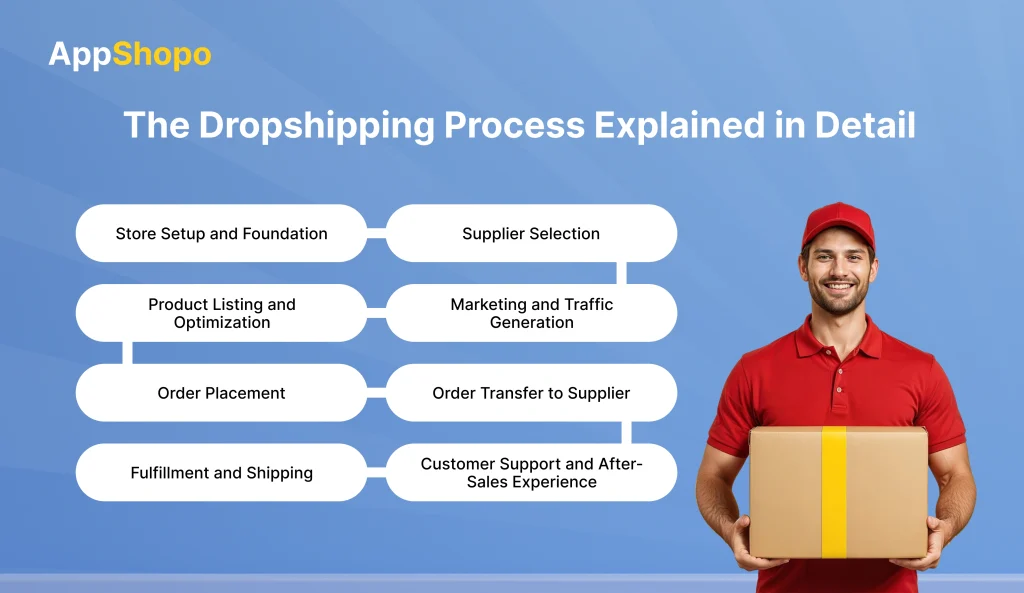
The dropshipping process is a chain of transferring products from the supplier to the buyer and at no point does the seller own the inventory. In 2026, the success of dropshipping is determined by execution, automation, and mobile-first experiences that are structured. Every step of the process is equally vital for conversion, accuracy in fulfilling orders, happy customers, and sustainability of business in the long run.
1. Store Setup and Foundation
The dropshipping adventure starts off with creating a reliable online shop that attracts buyers and makes transactions easy. A properly organized store lets customers navigate, get product knowledge, and make purchases with the least effort, while backend systems handle pricing, payments, and shipping rules in an efficient manner.
- Selecting a clear and focused niche
- Designing a user-friendly storefront
- Creating detailed product pages
- Defining pricing and return policies
- Configuring payments and shipping settings
2. Supplier Selection
Selecting a supplier is probably the most important decision of a dropshipping model. Reliable suppliers essentially become the pillars that support product quality, ensure stability in stock, and ensure punctuality in delivery. Bad supplier performance, on the other hand, is a sure way to upset customers, increase the amount of refunds, and dirty a brand’s image. Hence, this stage is the final level that really decides how successful a business will be over time.
- Consistent product quality standards
- Stable and updated inventory levels
- Realistic and reliable shipping timelines
- Clear communication and support
- Transparent return and refund policies
3. Product Listing and Optimization
Product listing is where value perception is created. Successful dropshipping stores generally put a lot of their products on display in a simple and straightforward way. Giving nice pictures, accurate descriptions, and honest delivery information makes the buyer comfortable enough to take the decision by themselves and this has a huge effect on the conversion rates.
- Clear and benefit-driven product descriptions
- High-quality product images
- Competitive yet profitable pricing
- Honest shipping and delivery expectations
- Mobile-optimized product layouts
4. Marketing and Traffic Generation
In dropshipping, the responsibility of attracting customers falls upon the store operator. Although traffic generation brings about the first sales, the longevity of profitability in 2026 will be decided by the retention and repeat purchases of customers. Marketing strategies that are well-balanced minimize the need for ads and at the same time increase the customer lifetime value.
- Paid advertising campaigns
- Search engine optimization (SEO)
- Social media promotion
- Content-based marketing
- Retargeting and retention strategies
5. Order Placement
Order placement is the moment revenue is generated. Once a customer completes checkout, the store processes payment and records the transaction. Although fulfillment has not yet occurred, accurate order handling at this stage prevents downstream errors.
- Customer completes checkout
- Payment is securely processed
- Order confirmation is generated
- Order data is recorded in the system
- Inventory is reserved with the supplier
6. Order Transfer to Supplier
After order confirmation, details are forwarded to the supplier for fulfillment. Automation plays a key role in reducing delays and errors. Accurate data transfer ensures the correct product reaches the correct customer without manual intervention.
- Product and variant information
- Customer shipping address
- Selected shipping method
- Order quantity and notes
- Payment confirmation reference
7. Fulfillment and Shipping
The supplier completes the order by placing the product in a box and sending it straight to the customer. The shipping speed, the quality of the packaging, and the clarity of tracking all have a direct impact on the customer’s satisfaction, reviews, and the likelihood of making repeat purchases.
- Secure product packaging
- Timely shipment processing
- Tracking number generation
- Carrier coordination
- Delivery status updates
8. Customer Support and After-Sales Experience
Even though fulfillment is outsourced, customer support remains the seller’s responsibility. A strong post-purchase experience builds trust, resolves issues efficiently, and turns first-time buyers into long-term customers.
- Responding to delivery inquiries
- Handling refunds and returns
- Resolving complaints professionally
- Managing supplier-related issues
- Maintaining customer trust and loyalty
How Dropshipping Works: Step-by-Step
The dropshipping workflow enables businesses to market their items on the web without the necessity to hold or care for physical stock. A seamless operation, precise order fulfillment, and a trustworthy customer experience are all partly dependent on each and every step in the process being carried out without any hitch.
Step 1: Create Your Online Store
Creating a visually appealing online store that flawlessly reflects your brand is the first thing to do in the dropshipping process. This shop will be your primary sales channel where potential customers will get the products, check the trustworthiness of the store, and make their choices. At this point, an eye-catching design, user-friendly layout, mobile compatibility, and trust signals such as policies and reviews will play a major role in increasing the chances of sale significantly.
Step 2: List Products From Suppliers
After the store’s groundwork is done, the products coming from dropshipping suppliers are added. You manage the way the products are displayed, including descriptions, images, prices, and profit margins. However, the supplier still has to take care of the stock and readiness for shipping in the background.
Step 3: Customer Places an Order
The payment will be done through the payment gateway of your store when a customer checks out. You will make a profit then, even if the product hasn’t been delivered yet. The order information will be stored in your system for shipping and to keep in touch with the customer.
Step 4: Forward the Order to the Supplier
Once an order is confirmed, the details of the order are forwarded to the supplier. These encompass variations of the product, the number of items, and the client’s delivery address. In the majority of contemporary dropshipping systems, this process is automated to guarantee rapidity, precision, and very little manual work.
Step 5: Supplier Ships the Product
The product is prepared, packaged, and shipped by the supplier directly to the customer. They are in charge of the entire process including logistics, shipping companies and dispatch times, while your brand is still the visible seller. At this point, the quality of fulfillment has a big influence on customer satisfaction.
Step 6: Share Tracking and Updates
When the order gets dispatched, the provider creates and gives you tracking info. Then the customer gets the information via email or app alerts. Regular updates lower fear and help reduce support requests, plus they are a good way of gaining customer trust.
Step 7: Manage Customer Support and After-Sales Service
Outsourcing could be part of your order processing, but the customer service will be your responsibility, definitely. You need to be ready to answer order-related questions, solve delivery issues, manage returns or refunds, and keep the communication going. After-sales service done well is one of the main reasons why customers trust you and come back for their next purchase.
Dropshipping in 2026: What Has Changed?
Dropshipping still has a place in 2026, but to be successful, it requires more. The list of the major customer’s demands consists of speed, transparency, mobile-centricity, and quality throughout the whole process. The current level of competition and high costs of acquiring new customers prompt brands to invest in uniqueness, customer retention, and a good user experience to keep making profits.
- Faster and Transparent Delivery Demand: Customers want their goods shipped faster and supplied with clear delivery timelines, real-time tracking, and proactive updates making up the shipping transparency that is indispensable for trust to be built and consequently refund requests reduced.
- Mobile shopping wins over: Majority of those making purchases and browsing are on their smartphones, thus needing a mobile-friendly site to convert and reduce cart abandonment rates.
- The generic niches have an increase in competition: The selling of generic products with the same messages is no longer an option. Brands have to make their way through by positioning, experience, and the value they give.
- The shift of customer retention importance: The increase in advertising costs places a repeat purchase at the center, while over the customer lifetime value, the market shifts that to one-time transactions.
- User Experience Tolerance is Lowered: The users’ trust can be very easily lost through slow loading, non-intuitive navigation, and complicated checkouts. These customers will soon be looking for a competitor offering better service.
The Role of Mobile Apps in Modern Dropshipping
In the modern dropshipping world, mobile applications are very much needed, since the usage of mobiles for shopping is gaining traction. Apps provide fast performance, easy checkout, personalized customers, and communication, and these are all advantages for the dropshipping brands that would eventually lead them to better conversions, more repeat purchases, and less reliance on paid ads in 2026.
- Faster Checkout Experience: Mobile applications allow for a faster checkout process due to the storage of user addresses and payment information, thus removing one of the barriers at the last stage and raising the total conversion rates.
- Personalized Shopping Journeys: The applications offer personalized product suggestions, custom deals, and changing content according to the customer’s actions; hence, the users are more engaged and the product is perceived to have more value.
- Higher Repeat Purchases: Mobile applications can make reorder very simple by just letting the customers tap a few times for ordering the product they want most, which is great for the items that are bought often.
- Direct Customer Communication: Through push notifications, the company can communicate instantly for sales, order changes, and reminders without going through email or using an advertising channel that costs money.
- Stronger Brand Loyalty: A mobile application that represents the brand keeps the store visible on the customer’s device, thus solidifying the brand presence and creating long-term trust and loyalty.
Conclusion
The year 2026 will see the end of dropshipping as a way to make a quick profit or take shortcuts. Rather, it will be the starting of the process of building a strong customer-oriented business that constantly provides value. Apart from the fact that the dropshipping model decreases the risk of holding stock, the success still very much relies on good execution, experience, and long-term strategy.
The fact that mobile commerce is still the main channel for online shopping means the dropshipping brands that still invest in mobile activities are the ones who will benefit most. AppShopo is helping this transition, as it allows Shopify dropshipping businesses to have their own branded mobile apps that not only attract but also keep customers by offering them a good experience, thus increasing customer loyalty and repeat purchases.
For those dropshipping business owners who target sustainable growth in 2026, the combination of a solid Shopify base and a mobile-first strategy is not a mere option anymore; it is a must-have.
FAQs
1. Will dropshipping still be a good business model in 2026?
Definitely, if considered professionally, dropshipping still holds a business and will be in 2026. The companies that keep on investing in their brand, customer satisfaction and loyalty will keep earning stable revenues and growing in the long run.
2. What is the minimum investment for dropshipping to get started?
Dropshipping has a very low initial investment requirement, as there is no need for prior purchase of stock. Nevertheless, there will be a requirement for a budget for marketing, platform tools, branding, and ongoing operational expenses.
3. Can dropshipping function without relying on paid advertising?
Yes, it is possible but requires time. Paid ads can be slowly eliminated as the business gets relying more on organic traffic, email marketing, and mobile app engagement, especially if retention strategies are implemented effectively.
4. Do I need to develop a mobile app for my dropshipping business?
Mobile apps are not essential, but their positive effects on customers’ repeat purchases and companies’ engagement are beyond doubt. In 2026, most of the successful dropshipping brands will still be using apps as one of their major tools to develop good relationships with their customers.
5. How does AppShopo support dropshipping businesses?
AppShopo helps dropshipping businesses by converting Shopify stores into branded mobile apps, enabling faster checkout, push notifications, and improved customer retention without requiring technical development skills.

Pankaj Arora
Founder, AppShopo

Pankaj Arora is a technology entrepreneur and the Founder of AppShopo, with over 10 years of experience in helping businesses transform websites into high-performing mobile apps. His expertise spans eCommerce app development, Shopify and WooCommerce integrations, mobile UX optimization, and scalable app delivery. Through AppShopo, Pankaj has enabled brands worldwide to launch fast, reliable Android and iOS apps that drive higher engagement, retention, and mobile sales.