Top Shopify Sales Growth Strategies for 2026

Shopify still holds the title of the best eCommerce platform worldwide, and it assists millions of companies in conducting sales online each day. However, the year 2026 has imposed a number of restrictions on the creation of a Shopify store similar to those that were in place before. It is no longer enough for a brand just to create a store and run ads; now, a whole new set of activities must be implemented for success. The competition is very stiff, and the expenses are very high, plus customers are not only more sophisticated but also demanding more from the brands they buy from.
Meanwhile, the Shopify stores that are increasing their sales rapidly have made it their central concern to develop customer relationships rather than just making sales. Today’s customers demand their shopping to be fast and easy and suitable for their tastes, and they are looking for trustworthy brands. Hence, the practice of focusing on those factors like consumer retention, mobile experience, personalization, and communication has become the standard, rather than the traffic numbers going up.
In this blog, we’ll highlight eight practical ways to boost Shopify sales in 2026. These strategies are not quick hacks or temporary tricks. They are based on our team’s real experience working with eCommerce brands, especially fashion stores, and helping them transform their Shopify websites into high-performing mobile applications. Through this work, we’ve seen what truly improves engagement, retention, and long-term sales growth.
Shopify’s scale highlights just how competitive the ecosystem has become. According to Wikipedia, Shopify supports over 5 million active merchants worldwide and processed nearly $300 billion in transactions in 2024, powering 875 million+ shoppers globally, with a new merchant making their first sale approximately every 26 seconds.
- Shopify sales growth in 2026 depends on retention, not just traffic.
- Mobile-first experiences outperform desktop-focused Shopify stores.
- Personalization significantly improves Shopify conversion rates and AOV.
- Owned channels reduce reliance on rising paid advertising costs.
- Mobile apps create long-term Shopify revenue and customer loyalty.
- Retention-focused Shopify techniques boost the lifetime value and revenue as customer acquisition costs rise across digital platforms.
- Mobile-first Shopify experiences not only offer faster checkout but also engage users more effectively and convert them at a rate that exceeds that of traditional responsive websites.
- Personalized shopping journeys through the use of AI allow merchants to present products that match customers’ needs, assist them in making choices, and result in increased order sizes, hence higher profits.
- Marketing channels owned by companies, such as push notifications and emails, allow direct communication with customers without the need for recurring advertising expenses.
- Custom mobile applications for Shopify are not just for creating brand loyalty but also to allow repeat purchases and establish a scalable basis for the long-term growth of the business.
Top Shopify Sales Growth Strategies
By 2026, raising sales on Shopify would not be a mere short-term tactic but rather a customer-oriented, sustainable growth strategy that would probably have to be devised. Brands had no choice but to adopt a strategy of retention, personalization, owned channels, and data-driven decision-making, which were the only ways to ensure a stable and continuous revenue flow. This was particularly true as the number of mobile-device users kept on rising and competition in the market was becoming tougher.
The opportunity is massive, but so is the competition. Shopify reports that global eCommerce sales are projected to reach $6.88 trillion by 2026, accounting for more than 20% of total global retail sales, making long-term, experience-driven growth strategies essential.
1. Shift From Traffic Growth to Retention-Led Shopify Sales
In the year 2026, retention has turned out to be the most trustworthy and cheapest method to increase Shopify revenue. Due to the increase in advertising costs and the overcrowding of acquisition channels, the sole focus on new visitors loses its effectiveness. Growth through retention leads to focusing on the current customers’ value rather than the new ones’ acquisition.
Returning customers, in this case, are the ones who are already trusting your brand, thus they will have an easier conversion, and also they will buy more. By making post-purchase experiences better and keeping the engagement at the same level, Shopify merchants can generate revenue growth that compounds without marketing expense increase.
- Increase repeat purchase frequency
- Improve customer lifetime value (CLV)
- Build long-term brand loyalty
- Strengthen post-purchase communication
- Reduce dependency on paid acquisition
This shift is backed by data. Statista-backed industry research shows that returning customers convert up to 3× more often than first-time buyers and consistently generate higher lifetime value, making retention one of the most profitable growth levers for Shopify stores.
2. Adopt a Mobile-First Shopify Growth Strategy
Mobile commerce is the ruling king in online shopping, and by 2026, mobile-first experiences will be the milestones for Shopify growth. A majority of the customers nowadays are involved in the process of going through the products, comparing them, and finally buying them through their smartphones, which makes mobile usability a major factor of conversion.
Nevertheless, it is almost a rule that most of the online shops using Shopify go for the desktop-first design strategy, which only adjusts to mobile devices. This, in turn, results in a series of problems like prolonged loading times, cluttered layouts, and difficult checkouts that negatively impact sales.
In a mobile-first strategy, the shopping experience is made specifically for smaller screens, speed, and convenience.
- Faster mobile load times
- Simplified navigation and layouts
- One-tap or express checkout options
- Thumb-friendly design elements
- Push notifications for re-engagement
Also Read: Seasonal App Design Strategies Every Shopify Store Needs
3. Use Personalization to Increase Shopify Conversion Rates
Customer expectations have evolved in such a way that generic shopping experiences do not suffice any more. In 2026, the shoppers of Shopify would like the brands to be able to understand their likes, their behavior on the site, and their buying history.
Personalization is the factor that leads to an increased number of conversions by showing the customers at the right time what is most important to them. It also reduces the customer’s effort in making a decision and raises the average order value by showing the customer similar products and offers.
Even a very simple form of personalization can, if applied consistently, result in significant sales growth that can be measured.
- Personalized product recommendations
- Dynamic homepage content
- Targeted email and push messaging
- Personalized discounts and offers
- Recently viewed and complementary products
4. Optimize Checkout and Reduce Purchase Friction
Friction at the checkout is still a major hindrance to the sales growth of Shopify. Any additional step, field or waiting time involved in the process leads to the abandonment of the cart and finally the revenue loss.
The customers will ask for the checkout process to be very fast, simple, and secure in the year 2026. Shopify merchants who make the checkout procedure very customer-friendly will still enjoy higher conversion rates without any additional traffic.
Optimizing checkout is one of the fastest ways to generate immediate ROI.
- Fewer form fields during checkout
- Multiple payment and wallet options
- Express checkout methods
- Transparent pricing and shipping costs
- Automated abandoned cart recovery
5. Build Owned Marketing Channels Beyond Paid Ads
The use of paid ads will still be a factor in the growth of Shopify, but depending solely on them will result in revenue models that are unstable and costly. As time goes by, changes in algorithms and increased expenses will make paid advertisements less predictable.
In the year 2026, the most successful Shopify brands are already utilizing and maximizing their own marketing channels, ones that they have complete control over and do not incur any costs for each interaction. These channels not only enable the brands to establish long-term customer relationships but also provide them with a steady stream of income that they can forecast.
- Email marketing for lifecycle engagement
- Push notifications for instant communication
- SMS used selectively for urgency
- Mobile apps as a direct sales channel
- Segmentation and personalization across channels
Read Also: How to Convert Shopify Store to Mobile App
6. Strengthen Brand Trust and Authority
The absence of trust is the main reason for eCommerce purchasing decisions in today’s world. Customers are very careful when it comes to spending their money, as there are thousands of Shopify stores selling the same products.
A brand that desires to win its customers’ trust needs to be unambiguously, freely, and uniformly communicative with them at all times. Trustworthy brands are more capable of acquiring and also maintaining the customers for a longer time period.
Strong trust also fuels referrals and organic growth.
- Clear value propositions
- Authentic customer reviews and testimonials
- Transparent policies and pricing
- Consistent brand messaging
- Educational and storytelling content
7. Use Data to Drive Smarter Shopify Decisions
In 2026, Shopify, which has prospered, will owe it all to its reliance on data. To base one’s actions on gut feeling or on keeping assumptions leads to nothing but lost opportunities and misdirected funds.
With the constant performing of data analysis, Shopify stores can spot the areas of revenue loss, pros and cons of customer paths, and also can enlarge the winning practices. Data allows for more intelligent choices to be made at each growth phase.
Just a little improvement based on data can, however, lead to tremendous gain in the long run.
- Customer behavior analysis
- Conversion funnel tracking
- Retention and churn metrics
- Product performance insights
- Campaign and channel ROI evaluation
8. Expand Shopify Sales Through Mobile Apps
In the year 2026, mobile applications were recognized as one of the strongest tools for the growth of Shopify. Applications offered quicker performance, more profound personalization, and a shopping experience that was more integrated than mobile sites.
Customers who download the app of a particular brand are more active, buy more often, and have a greater lifetime value. Apps also create a direct channel that competitors cannot easily replicate.
For growing Shopify brands, mobile apps are a long-term retention and revenue engine.
- One-tap repeat purchases
- Push notifications for promotions and updates
- App-exclusive deals and rewards
- Faster navigation and checkout
- Stronger customer loyalty and retention
Also Read: Top 15 Best Shopify Mobile App Builders
How These Shopify Growth Strategies Work Together
Shopify growth strategies can only be their full value if they work as an interconnected system rather than separate initiatives. In 2026, Shopify brands that are successful do not depend on isolated optimizations anymore. They rather create growth frameworks in which each strategy supports the other, thus producing compounding results over time.
Retention is the element that lies at the systems center. The impact of personalization becomes more powerful when customers return more frequently, as there is more behavioral data available. Personalized product recommendations, targeted messaging, and tailored offers get to be more precise; thus, conversion rates and average order value are further improved.
Mobile optimization is an essential silent partner. A quick, mobile, first experience is a factor that reduces friction both in browsing and checkout; hence, retention and repeat purchases become easier. If mobile performance gets better, checkout optimizations will be more effective, and owned channels such as push notifications will be able to drive users back into a seamless, high-converting experience.
Owned marketing channels are the system’s amplifier. Email, push notifications, SMS, and mobile apps are means through which brands can re-engage customers regularly without incurring a cost for each interaction. These channels are a source of retention, a platform for personalized messaging, and a way to stabilize revenues by lessening the dependence on paid acquisition.
Data is what brings together everything. Analytics disclose the strategies that yield the best results and the places where customers drop off, as well as the ways in which different channels affect each other. Data-driven insights.
Aligned growth strategies lead to:
- Higher customer lifetime value through repeat engagement
- More predictable and resilient revenue streams
- Lower dependence on paid advertising and traffic volatility
- Stronger brand loyalty and long-term customer trust
In 2026, the real competitive advantage is not adopting individual growth tactics but executing them consistently as part of a unified, data-driven Shopify growth system that scales sustainably over time.
How Long Does It Take to See Results From Shopify Growth Strategies?
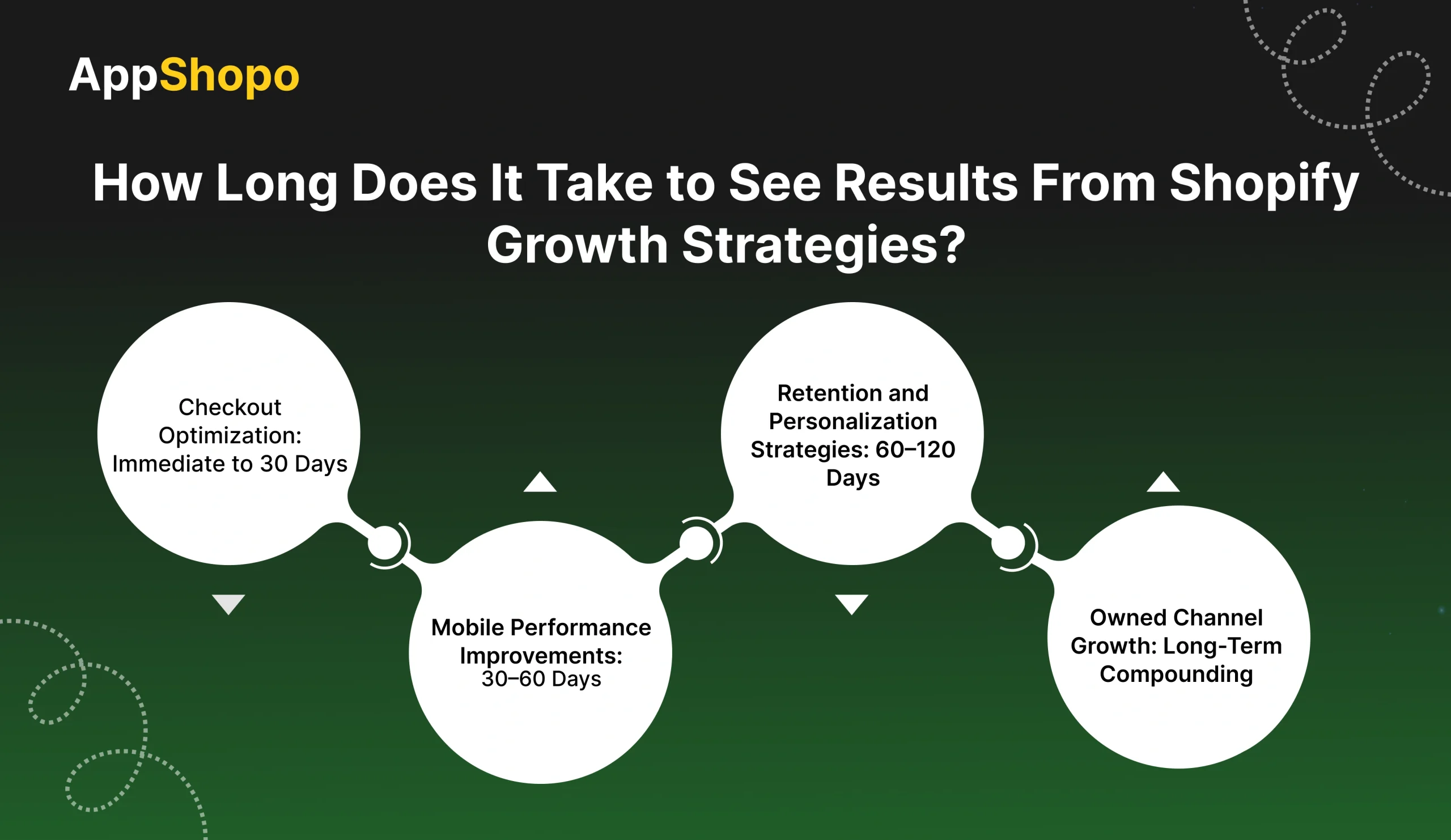
The growth timeline for Shopify is determined by the strategy applied, the execution of the implementation, and the development stage of the store. Some optimizations can provide results that are immediate and quantifiable, while most others need persistent effort and time before results are seen. Understanding these timelines enables merchants to have the right picture of the situation, set the appropriate expectations, and make decisions regarding the hierarchy of their actions.
Checkout Optimization: Immediate to 30 Days
The quickest Shopify growth impact is made through the optimization of checkout processes. Reducing cart abandonment and getting better sales in less than a week after making changes is possible by simplifying forms, allowing express checkout, increasing the ways to pay, and making the price clearer.
Mobile Performance Improvements: 30–60 Days
Most of the time, mobile-centric improvements such as faster loading times, easier navigation, and enhanced mobile user experience will show their impacts in a period of one to two months, which results in increased interaction and a slow increase in mobile conversion rates.
Retention and Personalization Strategies: 60–120 Days
Retention and personalization tactics demand repeated interactions with the customer. Measures such as loyalty programs, individual recommendations, and messaging after the sale all take at least two to four months to show significant effects, albeit big ones in terms of customer lifetime value and purchases made again.
Owned Channel Growth: Long-Term Compounding
Owned channels like email, push notifications, and mobile apps grow gradually but deliver the most sustainable Shopify revenue. While early results appear within months, their true value compounds long-term, reducing reliance on paid acquisition.
Why Patience and Consistency Matter
The growth of Shopify, which is eco-friendly, is a continuous optimization and not a one-time action. Brands that conduct experiments, analyze data, and fine-tune their strategies do not only create more effective systems but also produce revenue gains that are eventually predictable and long-term.
Read Also: Shopify Mobile App Builders: Top Affordable Options
Tools and Technologies Powering Shopify Growth in 2026
With the Shopify ecosystem becoming more and more mature, growth can no longer be driven only by manual effort. In 2026, Shopify brands that are successful are the ones that depend on a well-thought-out technology stack, which makes automation, getting deep insights, and providing customer experiences of high quality possible without the business operations getting further complicated. The proper instruments give the merchants the opportunity to scale in a way that is performance, personalization, and profitability friendly.
- Conversion Rate Optimization (CRO) Tools: CRO tools help in identifying the friction points, understanding the user behavior through data, and updating the product pages and checkout flows to get more Shopify conversions without needing extra traffic.
- Customer Analytics and Segmentation Platforms: Customer analytics tools collect data on behavior, purchases, and retention, thus allowing Shopify merchants to segment audiences and send more targeted, data-driven marketing and personalization messages.
- Email and Push Notification Systems: Email and push notification instruments energize owned channels through the use of automation to lifecycle messaging, abandoned cart recovery, promotions, and re-engagement, thus leading to repeat Shopify purchases.
- Mobile App Solutions for Shopify Stores: Mobile app solutions make the experience quicker and offer push notifications and personalization, thereby helping Shopify brands to increase retention, engagement, and customer lifetime value.
- Performance and Speed Optimization Tools: Performance optimization instruments are the means to quicker page speeds and more stability, thus lessening bounce rates, raising SEO rankings, and enabling easy shopping experiences on all devices.
Conclusion
Expanding Shopify sales in 2026 is a matter that cannot be solved by quick wins or short-term tactics alone. Long-term growth is achieved by retention, mobile, first experiences, personalization, and owned channels, all functioning as a system.
This is the reason why AppShopo is a strategic advantage for Shopify merchants. AppShopo assists brands in turning their Shopify store into an attractive mobile app without the usual hassle or high development costs. With the help of features like effortless Shopify sync, push notifications, conversion-focused mobile experiences, and more, AppShopo is the tool that empowers merchants to execute the strategy of repeat purchases, to increase engagement, and to lower the dependency on paid ads.
For Shopify brands that want to grow sustainably in the long run, AppShopo is not only a tool but also a growth partner that is conceived for the future of e-commerce.
FAQ’s
1. What is the most effective Shopify sales growth strategy for 2026?
Retention-led growth is, by far, the best Shopify sales growth strategy in 2026. Simply put, one should focus on keeping the existing customers happy and then attracting new customers. As a result, by focusing on mobile-first, personalized, and owned channel experiences, merchants can not only retain their customers and increase their value but also lower their dependency on the rising costs of paid ads and unpredictable traffic sources.
2. Why is mobile-first important for Shopify stores in 2026?
Mobile-first is very important because the majority of Shopify customers do their browsing and buying with their mobile phones. An optimized mobile experience enhances the site’s speed, navigation, and flow of payment, which all contribute to the higher engagement, better conversion rates, and stronger retention as compared to the desktop-focused store designs.
3. How does personalization help increase Shopify sales?
By personalizing, customers see the products, content, and offers that are most suitable for them as per their behavior and likes; thus, there is a resulting increase of Shopify sales. This way the decision fatigue is minimized, the trust level is enhanced, the number of conversions is increased, and the average order value is uplifted by giving the right experience at the right time.
4. Are paid ads still useful for growing Shopify sales?
Paid ads are still a useful tool for Shopify sales growth, although they should be a supporting factor rather than the main strategy. The sole reliance on ads for sales would be like having an unstable revenue. On the other hand, the combination of paid traffic along with owned channels such as email, push notifications, and mobile apps leads to more predictable and sustainable revenue growth in the long run.
5. How does a mobile app help Shopify merchants grow faster?
The mobile application is an invaluable resource for Shopify store owners who wish to accelerate their business growth since it allows for instant repeat buying, sending notifications to customers, and giving special offers for the app users only. Merchants are gaining the customers’ loyalty through these customer-centric services; Meanwhile, the customers are now buying more often, which ultimately results in a larger customer lifetime value being generated exponentially over time.

Pankaj Arora
Founder, AppShopo

Pankaj Arora is a technology entrepreneur and the Founder of AppShopo, with over 10 years of experience in helping businesses transform websites into high-performing mobile apps. His expertise spans eCommerce app development, Shopify and WooCommerce integrations, mobile UX optimization, and scalable app delivery. Through AppShopo, Pankaj has enabled brands worldwide to launch fast, reliable Android and iOS apps that drive higher engagement, retention, and mobile sales.