Why B2B Ecommerce Brands Need Mobile Apps to Scale
B2B eCommerce is no longer a background player in the digital economy. It is one of the very fastest-growing online commerce segments, essentially due to the changes in buyer behaviors, mobile-first workforces, and ever-increasing expectations of speed and convenience. B2B buyers of today are not asking for slow portals, complicated ordering methods, or being dependent on desktops. What they expect is the same seamless, intuitive, and always-available experience they already have with B2C platforms.
With B2B eCommerce advances, brands that only have websites or rely on traditional ERP-based ordering systems are getting the pressure. The sales cycles are getting shorter, the buyers are making frequent, repeating orders, and the decision-makers are demanding real-time access to pricing, inventory, and order history. In this situation, a mobile app is not an optional upgrade anymore but a necessary tool for growth.
B2B eCommerce through a mobile app can make buying simpler, customer loyalty can be increased, the sales force can be given more power, and operations can be scaled without getting more complicated. The best part is, it helps businesses to be there for the buyers wherever they might be: on their mobile phones, during the day, in the warehouses, at job sites, or while handling procurement remotely.
According to Gartner, 80% of B2B Sales Interactions Between Suppliers and Buyers Will Occur in Digital Channels by 2025
Through this blog, the writers explain the need for every B2B eCommerce brand to have a mobile app if they want to grow their business faster, how mobile apps solve the major problems of the B2B industry, and the long-term business benefits of implementing a mobile-first strategy in a highly competitive B2B eCommerce market.
TL;DR
- Mobile apps accelerate repeat purchasing in B2B eCommerce businesses
- Faster ordering improves efficiency and reduces sales cycle delays
- Personalized pricing strengthens long-term B2B eCommerce customer relationships
- Mobile-first access increases retention and buyer engagement
- AppShopo enables scalable, cost-effective B2B eCommerce mobile apps
Key Points
- B2B eCommerce mobile apps simplify complex buying workflows through personalized pricing, repeat ordering, and real-time inventory access.
- Dedicated mobile apps improve customer retention by offering faster access, consistent experiences, and direct communication channels.
- Sales teams benefit from mobile apps through real-time data access, faster order placement, and improved customer service efficiency.
- Mobile apps reduce operational costs by automating orders, enabling self-service, and minimizing manual support dependency.
- AppShopo provides B2B eCommerce brands with a ready-to-scale mobile app solution built for long-term growth and performance.
The Evolution of B2B eCommerce Buyer Expectations
For many years, B2B eCommerce lagged behind B2C in terms of user experience. Ordering systems were built for internal efficiency rather than buyer convenience. However, this gap has closed rapidly.
Modern B2B buyers are digital-native professionals who expect:
- Fast and intuitive ordering
- Personalized pricing and catalogs
- Real-time inventory visibility
- Self-service account management
- Mobile access without friction
In fact, a large number of B2B purchasing decisions are entirely done through mobile devices these days. Procurement managers can check the stock while they are on their way, distributors can send reorders to warehouses, and field teams can place urgent orders right from their job sites. While a mobile-optimized website may be of some assistance, it is not enough to fully facilitate these workflows.
By design, a mobile app is better suited for repetitions, quickness, and user personalization, which are three elements that have a direct impact on the increase of B2B eCommerce.
Also Read: Shopify Mobile App Builders: Best Budget-Friendly Option
How Mobile Apps Are Accelerating Growth for Modern B2B eCommerce Brands
B2B eCommerce brands have to deal with the demand of customers who want to receive their products faster, to have a simpler shopping process, and to get personalized services. B2B eCommerce companies can use a mobile app to make ordering easier, keep customers longer, help the sales department, and grow their business in a more efficient way. Since the behavior of buyers is more and more inclined towards mobile devices, the implementation of a dedicated app is not just a choice anymore but rather a strategic advantage that ensures the company’s survival in the long run.
1. Faster Ordering Experiences Drive B2B eCommerce Growth
B2B eCommerce buyers can reorder products quickly with the help of a mobile app through saved carts, order history, and favorite products. By this fast way of purchasing, the friction of purchasing is reduced, the buying cycles become shorter, and thus the businesses can grow in a more efficient way without the necessity of additional manual work.
- One-tap reordering for frequent purchases
- Saved carts and product lists for quick checkout
- Faster page loads compared to mobile websites
- Reduced dependency on sales calls and emails
- Improved buying experience for repeat customers
2. Mobile Apps Improve Customer Retention in B2B eCommerce
Keeping customers comes first if you want to keep a B2B eCommerce business running in the long term. Having a mobile app is a way to make your brand always available to customers, thus, repeat transactions are facilitated via a stable and familiar ordering process which is the main factor for the expansion of long-term trust.
- Always-on access through a dedicated mobile platform
- Personalized experience for returning buyers
- Push notifications to encourage repeat orders
- Higher engagement compared to web-only platforms
- Stronger long-term customer relationships
3. Personalized Pricing and Catalogs Strengthen B2B eCommerce Relationships
B2B eCommerce is mostly dependent on customer-specific pricing, catalogs, and contracts. Mobile apps are designed to enable very advanced personalization whereby buyers get to see only those products that are relevant to them along with the prices that have been negotiated, thereby resulting in both higher accuracy and trust.
- Customer-specific pricing visibility
- Personalized product catalogs by account
- Role-based access for different buyer teams
- Reduced pricing and ordering errors
- Improved buyer confidence and satisfaction
4. Mobile Apps Enable Real-Time Communication in B2B eCommerce
Communication in real time is a necessity for the smooth operation of B2B eCommerce. Through mobile apps, brands are able to communicate to customers about any alterations or updates in the orders, stock, or shipments immediately. In this manner, misunderstandings and delays are reduced to a bare minimum.
- Instant order status notifications
- Stock availability and restock alerts
- Delivery and shipment updates
- Promotional and announcement messaging
- Reduced reliance on email communication
5. Streamlined Reordering Simplifies B2B eCommerce Operations
The majority of B2B eCommerce transactions are made up of repeat orders. Mobile applications ease the process of reordering by enabling users to place orders for past items in just seconds, thereby saving time for both customers and internal personnel.
- Quick access to order history
- One-click reordering of past purchases
- Reduced manual order entry
- Faster purchasing for high-volume buyers
- Lower operational workload for support teams
6. Sales Team Enablement Through B2B eCommerce Mobile Apps
The mobile application is a very powerful instrument for B2B eCommerce sales teams. Sales reps are able to take orders, get customer info, and verify stock levels instantly, thus speeding up and making the service more accurate at the same time.
- On-the-go order placement for clients
- Real-time inventory and pricing access
- Customer order history during meetings
- Reduced sales processing time
- Better alignment between sales and digital channels
7. Mobile Apps Increase Operational Efficiency in B2B eCommerce
For B2B eCommerce, operational efficiency is the main factor for scaling. By using mobile applications, the whole process of ordering, updates, and account management gets automated thus minimizing the manual work and letting the businesses to grow without raising their overhead costs.
- Automated order workflows
- Self-service account management
- Reduced customer support queries
- Faster issue resolution
- Scalable operations without extra staffing
8. Data-Driven Insights Improve B2B eCommerce Decision Making
Mobile applications produce significant information which enables B2B eCommerce brands to recognize their customers’ actions. The gained knowledge assists in making better choices regarding stock management, setting prices, and interacting with customers.
- Tracking order frequency and trends
- Identifying high-demand products
- Monitoring buyer engagement patterns
- Optimizing pricing and promotions
- Improved demand forecasting
9. Secure and Controlled Access for B2B eCommerce Buyers
In a market that is becoming more and more competitive, B2B eCommerce brands need to go beyond pricing to differentiate themselves. Having a mobile app is a great way to enhance professionalism, customer experience, and brand credibility.
- Secure login and authentication methods
- Role-based user permissions
- Controlled pricing visibility
- Encrypted data and transactions
- Compliance with enterprise security standards
10. Mobile Apps Create a Competitive Advantage in B2B eCommerce
As the market gets more and more competitive, B2B eCommerce brands have to find ways to stand out that are not just based on pricing. The use of a mobile app elevates the business to a higher level in terms of professionalism, customer experience, and brand credibility.
- Stronger brand presence on customer devices
- Modern and professional digital image
- Improved customer satisfaction
- Higher switching costs for competitors
- Long-term growth and scalability advantage
Read Also: How to Turn Shopify Store into a Mobile App
The Role of Mobile Apps in Solving B2B eCommerce Challenges
The issues that B2B eCommerce brands without a mobile app (slow ordering, limited engagement, communication gaps, and operational inefficiencies) experience are not problems that are separate from each other. Instead, they are indications that the brands are still using tools that have never been designed for the modern B2B buying behavior.
By a mobile app, these issues are confronted directly as it changes the way buyers interact with your B2B eCommerce platform. Buyers obtain instant, always-available access to ordering, account management, and real-time information instead of struggling through complex web portals or depending on manual processes. This change lessens the buying journey’s friction at every stage.
Besides, mobile apps from a business perspective, establish a more organized and scalable environment where automation takes over the monotonous tasks and self-service replaces the support dependency. The sales teams, operations, and customers, being the stakeholders, all work on one single, connected platform; hence, effectiveness and consistency are improved.
Essentially a mobile application turns B2B eCommerce from a mere transactional system into a continuous engagement channel. The app accelerates the decision-making process, improves customer delight, and creates opportunities for long-term growth that is environmentally friendly.
Knowing how mobile apps help in solving core B2B eCommerce challenges, it is evident that the particular features within the app have a crucial role in leading to the real business value.
Key Features Every B2B eCommerce Mobile App Should Have
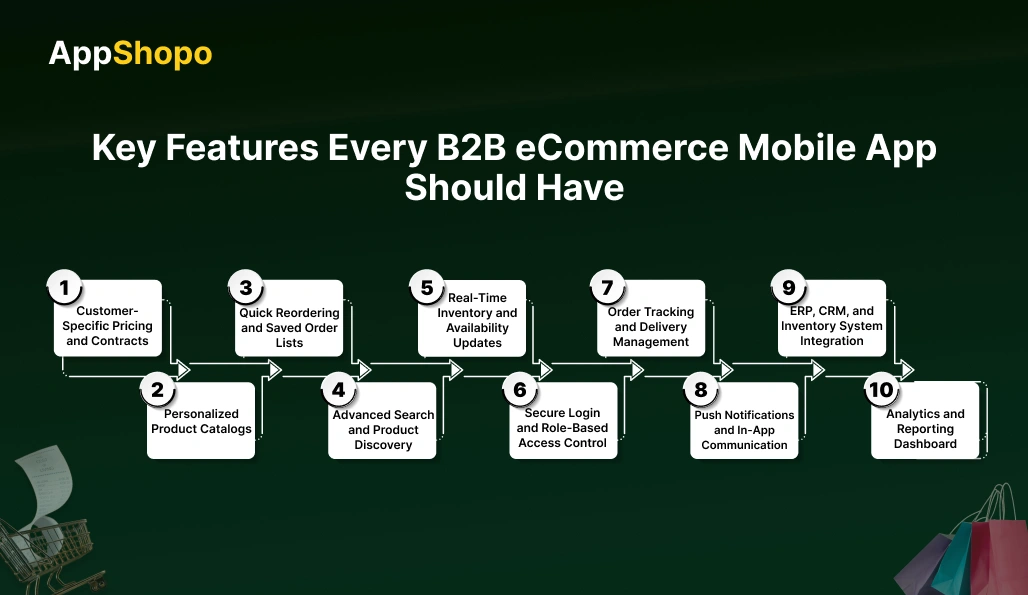
A mobile app should be able to provide genuine worth only when it is created based on the distinct requirements of B2B eCommerce buyers B2B eCommerce mobile apps need to support complex pricing structures, habitual purchasing of the same items, user roles, and simple integration with backend systems, unlike B2C apps, which are more straightforward. The right features result in faster uptake, higher user engagement, and measurable business growth.
Below are the essential features every B2B eCommerce mobile app should include.
1. Customer-Specific Pricing and Contracts
B2B eCommerce transactions usually involve prices that are negotiated and have agreements that last for a long time. It is necessary for a mobile application to show these conditions clearly for every client so that there is no misunderstanding and arguing over prices.
- Display account-specific pricing in real time
- Support contract-based and tiered pricing
- Show volume discounts automatically
- Prevent unauthorized price visibility
- Build trust through pricing accuracy
2. Personalized Product Catalogs
Not every buyer should see the same products. Personalized catalogs ensure B2B eCommerce buyers access only relevant items based on location, account type, or agreement.
- Account-based product visibility
- Region- or warehouse-specific availability
- Industry- or role-based catalogs
- Reduced product clutter for buyers
- Faster and more accurate ordering
3. Quick Reordering and Saved Order Lists
B2B transactions together drive most of the revenue in B2B eCommerce. A mobile app should make re-ordering easy and quick.
- One-tap reordering from order history
- Saved carts and favorite products
- Frequently ordered item lists
- Bulk ordering support
- Reduced time spent on repeat purchases
4. Advanced Search and Product Discovery
Large B2B eCommerce catalogs require powerful search functionality. Buyers must find products quickly without frustration.
- Smart search with SKU and keyword support
- Filters by category, price, and availability
- Barcode or SKU scanning
- Recently viewed product suggestions
- Improved buyer productivity
5. Real-Time Inventory and Availability Updates
Accurate inventory visibility is critical in B2B eCommerce decision-making. Buyers need confidence that products are available before placing orders.
- Live inventory status
- Warehouse-level stock visibility
- Low-stock alerts
- Backorder and preorder options
- Fewer order fulfillment issues
6. Secure Login and Role-Based Access Control
B2B eCommerce accounts often involve multiple users with different responsibilities. A mobile app must support controlled access.
- Secure authentication methods
- Role-based permissions for teams
- Approval workflows for orders
- Restricted pricing visibility
- Enterprise-level data protection
7. Order Tracking and Delivery Management
Transparency after checkout is essential for B2B eCommerce buyers who depend on timely deliveries.
- Real-time order tracking
- Shipment and delivery updates
- Order status notifications
- Invoice and receipt access
- Reduced post-order support requests
8. Push Notifications and In-App Communication
Emails are, of course, a valuable tool for connecting B2B eCommerce buyers, but bypassing emails greatly reduces the risk of being lost amid spam.
- Order and shipment alerts
- Stock and restock notifications
- Payment and invoice reminders
- Promotional and announcement messages
- Higher engagement rates
9. ERP, CRM, and Inventory System Integration
In order to ensure the exchange framework performs fluently with existing methods of conducting business, connectivity is of prime importance.
- Real-time ERP synchronization
- CRM integration for customer insights
- Inventory and pricing consistency
- Automated order processing
- Reduced manual data entry
10. Analytics and Reporting Dashboard
Data visibility helps B2B eCommerce brands optimize performance and improve decision-making.
- Buyer behavior insights
- Order frequency and value tracking
- Product demand analysis
- App engagement metrics
- Smarter growth strategies
Also Read: Top 15 Best Shopify App Builders
How to Choose the Right B2B eCommerce Mobile App Solution
Selecting the perfect mobile app solution is a tactical move for any B2B eCommerce brand that sells to other businesses. A suitable option is one that can handle complicated B2B processes, work smoothly with the existing systems, and expand with the business. If B2B eCommerce brands only think about designing or costing, they will lose out on evaluating aspects such as functionality, flexibility, security, and long-term value, which are necessary for obtaining a wide grip and maintaining growth.
- Alignment with B2B eCommerce Business Model: The solution should support customer-specific pricing, repeat orders, bulk purchasing, and multi-user accounts.
- Scalability and Performance: The app must be capable of handling a growing product catalog, an increasing number of orders, and enterprise-level users without any performance issues.
- Built-in B2B eCommerce Features: One of the features should be the negotiation of prices, customized catalogs, approval of workflows, and role-based access that can be native.
- Seamless ERP and System Integrations: The solution has to be a smooth integration with ERP, CRM, inventory, and accounting systems for up-to-the-minute data accuracy.
- Ease of Use and Adoption: In this context, a simple and user-friendly interface means that users will adopt it more rapidly, be they buyers, sales teams, or internal users.
- Security and Access Control: Proper authentication, role-based permissions, and data encryption should be some of the capabilities that protect B2B eCommerce data.
- Customization and Branding Flexibility: The app should be able to brand and customize workflows without heavy development intervention.
- Cost Transparency and ROI: Review all ownership costs, such as setup, maintenance, updates, and long-term return on investment.
- Vendor Support and Reliability: Find a provider who has the B2B eCommerce experience, provides ongoing support, and has a clear product roadmap.
- Future-Ready Technology: The solution should be capable of future enhancements, new integrations, and the requirement of evolving B2B eCommerce.
Success Stories: How B2B Brands Thrived With a Mobile App
Now that you understand the advantages of having a mobile app for a B2B Shopify store, let’s look at real success stories of brands that adopted a mobile-first approach and achieved measurable business growth.
1. ProntoForms (TrueContext): Boosted Field Productivity With a Mobile App
ProntoForms (now known as TrueContext) is a Canadian B2B SaaS company based in Ottawa that provides mobile workflow solutions for enterprises with large field teams, including utilities, telecom, manufacturing, and construction companies.
Before adopting a mobile-first approach, many of their customers relied on paper forms, spreadsheets, and manual reporting, which caused delays, data inaccuracies, and compliance challenges. Field teams spent hours completing paperwork after returning from job sites.
To solve this, ProntoForms introduced a dedicated mobile app that allowed field workers to capture data in real time, even offline. Technicians could submit digital forms, photos, signatures, and GPS data directly from the field, with instant sync to enterprise systems like CRM and ERP platforms.
The impact was significant. Businesses using the ProntoForms mobile app saved up to 90 minutes per technician per day, reduced administrative work by nearly 80%, and achieved 1,000%+ ROI within the first year.
By focusing on real-world B2B workflows and mobile usability, ProntoForms transformed complex field operations into streamlined, mobile-driven processes, making their app a mission-critical tool rather than a nice-to-have feature.
2. Staples Canada Business: Driving Faster Reorders With a Mobile App
Staples Canada Business serves thousands of B2B customers, including offices, educational institutions, and enterprises that rely on frequent and repeat purchases of supplies.
Despite strong online sales, Staples noticed that B2B customers often faced friction when reordering products through mobile browsers. Procurement teams wanted faster access to personalized pricing, order history, and quick reordering—something traditional web experiences struggled to deliver.
Staples Canada introduced a B2B mobile app designed specifically for business buyers. The app enabled customers to reorder supplies in seconds, access contract pricing, track shipments in real time, and manage accounts directly from their mobile devices.
To increase engagement, Staples used push notifications for order updates and replenishment reminders, ensuring buyers never ran out of essential supplies. The simplified mobile experience significantly reduced purchase friction for repeat buyers.
As a result, Staples Canada Business saw higher order frequency, faster procurement cycles, and increased mobile conversions, especially among SMB and enterprise customers managing purchases on the go.
By shifting to a mobile-first B2B strategy, Staples strengthened customer loyalty while making procurement simpler, faster, and more efficient.
Conclusion
B2B eCommerce is evolving toward faster decision-making, repeat-driven revenue, and mobile-first buyer behavior. Brands that rely only on websites risk slower growth, lower engagement, and higher operational costs. A dedicated mobile app simplifies ordering, strengthens customer relationships, and enables scalable operations.
Choosing the right solution is critical. Platforms like AppShopo are built to support real B2B eCommerce needs, offering personalized pricing, seamless integrations, and a user-friendly mobile experience. With the right mobile app partner, B2B eCommerce brands can scale faster, serve customers better, and stay competitive long term.
FAQ’s
1. Why is a mobile app important for B2B eCommerce businesses?
A mobile app allows B2B eCommerce buyers to place orders faster, access personalized pricing, and manage accounts anytime. It reduces ordering friction, increases repeat purchases, and improves customer retention, making it easier for businesses to scale without increasing operational complexity.
2. How does a mobile app improve B2B eCommerce customer retention?
Mobile apps keep B2B eCommerce brands always accessible on customer devices. Features like quick reordering, push notifications, and personalized catalogs encourage frequent engagement, build long-term trust, and reduce the likelihood of customers switching to competitors.
3. What features should a B2B eCommerce mobile app include?
A strong B2B eCommerce mobile app should support customer-specific pricing, personalized catalogs, bulk and repeat ordering, role-based access, real-time inventory, secure authentication, and seamless ERP integration to handle complex business workflows efficiently.
4. Is a mobile app expensive to build for B2B eCommerce?
With modern platforms like AppShopo, building a B2B eCommerce mobile app is no longer expensive or complex. Pre-built B2B-focused features, faster deployment, and lower maintenance costs make mobile apps a cost-effective investment with strong long-term ROI.
5. How does AppShopo help B2B eCommerce brands scale faster?
AppShopo provides a B2B eCommerce-ready mobile app solution with personalized pricing, smooth integrations, secure access controls, and an intuitive user experience. It helps brands launch faster, reduce operational friction, and grow revenue through repeat and mobile-first ordering.

Pankaj Arora
Founder, AppShopo

Pankaj Arora is a technology entrepreneur and the Founder of AppShopo, with over 10 years of experience in helping businesses transform websites into high-performing mobile apps. His expertise spans eCommerce app development, Shopify and WooCommerce integrations, mobile UX optimization, and scalable app delivery. Through AppShopo, Pankaj has enabled brands worldwide to launch fast, reliable Android and iOS apps that drive higher engagement, retention, and mobile sales.